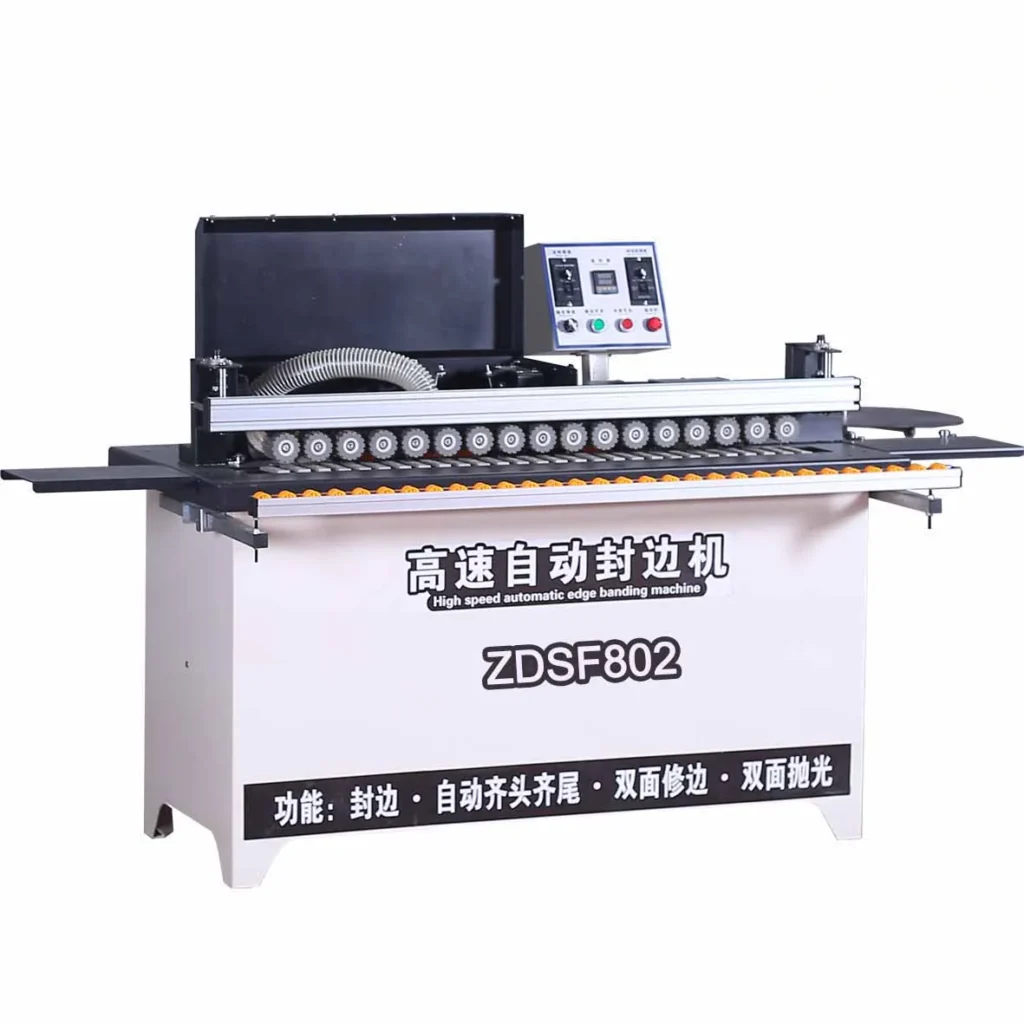
Voltage-verified configuration — every ZDSF802 unit ships with an electrical schematic matched to the buyer's confirmed local frequency and voltage before assembly begins.
Technical Specifications
| Parameter |
Value |
| Model |
ZDSF802 |
| Product Type |
Automatic Edge Banding Machine |
| Rated Voltage |
220V (configurable from 110V to 440V) |
| Rated Power |
4 kW |
| Feed Speed |
0–10 m/min |
| Conveyor Belt Speed |
0–10 m/min |
| Sheet Thickness Range |
10–50 mm |
| Strip Thickness Range |
0.5–2.5 mm |
| Edge Type |
Straight line |
| Trimming Power |
800 W × 2 |
| Polishing Power |
180 W × 2 |
| Suction Power |
1200 W |
| Heating Power |
1000 W (5–10 min warm-up) |
| Glue Pot Capacity |
4000 ml |
| Rated Air Pressure |
0.4–0.6 MPa |
| Pressure Beam |
Integrated, double rows of pressure wheels |
| Conveyor Belt Material |
Silicone |
| Belt Breaking Method |
Pneumatically controlled |
| Trimming Configuration |
Double high-speed motors, up and down |
| Polishing Configuration |
Up and down two motors |
| Extendable Support |
Fluent strips for large plates |
| Control Panel |
Digital display of glue pot temperature, independent switches |
| Overall Dimensions (L×W×H) |
130 × 65 × 75 cm |
| Machine Weight |
150 kg |
Application Suitability
| Application |
Material or Output |
| Custom cabinet door edge finishing |
MDF and particleboard with PVC edge banding |
| Small-batch shelving production |
Plywood panels with melamine or veneer strips |
| Workshop-scale furniture manufacturing |
Solid wood panels up to 50 mm thickness |
| Joinery startup transitioning from manual to automated |
Mixed panel substrates with straight-line profiles |
Why Voltage Confirmation Must Precede Every Automatic Edge Banding Machine Specifications Review
An edge bander rated for 220V/50Hz will draw excess current and overheat on a 415V/60Hz supply within hours of first startup.
I once commissioned an automatic edge banding machine in a Lagos furniture factory. The local grid ran 415V/60Hz, but the order paperwork listed the standard 380V/50Hz configuration. The main motor burned out before the first shift ended, and the factory waited three weeks for a replacement stator while the entire panel line sat idle [NEED_CITE: voltage and frequency standards by export market]. That delay cost the owner more than the machine itself in missed delivery penalties. Now I never let a unit enter production scheduling until the buyer has signed a voltage and frequency confirmation sheet referencing their actual on-site supply, not the national standard.

Matching Feed Speed to Panel Mix and Daily Throughput
The ZDSF802 delivers a variable feed speed between 0 and 10 m/min, which positions it for workshops running mixed panel sizes rather than high-volume single-format lines. At the lower end of the range, operators can feed small cabinet components with greater control over alignment, while the upper limit supports longer shelving and wardrobe panels at a pace that keeps upstream saws and downstream boring stations from bottlenecking. When comparing automatic edge banding machine specifications across models, the key question is whether your typical panel length and daily batch volume sit comfortably within that envelope or demand a higher-throughput unit.
Glue Pot Capacity and Continuous Run Stability
A 4000 ml glue pot means fewer mid-run interruptions for adhesive refill, which matters most when a batch of cabinet doors must be edged in a single session without temperature drop-off between batches. The 1000 W heating element reaches operating temperature in five to ten minutes, and the digital temperature display allows the operator to verify the melt point before the first panel enters the feed zone. For workshops switching between EVA hot-melt adhesives for PVC banding and lower-temperature formulations for thin veneer, this thermal control window is a specification worth cross-referencing against your adhesive supplier's data sheet [NEED_CITE: hot-melt adhesive application temperatures for wood edge banding].
How Trimming and Polishing Power Relate to Edge Finish Quality
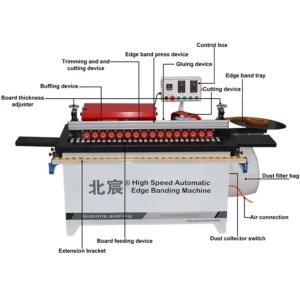
The ZDSF802 uses two 800 W high-speed motors for head-and-tail trimming and two 180 W motors for upper and lower polishing. Trimming power directly governs how cleanly the machine severs excess banding at the panel ends; insufficient wattage on dense PVC or thick veneer leaves a ragged edge that requires hand finishing. The double-row pressure beam keeps the strip seated flat against the substrate during the trimming pass, which maintains the claimed ±0.02 mm tolerance zone. Polishing motors then remove residual adhesive squeeze-out and smooth the transition between banding and panel face. When you evaluate automatic edge banding machine specifications for edge-finish consistency, these three elements — trimming wattage, pressure beam design, and polishing configuration — form the mechanical chain that determines whether panels move straight to assembly or loop back to a manual touch-up bench.
The Hidden Cost of Skipping the Air Pressure Audit
A rated air pressure of 0.4–0.6 MPa sounds standard until you connect the ZDSF802 to a workshop compressor that also feeds a spray booth and a pneumatic nail station. Pressure drop during simultaneous use can cause the belt-breaking mechanism to hesitate mid-cycle, leaving banding misaligned on the panel edge. I have seen edge banders of this class produce weeks of defective output before anyone traced the fault to a shared air line rather than the machine itself [NEED_CITE: compressed air system sizing for woodworking machinery]. Before installation, verify that a dedicated regulator or a separate compressor circuit supplies the edge bander at a stable pressure within the specified range.
Why Procurement Through This Configuration Channel Works
Voltage, control-panel language, and specification adjustments are treated as standard configuration steps rather than special requests. Every quotation is prepared by an engineer who reviews your panel mix, existing line throughput, and workshop utilities before recommending a model tier. A four-stage quality control sequence covers incoming material inspection, in-process assembly checks, finished-product testing, and pre-shipment verification, with test records documenting actual panel runs. Patented cutting mechanisms are manufactured in-house, which means tolerance claims can be traced back to the grinding and assembly floor rather than a third-party component supplier. Factory visits are welcomed so you can witness a sample processing test on your own substrate before the machine is crated.
Documentation & Verification
- Machine specification sheet listing confirmed voltage, frequency, and air pressure for your facility
- Electrical schematic showing motor wiring matched to local supply before dispatch
- Factory test record on your panel thickness range and chosen edge banding material
- Operation and maintenance manual supplied in the language your operators read
- Spare parts list identifying trimming blades, polishing wheels, and silicone belt sections
- Packing photographs documenting crating condition before the container is sealed
Installation, Commissioning & Support
- The 4 kW rated power draw requires a dedicated 220V circuit with appropriate breaker sizing
- Overall footprint of 130 × 65 cm fits through standard workshop doors but confirm ceiling clearance for the 75 cm height plus panel infeed
- Pneumatically controlled belt breaking demands a stable 0.4–0.6 MPa supply on a dedicated line
- Fluent-strip extendable supports must be leveled to the conveyor height before the first large-panel run
- Silicone conveyor belt tension and double-row pressure wheel alignment are set during first-day commissioning
- Trimming blade and polishing wheel replenishment schedules are documented in the spare parts list
What to Include in Your Specification Inquiry
To receive an accurate configuration proposal, share your typical panel substrate types, the thickness range you process most often, and your local supply voltage and frequency as measured on-site. Note the edge banding materials you run — PVC, melamine, or veneer — and the strip thickness range. If the ZDSF802 will sit within an existing line, list the upstream panel saw model and downstream boring or drilling stations so feed-speed matching can be verified before the order is confirmed.
Frequently Asked Questions
Q: How is the 0–10 m/min feed speed verified, and what panel dimensions define the test condition?
A: Feed speed is measured at the conveyor belt surface under load using a calibrated tachometer. The factory test record documents the speed across the full range using a panel representative of your typical thickness and length. Request this record as part of your pre-shipment documentation package so you can replicate the measurement during on-site commissioning.
Q: Can the 220V rated voltage be customized to match a 380V or 440V supply with a different frequency?
A: Voltage and frequency are configurable between 110V and 440V at 50 or 60 Hz. The configuration is locked in after you sign a voltage confirmation sheet referencing your measured on-site supply. The electrical schematic shipped with the machine reflects the exact motor winding and control transformer specification built for your facility.
Q: What control panel language options are available, and is the digital display configurable?
A: The digital temperature display and independent switches can be labeled in the language your operators use daily. This is confirmed during the specification review stage before assembly begins, so the panel arrives readable without requiring a post-delivery overlay or translation sticker.
Q: How does the ZDSF802 throughput match with upstream panel saws and downstream boring machines?
A: The 0–10 m/min feed speed and 10–50 mm sheet thickness range define the working envelope. Share your panel saw cycle time and boring station feed rate so the engineer can verify that no single station creates a bottleneck. Line-throughput matching is part of the configuration proposal before the order is finalized.
Q: Which spare parts ship with the machine, and what is the lead time for consumable replenishment?
A: A spare parts list is included in the shipment covering trimming blades, polishing wheels, and belt sections. Replenishment lead times vary by part and destination. Confirm the schedule for your region during the order stage so you can plan inventory before your initial consumables are exhausted.