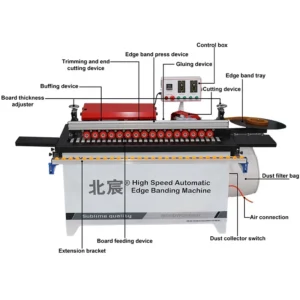
Voltage Customization as Standard — the DW702 is configured to your local grid frequency and voltage before assembly, eliminating on-site electrical rework.
Technical Specifications
| Parameter |
Value |
| Model |
DW702 |
| Product Type |
Automatic Edge Banding Machine |
| Total Power |
3800W |
| Voltage |
220V / 380V / customization (frequency to be confirmed) |
| Edge Banding Height Range |
0–50 mm |
| Edge Banding Thickness Range |
0.3–3 mm |
| Minimum Sheet Length |
25 cm |
| Minimum Sheet Width |
10 cm |
| Edge Motor Power |
20W |
| Transmission Motor Power |
140W |
| Trimming Motor Power |
800W × 2 |
| Polishing Motor Power |
180W × 2 |
| Vacuum Motor Power |
1200W |
| Glue Pot Capacity |
1000 ml |
| Air Source Pressure |
0.4–0.8 MPa |
| Overall Dimensions (L×W×H) |
120 × 55 × 110 cm |
| Net Weight |
105 kg |
| Language Options |
Chinese, English (other languages customizable) |
| Assembly State |
Fully assembled |
| Standard Features |
Edge banding, trimming, polishing, automatic head and tail cutting, vacuum |
Application Suitability
| Application |
Material or Output |
| Cabinet door edge finishing |
MDF and particleboard with PVC or melamine banding |
| Custom furniture panel processing |
Plywood and blockboard with veneer edge strips |
| Polymer door production |
Polymer composite panels with matched edge profiles |
| Small-batch component banding |
Boards down to 25 cm × 10 cm for drawer sides and shelving |
Why the Voltage Question Must Come Before the Quotation
Confirming your local voltage and frequency before order prevents a machine that simply will not start on arrival.
I once watched a fully automatic edge bander sit idle for days at a workshop in the Middle East because the motor was wound for 380V/50Hz while the site ran on 220V/60Hz. The contractor had to source a step-up transformer locally, and the control board needed a separate frequency converter. Those are not small line items, and they delayed commissioning while the production schedule slipped. [NEED_CITE: voltage and frequency standards by export market]
When reviewing Automatic Edge Banding Machine specifications, electrical compatibility is the first parameter to lock down. The DW702 supports 220V and 380V configurations with frequency customization available, but the exact combination must be confirmed against your facility's supply before the motor is wound and the control panel is wired.
Mapping Power Distribution Across Each Station
The DW702 allocates its 3800W total power across distinct functional stations. The two trimming motors draw 800W each, which is where most of the cutting force is concentrated. The polishing station runs twin 180W motors for final surface refinement, while the vacuum motor at 1200W handles dust extraction directly at the trimming head. Understanding this breakdown helps you plan the electrical circuit and breaker sizing, because the inrush current when all stations engage simultaneously can exceed the nominal running load.
Matching Air Supply to Pneumatic Demand
Edge banding machines in this class rely on compressed air for panel clamping, banding feed, and automatic head-and-tail cutting. The DW702 requires 0.4–0.8 MPa air source pressure. If your existing compressor serves multiple machines, you need to calculate whether the cumulative CFM demand keeps pressure within this window during peak cycling. A pressure drop below 0.4 MPa typically shows up as inconsistent trimming cuts or incomplete banding adhesion, problems that operators often misdiagnose as glue temperature issues. [NEED_CITE: pneumatic system sizing for woodworking machinery]
How Trimming and Polishing Specs Translate to Edge Quality
The dual 800W trimming motors handle the bulk material removal after the banding is applied. On MDF and particleboard, trimming power directly affects how cleanly the excess banding is sheared from the panel edge. Underpowered trimming stations tend to tear rather than cut, especially on 3 mm PVC banding. The subsequent 180W polishing motors then smooth the transition between banding and panel surface. When evaluating Automatic Edge Banding Machine specifications, the ratio between trimming and polishing power indicates whether the machine prioritizes material removal speed or final surface refinement.

What Happens When the Language Option Gets Overlooked
A control panel in a language the operator cannot read is not an inconvenience; it is a production stoppage. I spent a week on-site troubleshooting what turned out to be a simple parameter error, except the error codes were displayed in characters the local technician could not parse. The DW702 offers Chinese and English as standard, with other languages customizable at order. Specifying the correct control language on the purchase order costs nothing but prevents days of idle capacity while waiting for a translator or a firmware reflash. [NEED_CITE: operator interface language requirements in industrial equipment procurement]
Sourcing From a Manufacturer That Builds the Full Range
The DW702 sits within a product family that scales from entry-level manual feed units to fully automated pre-milling lines. This matters when your workshop grows and you need to add capacity without switching suppliers and retraining operators on a different control architecture. The manufacturer holds proprietary cutting mechanism patents and runs four-stage quality control from incoming material through pre-shipment verification. Voltage and language customization are handled during production, not as afterthoughts. Each machine ships with a factory test record and an operation manual in the agreed language.
Documentation & Verification
- CE declaration of conformity matched to the DW702 configuration
- Machine specification sheet listing verified trimming tolerance values
- Electrical schematic confirming your ordered voltage and frequency combination
- Factory test record showing edge banding results on your specified panel material
- Operation and maintenance manual delivered in your agreed control panel language
- Spare parts list with part numbers for trimming blades and polishing wheels
Installation, Commissioning & Support
- Allocate floor space for the 120 × 55 cm footprint plus operator clearance on the feed side
- Provide a dedicated circuit matching the confirmed voltage with breaker rated above 3800W continuous draw
- Machine arrives fully assembled; verify no transit damage to the trimming and polishing heads
- First startup should include air pressure calibration within the 0.4–0.8 MPa range at the regulator
- Train operators on glue pot refill procedure for the 1000 ml capacity before production runs begin
- Stock replacement trimming blades and polishing pads from the included spare parts list
Requesting a Configuration That Fits Your Line
When you are ready to evaluate the DW702 for your workshop, share the panel materials you process most frequently, the range of board thicknesses in your typical orders, and your local voltage and frequency standard. If you run existing edge processing equipment upstream or downstream, mention the feed height and throughput so the configuration can be matched. A sample processing test on your actual board stock is available before commitment.
Frequently Asked Questions
Q: What panel thickness range does the DW702 support, and how do I verify it handles my boards?
A: The edge banding height range covers 0–50 mm, but the maximum panel thickness is not stated in the current specification sheet. Before placing an order, request a factory test using your actual panel stock at its full thickness. This confirms that the trimming station clears the board surface and the banding adheres properly across the entire edge profile.
Q: How do I confirm voltage and frequency compatibility before the machine ships?
A: Specify your facility's exact voltage and frequency on the purchase order. The DW702 supports 220V and 380V with frequency customization available. The manufacturer will provide an electrical schematic matching your configuration for review before assembly. This prevents the situation where a machine arrives wired for a grid standard that does not match your local supply.
Q: What tolerance can I expect on edge trimming, and how do I verify it?
A: Tolerance values are not published in the base specification sheet for this model. Request a documented test record showing measured deviation on your chosen panel material and banding thickness. Independent verification at the factory before shipment is the most reliable way to confirm that trimmed edges meet your assembly requirements without visible gaps or overhangs.
Q: How do the trimming and polishing motor specifications affect edge finish on MDF versus particleboard?
A: The dual 800W trimming motors provide sufficient cutting force for both substrates, but particleboard tends to chip more easily if the trimming blade is not sharp or the feed rate is too aggressive. The twin 180W polishing motors then smooth any micro-irregularities. Ask for a sample finished on each material you plan to run so you can evaluate edge quality before production starts.
Q: What control system and language options are available, and how do I specify them?
A: The DW702 ships with Chinese and English control panel options as standard, and additional languages are customizable at the time of order. State your preferred language explicitly on the purchase order along with any specific control interface requirements. This ensures the firmware is loaded and tested at the factory before the machine is packed for dispatch.