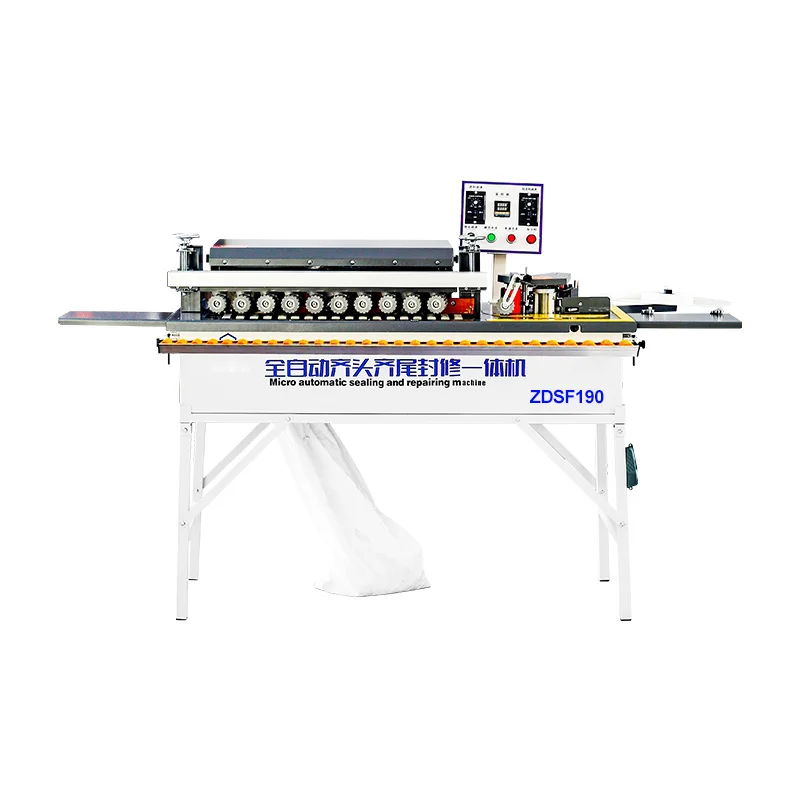
Precision-Built Tolerance Control — verified through a four-stage inspection covering incoming material to pre-shipment testing, ensuring the ZDSF190 meets its stated ±0.02mm edge profiling accuracy on your exact panel and banding combination before it leaves the factory.
Technical Specifications
| Parameter |
Value |
| Model |
ZDSF190 |
| Product Type |
Curved and Straight Edge Banding Machine |
| Function Set |
Automatic plate feeding, belt breaking, double-sided gluing, upper/lower trimming and polishing, curved and straight edgebanding, large diameter surrounding vacuum |
| Edge Type |
Both curved and straight lines |
| Voltage & Frequency |
220V 50Hz |
| Rated Power |
4 kW |
| Heating Power |
800 W |
| Trimming Power |
800 W × 2 |
| Polishing Power |
180 W × 2 |
| Suction Power |
1200 W |
| Belt Power |
25 W |
| Transmission Power |
120 W |
| Feed Speed |
0–14 m/min |
| Panel Thickness Range |
10–50 mm |
| Strip Thickness Range |
0.5–2.5 mm |
| Glue Pot Capacity |
1000 ml |
| Rated Air Pressure |
0.4–0.6 MPa |
| Trimming Cutter |
4-blade alloy arc knife |
| Conveyer System |
Crawler transmission with steel rod slide rails |
| Pressure Beam |
Adjustable aluminum alloy |
| Edge Strip Cutting |
Pneumatically controlled |
| Overall Dimensions (L×W×H) |
1900 × 560 × 1300 mm |
| Net Weight |
12*embly required |
| Standards |
CE |
Application Suitability
| Application |
Material or Output |
| Custom cabinet door edge finishing |
MDF and particleboard with PVC or ABS banding, 0.5–2.5 mm strip thickness |
| Small-batch curved panel edging |
Plywood and shaped solid wood panels on radii down to typical furniture contours |
| Joinery workshop straight-line banding |
Melamine-faced chipboard and MDF with veneer or PVC edge strips |
| Prototype and sample production |
Mixed substrate runs across MDF, plywood, and particleboard for fit-check assemblies |
| Transition from manual to mechanized edging |
Startups replacing hand-trimming with automated trimming and polishing on standard panel stocks |
Why Voltage Confirmation Must Precede Every Edge Bander Purchase
A 220V 50Hz machine wired into a 60Hz supply will run its glue pot heater and feed motor at altered output, shifting adhesive open time and feed synchronization before the operator notices a problem.
One of the most common edge banding machine specifications failures I see across Latin American installations traces back to a simple mismatch: the nameplate says 50Hz, the shop runs 60Hz, and nobody checked until the glue started setting too fast or too slow on the band. The ZDSF190 ships at 220V 50Hz as standard, but frequency affects everything from the 800W heating element's thermal curve to the crawler transmission's actual feed rate. When a technical buyer skips this confirmation, the machine arrives and runs — just not correctly. The glue line looks acceptable on the first panel, then fails on the twentieth when the pot temperature drifts. Panels pass visual inspection but fail the fingernail peel test during assembly. [NEED_CITE: voltage and frequency standards by export market]
That is exactly why every configuration discussion for this machine starts with your local supply specs before any other parameter gets locked in.

Feed Speed and Panel Thickness: Reading the Envelope Together
The 0–14 m/min feed speed range on this edge banding machine only tells half the story. What matters is how that speed interacts with the 10–50 mm panel thickness capacity. Running 18 mm MDF at higher feed rates behaves very differently from pushing 40 mm solid wood panels through the same trimming stations. The crawler transmission with steel rod slide rails provides the feed stability needed across that range, but optimal speed selection depends entirely on your specific substrate and edge strip combination. Choosing the right operating point within this envelope determines whether trimming stays clean or starts chipping the banding edge.
Double-Sided Gluing and the 1000 ml Pot Reality
The 800W heating element paired with a 1000 ml glue pot capacity defines how long you can run before reloading adhesive. For a small workshop producing custom cabinets in batches, this pot size typically supports continuous operation through a standard production run without interrupting for refills. The double-sided gluing function applies adhesive to both the panel edge and the strip simultaneously, which matters when you are working with porous substrates like particleboard that absorb glue differently than MDF. Consistent thermal output from the heating element keeps adhesive viscosity stable across the run.
Trimming Stations, Cutter Geometry, and Downstream Fit
The dual 800W trimming motors driving 4-blade alloy arc cutters define the edge profiling accuracy you will see on finished panels. In woodworking edge banding, trimming quality directly affects how panels mate during assembly — a visible glue line or a proud edge means the cabinet carcase will not close square. The arc knife geometry on the ZDSF190 is designed to follow both straight and curved profiles without swapping cutter heads between jobs. Polishing power at 180W per station then removes the micro-scratches left by trimming, leaving a surface ready for finish or direct installation. When edge banding machine specifications list trimming power and cutter type separately, you need to read them together to understand what the machine actually produces at the exit end. [NEED_CITE: edge profiling tolerance standards for furniture assembly]
The Cost of Skipping Configuration Verification
I have walked into workshops where a newly installed edge bander was producing acceptable-looking work, only to discover weeks later that the banding was delaminating on curved sections because the feed pressure and glue temperature were never matched to ABS thick strip. The operator had been running PVC thin-edge settings the entire time. With the ZDSF190 handling strip thickness from 0.5 to 2.5 mm, that range covers both material families — but the machine settings for each are fundamentally different. When a buyer orders without specifying their actual edge material, the factory defaults to one configuration, and the mismatch only surfaces when assembled furniture fails in the field. [NEED_CITE: common edge banding failure modes related to material mismatch]
Why Source This Machine Through This Configuration Channel
In-house manufacturing with patented cutting mechanisms means the trimming geometry on the ZDSF190 is not a generic sourced component — it is controlled from design through production. The four-stage QC process covering incoming material, in-process assembly, finished product, and pre-shipment verification applies directly to this model, so the unit you receive has been tested before crating. Voltage configuration from 110V to 440V is available as standard customization, which means the 220V 50Hz baseline can be matched to your local supply before production begins rather than adapted after arrival. An engineer-led configuration recommendation arrives as a formal quotation within 24 hours of your inquiry, addressing your actual panel materials and production volume. Factory visits are welcomed if you want to see a how to choose edge banding machine decision validated in person before committing.
Documentation & Verification
- CE declaration of conformity covering the ZDSF190's electrical and mechanical safety requirements
- Machine specification sheet confirming all parameters match your agreed configuration
- Electrical schematic with voltage and frequency confirmation for your destination market
- Factory test record on your specific panel thickness and edge strip material before dispatch
- Operation and maintenance manual provided in your operator's working language
- Spare parts list identifying wear items specific to the trimming and polishing stations
Installation, Commissioning & Support
- Floor space allocation for the 1900 × 560 mm footprint with operator clearance on feed and exit sides
- Dedicated 220V circuit sized for the 4 kW rated power draw, separate from other high-draw equipment
- Partial assembly required on arrival — pressure beam, dust collection, and pneumatic lines need field completion
- First-run calibration of feed speed against your actual panel thickness range using test stock
- Pneumatic system verification at 0.4–0.6 MPa with compressor capacity matched to the edge strip cutting cycle
- Trimming and polishing station alignment check on both straight and curved sample profiles before production begins
What We Need to Configure Your Machine Correctly
Before quoting a configuration, we need to know the specific panel materials you run most often, the edge strip types and thicknesses in your standard product range, and your confirmed local voltage and frequency. If you are replacing manual edging or upgrading from a straight-only machine, tell us your typical daily volume and whether curved panels are a regular part of your output or an occasional requirement. This information lets us verify that the ZDSF190's specification envelope actually fits your production reality.
Frequently Asked Questions
Q: How do I verify trimming accuracy on my specific panel material before placing an order?
A: Request a sample processing test using your actual panel stock and edge banding type. The factory runs your material through the ZDSF190 at your specified feed speed, documents the trimming result with measurements, and ships the sample panels to you for assembly fit-check. This confirms edge profiling accuracy on your exact substrate before production begins.
Q: Can the 220V 50Hz configuration be changed to match a different local power supply?
A: Yes. Voltage is configurable from 110V to 440V, and frequency can be matched to 60Hz markets. This customization is confirmed during the specification and voltage confirmation stage before production starts. The electrical schematic and voltage confirmation document you receive will reflect your exact local supply requirements, not a generic default.
Q: How should I select feed speed for different panel thicknesses within the 10–50 mm range?
A: Thinner panels like 10 mm MDF typically run at higher feed speeds within the 0–14 m/min range, while thicker 40–50 mm solid wood panels require slower feed rates to maintain trimming quality. The optimal speed depends on your specific substrate density and edge strip thickness. Factory testing on your material establishes the correct operating point.
Q: What compressor capacity do I need for the 0.4–0.6 MPa pneumatic system?
A: The pneumatic edge strip cutting and pressure beam adjustment require a stable air supply within the 0.4–0.6 MPa range. Compressor sizing should account for the ZDSF190's air consumption alongside any other pneumatic tools running simultaneously in your workshop. Undersized compressors cause pressure drops during the cutting cycle, leading to incomplete strip breaks.
Q: Is the control panel available in languages other than the default factory setting?
A: Multilingual control panels are available as part of the standard customization options. The agreed language is confirmed during the specification stage so that operators can read all feed speed, temperature, and function settings during commissioning without translation delays. The operation manual is also provided in the same language.