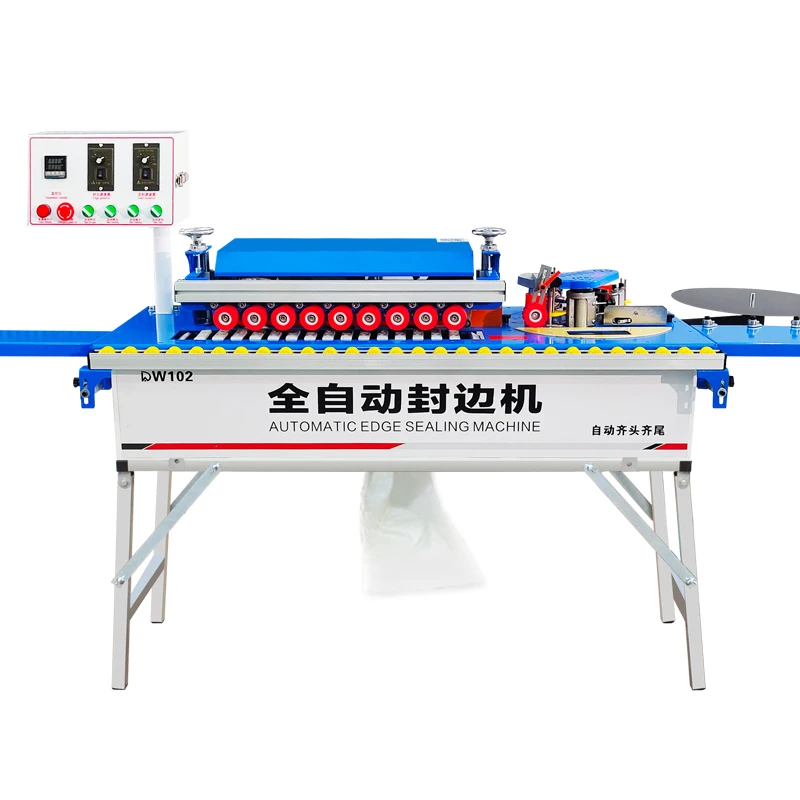
Verified Tolerance on Your Substrate — the DW102 edge banding machine specifications include proprietary cutting mechanisms ground to ±0.02mm, confirmed on your actual panel material before shipment rather than assumed from a generic brochure.
Technical Specifications
| Parameter |
Value |
| Model |
DW102 |
| Product Type |
Automatic Edge Banding Machine |
| Total Power |
3800W |
| Voltage Options |
220V / 380V / customization (frequency to be confirmed) |
| Control System |
PLC Controlled |
| Edge Banding Thickness Range |
0.3–3 mm |
| Edge Banding Height Range |
0–50 mm |
| Minimum Sheet Length |
25 cm |
| Minimum Sheet Width |
5 cm |
| Trimming Power |
650W × 2 |
| Polishing Power |
180W × 2 |
| Edge Power |
20W |
| Transmission Power |
60W |
| Vacuum Power |
1200W |
| Glue Pot Capacity |
1000 ml |
| Air Source Pressure |
0.5–0.8 MPa |
| Product Size |
128 × 47 × 69 cm |
| Product Weight |
75 kg |
| Language Options |
Chinese and English standard; Spanish, French and others customizable |
| Plug Options |
EU, USA, AU, UK |
| Assembly State |
Fully assembled |
| Standards |
CE, ISO 9001 |
Application Suitability
| Application |
Material or Output |
| Cabinet door edge banding |
MDF and particleboard with PVC or veneer strips 0.3–3 mm |
| Custom furniture panel finishing |
Plywood and blockboard, straight and curved profiles |
| Polymer door production |
Polymer substrates requiring controlled glue temperature |
| Small-batch workshop runs |
Mixed panel types in job-shop environments with frequent changeovers |
Why the Voltage Question Comes Before the Price on the DW102 Edge Banding Machine Specifications
A machine wired for the wrong frequency will trip breakers or burn motors within the first week of operation.
I once watched a plywood plant in the Yangtze Delta lose two full production days because an edge bander arrived configured for 50Hz while the facility ran on a 60Hz supply. The motor overheated during trimming, and the PLC threw faults that neither the operator nor the local electrician could trace. When you are comparing the DW102 edge banding machine specifications against your shortlist, confirming the exact voltage and frequency at your facility is the single step that prevents a machine from becoming dead weight on the floor [NEED_CITE: voltage and frequency standards by export market]. Specifying plug type and phase at the quotation stage eliminates the need for adapters or rewiring after delivery.

Matching Motor Configuration to Your Panel Mix
The DW102 carries dual trimming motors rated at 650W each, which provides enough torque for clean cuts on PVC and thin veneer without tearing the substrate edge. When a workshop alternates between MDF one hour and dense plywood the next, having independent trimming and polishing stations means the operator adjusts one zone at a time rather than reconfiguring the entire feed path. The 1200W vacuum unit pulls edge waste away from the glue zone continuously, preventing trimmings from contaminating the bonding surface on the next panel.
Control Panel Language and Operator Commissioning
A PLC-controlled interface in a language the operator cannot read stalls commissioning for days and introduces parameter errors that degrade edge quality. The DW102 ships with Chinese and English as standard, and the control panel can be configured in Spanish, French, or other languages at the time of order. This matters most when a distributor installs the machine and hands it to a local crew who must set glue temperature and feed speed without an interpreter present [NEED_CITE: CE machinery directive requirements for industrial equipment]. Multilingual labeling on the HMI reduces the chance that a wrong button press sends a half-finished panel through the trimming heads.
Reading the Numbers That Actually Affect Edge Quality
Edge banding thickness range of 0.3–3 mm covers the most common PVC and veneer stocks used in cabinet and furniture production. Running 0.3 mm veneer requires lower pressure at the pressing zone and a slower trimming feed to avoid chipping the wood grain, while 3 mm PVC demands more aggressive trimming motor engagement and adequate polishing to remove the witness line. The glue pot capacity of 1000 ml is sized for continuous small-to-medium batch runs, but the temperature setting must match the adhesive type and the substrate moisture content. I learned this the hard way commissioning a unit at a marine plywood plant: the glue pot was calibrated for standard MDF, but the high-moisture plywood caused the adhesive to cool too quickly, and edges peeled during trimming until we re-tuned temperature and feed speed over two days. Air source pressure between 0.5 and 0.8 MPa drives the pneumatic cylinders that control head-and-tail cutting and pressing roller engagement; pressure below the lower limit results in incomplete end cuts that require manual cleanup downstream.
The Hidden Cost of Skipping Substrate Verification
When a buyer selects an edge bander based on catalog specifications alone without running a sample test on the actual panel stock, the first sign of trouble appears during assembly. Panels with visible glue lines or slightly oversized edge trim force the dowel-and-bore stations out of alignment, compounding tolerance errors across an entire cabinet run [NEED_CITE: woodworking assembly tolerance stack-up in panel processing]. The cost is not the wasted edge banding material itself but the labor hours spent re-machining panels that should have been ready for packaging. A two-day commissioning delay caused by incorrect glue temperature on an unfamiliar substrate can push a delivery deadline into penalty territory, especially when the furniture factory has committed to a fixed installation date with the end client.
Why Technical Buyers Source This Machine Here
In-house manufacturing with patented cutting mechanisms means the trimming tolerance claimed on the spec sheet is verifiable on a factory test record, not an untested catalog promise. Voltage and plug customization is handled at the production stage rather than through field adapters, so the machine arrives electrically matched to the destination market. The full product family — from entry-level units to fully automatic lines — allows a workshop to scale capacity without switching suppliers or retraining operators on an unfamiliar control platform. Four-stage quality control covers incoming material inspection, in-process checks, finished product verification, and pre-shipment testing on the buyer's specified panel material [NEED_CITE: ISO 9001 quality management system stages in machinery manufacturing]. An engineer-led configuration recommendation with a formal quotation within 24 hours means technical buyers receive a machine matched to their actual throughput rather than an oversized or underpowered unit.
Documentation & Verification
- CE declaration of conformity referencing the DW102 edge banding machine specifications and applicable directives
- Electrical schematic confirming voltage, frequency, and plug type matched to your facility supply
- Factory test record produced on your specified panel thickness and edge banding material
- Operation and maintenance manual delivered in the language agreed at order confirmation
- Spare parts list identifying consumable trimming blades and polishing wheels by part number
Installation, Commissioning & Support
- Fully assembled delivery at 128 × 47 × 69 cm allows placement through standard workshop doors without rigging equipment
- Dedicated circuit required matching confirmed voltage and the 3800W total power draw including vacuum and trimming motors
- Air supply line at 0.5–0.8 MPa must be connected before first power-on to enable pneumatic head-and-tail cutting
- Glue pot temperature and feed speed calibrated during commissioning against your specific substrate and adhesive combination
- Multilingual PLC panel configured before dispatch so the operator can navigate parameters from the first production run
- Consumable trimming blades and polishing buffers listed in the spare parts documentation for local reorder planning
Preparing Your Inquiry for a Configuration Match
To receive a specification-matched quotation, share the panel materials you process most frequently along with the thickness range and edge banding stock you run. Confirm the voltage, phase, and frequency available at your facility so the electrical system is built to match. If you operate alongside existing sliding table saws or boring machines, provide their feed rates so the DW102 throughput can be evaluated for line balance.
Frequently Asked Questions
Q: How do I determine whether the DW102 panel range fits my daily production volume?
A: Share your average panel dimensions, edge banding thickness, and daily output target. The DW102 handles sheet lengths from 25 cm and widths from 5 cm with edge heights up to 50 mm. An engineer reviews these inputs against the trimming and polishing station cycle to confirm whether the configuration matches your throughput requirement or whether a higher-capacity model in the same product family is more appropriate.
Q: What voltage and frequency details must I confirm before the machine ships?
A: Provide the exact voltage, phase, and frequency at the installation point, along with the plug standard used in your country. The DW102 supports 220V and 380V configurations with EU, USA, AU, and UK plug options. Confirming these details at the quotation stage ensures the motor winding and control transformer are built to your local supply, preventing commissioning delays caused by electrical incompatibility.
Q: Can the PLC control panel display be set to a language other than English or Chinese?
A: Yes. Spanish, French, and other languages are available as custom configurations at the time of order. The language is flashed onto the HMI before the machine leaves the factory so operators can set glue temperature, feed speed, and trimming parameters in their working language from the first day of production without relying on translated manuals alone.
Q: How does glue pot capacity influence bonding on different substrates?
A: The 1000 ml glue pot maintains stable adhesive temperature across continuous runs on MDF and particleboard. High-moisture substrates such as marine plywood draw heat from the glue film faster, so the temperature setpoint and feed speed must be adjusted during commissioning. A sample test on your actual panel material confirms whether the standard calibration holds or needs tuning before full production begins.
Q: Which spare parts are consumable and how do I reorder them?
A: Trimming blades and polishing wheels are the primary consumables on the DW102. A spare parts list with part numbers is included in the documentation package so you can source replacements locally or order directly. The list also identifies wear items in the pneumatic cylinders and feed chain so your maintenance team can plan inspection intervals around your production schedule.