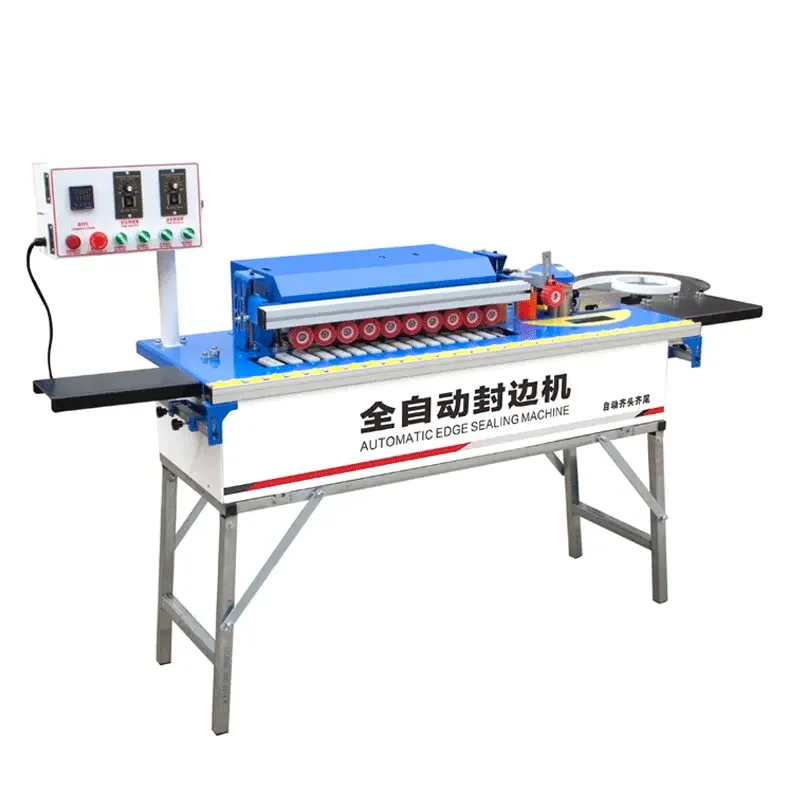
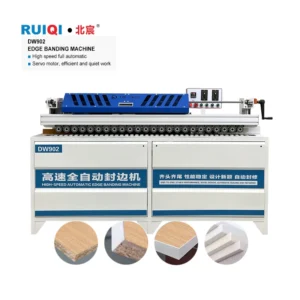
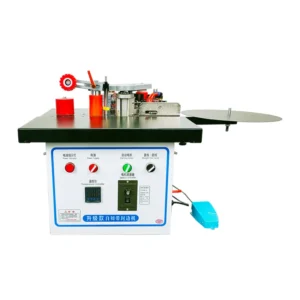
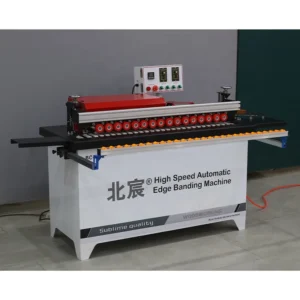
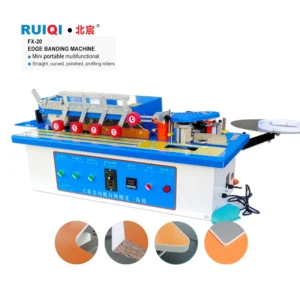
Precision-Matched Configuration — the DW102 is evaluated against your actual substrate and edge material before shipment, not just listed by catalog number.
Technical Specifications
| Parameter |
Value |
| Model |
DW102 |
| Product Type |
Automatic Edge Banding Machine |
| Rated Power |
3800W total |
| Voltage & Frequency |
220V / 380V / customization available |
| Overall Dimensions (L×W×H) |
128 × 47 × 69 cm |
| Net Weight |
75 kg |
| Edge Banding Height Range |
0–50 mm |
| Edge Banding Thickness Range |
0.3–3 mm |
| Minimum Sheet Length |
25 cm |
| Minimum Sheet Width |
5 cm |
| Glue Pot Capacity |
1000 ml |
| Trimming Stations |
Edge trimming, automatic head and tail cutting |
| Polishing Stations |
Included (180W × 2) |
| Vacuum Power |
1200W with vacuum function |
| Air Source Pressure |
0.5–0.8 MPa |
| Language Options |
Chinese / English standard; Spanish and other languages customizable |
| Feed Speed |
(basis to be confirmed) |
| Panel Thickness Range |
(basis to be confirmed) |
| Tolerance |
(basis to be confirmed) |
Application Suitability
| Application |
Material or Output |
| Cabinet door and carcass edge banding |
MDF and particleboard panels with PVC or melamine edge strips |
| Custom furniture panel finishing |
Plywood and blockboard with veneer or ABS banding |
| Polymer door profile edge treatment |
Polymer composite boards requiring straight and curved contour banding |
| Small-batch joinery production |
Mixed substrate runs in medium-sized furniture workshops |
Why the Voltage Question Must Come Before the Edge Banding Machine Specifications
Confirming your local voltage and frequency first prevents a machine arrival that cannot run on your shop floor.
I once watched a colleague ship an edge bander overseas without verifying whether the destination workshop ran on 50Hz or 60Hz. The machine powered on, but the feed motor ran at the wrong speed, throwing off the glue application timing entirely. Two days of on-site recalibration followed. For the DW102, voltage is configurable across 220V and 380V with customization available, but frequency must also match your grid. Requesting an electrical schematic and voltage confirmation document before production avoids this failure mode completely. When reviewing edge banding machine specifications, electrical compatibility should sit at the top of your checklist [NEED_CITE: voltage and frequency standards by export market].

Mapping Footprint and Power Draw to Workshop Reality
The DW102 occupies 128 × 47 × 69 cm and weighs 75 kg, which places it firmly in the compact segment of automatic edge banders. For workshops where floor space is already committed to a panel saw and a drilling station, this footprint determines whether the machine fits your existing layout without relocating other equipment. Edge banding machine specifications often list dimensions without context — measure your available wall length against the 128 cm machine length and account for operator standing room on both the infeed and outfeed sides.
Total rated power of 3800W includes the 1200W vacuum system, meaning your dedicated circuit must handle the combined load plus startup surge. Plan electrical routing before the machine arrives rather than discovering overloaded breakers during commissioning.
Air Pressure and Its Effect on Trimming Consistency
The DW102 requires 0.5–0.8 MPa from your compressed air supply, which feeds the pneumatic cylinders controlling head and tail cutting as well as edge trimming pressure. Inconsistent air pressure directly translates to uneven trimming results — too low and the cutters hesitate, leaving material proud of the panel surface; too high and you risk chatter marks on the banding edge [NEED_CITE: pneumatic pressure requirements for woodworking machinery].
Verify that your compressor can sustain this pressure range continuously, not just at peak output. A receiver tank sized for intermittent nail gun use will not maintain stable pressure through a full shift of edge banding production.
Interpreting Core Edge Banding Machine Specifications for Production Fit
The edge banding thickness range of 0.3–3 mm covers most PVC, ABS, melamine, and thin veneer strips used in cabinet and furniture production. If your shop runs real wood veneer banding above 3 mm or heavy acrylic edge material, this machine falls outside that envelope. The banding height range of 0–50 mm accommodates standard 18 mm and 25 mm panel thicknesses commonly used in carcass construction.
The 1000 ml glue pot capacity sets a practical ceiling on continuous run time before refilling. In a high-volume environment processing hundreds of linear meters per shift, a small glue pot means more frequent pauses. For lower-volume custom furniture shops running varied panel sizes and shorter batch lengths, this capacity is typically sufficient and reduces the risk of glue degradation from prolonged heating.
The included polishing stations at 180W × 2 provide the final surface finish after trimming, removing residual adhesive and smoothing the banding edge. This eliminates a separate manual polishing step downstream. The automatic head and tail cutting function trims the banding overhang at both ends of the panel as it passes through, reducing the operator's post-processing workload.
The Hidden Cost of Overlooking Specification Gaps
When a supplier leaves feed speed, panel thickness range, and tolerance values unstated, you cannot verify whether the machine matches your production requirement until it arrives and runs your material. I have seen workshops accept delivery, unbox the machine, and only then discover that their standard 25 mm MDF panels feed inconsistently because the pressure beam clearance was never confirmed. The cost is not just the return freight — it is the days of lost production while a replacement is sourced. Always request a formal specification sheet with these values confirmed in writing before committing to an order [NEED_CITE: machinery purchase verification best practices].
Why Procurement Through This Channel Works for Technical Buyers
In-house manufacturing with patented cutting mechanisms means the tolerance claims behind the DW102 can be traced back to verified mechanical design, not just marketing literature.
Voltage, language, and specification customization are treated as standard configuration options rather than special requests, so the machine ships matching your local electrical grid and operator language from day one.
A four-stage quality control process covers incoming material inspection, in-process checks, finished product verification, and pre-shipment testing — each stage documented before the machine leaves the factory floor.
Engineer-led configuration recommendation ensures the DW102 is matched to your actual substrate, edge material, and production volume before a formal quotation is issued within 24 hours.
The full product family ranges from entry-level to full-function models, so a workshop that outgrows the DW102 can scale to a higher-tier edge bander within the same supplier ecosystem without requalifying a new vendor.
Documentation & Verification
- Machine specification sheet confirming every DW102 parameter against your requirements before production
- Electrical schematic and voltage confirmation document matching your local grid standard
- Factory test record showing actual banding results on your substrate material
- CE declaration of conformity and ISO 9001 certificate issued for this model
- Operation and maintenance manual in your agreed language at time of shipment
Installation, Commissioning & Support
- Verify floor space accommodates the 128 cm machine length plus operator clearance on both sides
- Provide a dedicated circuit rated for 3800W total load including the 1200W vacuum system
- Confirm air compressor sustains 0.5–0.8 MPa continuously through full production shifts
- Arrange glue temperature calibration on your specific MDF or particleboard during first startup
- Review the 1000 ml glue pot refill procedure and heating cycle timing with your operators
- Stock replacement trimming cutters and polishing pads matched to your banding material type
Requesting a Configuration Match for Your Workshop
Before we quote a DW102, share the specific panel materials you process most frequently — MDF, particleboard, plywood, or polymer composite — along with the edge banding type and thickness you run daily. Let us know your local voltage and frequency so the electrical system is built to match. If you have a target production volume or existing upstream panel saw feeding this edge bander, include those details so the configuration aligns with your line throughput.
Frequently Asked Questions
Q: How do I verify feed speed and tolerance when they are not listed in the initial data sheet?
A: Request a formal machine specification sheet that confirms feed speed and tolerance values in writing before placing your order. Ask for a factory test record run on your actual panel material and edge banding type. If possible, arrange a sample processing test or factory visit to observe results firsthand before the machine ships.
Q: What documentation confirms the DW102 matches my local voltage and frequency?
A: Before production begins, you will receive an electrical schematic and a voltage confirmation document specifying the exact voltage and frequency the machine is built for. This prevents the common failure of machines arriving wired for the wrong grid standard. Always verify both voltage and frequency, not just voltage alone.
Q: How do I specify the control panel language before the machine enters production?
A: The DW102 ships with Chinese and English as standard interface languages. Spanish and other languages are available as customization options. Specify your required language at the quotation stage so the control panel firmware is loaded before assembly. This avoids commissioning delays caused by operators unable to read the display.
Q: How should I match the glue pot capacity to my daily production volume?
A: The 1000 ml glue pot suits workshops running varied panel sizes in shorter batches typical of custom furniture production. For continuous high-volume runs processing hundreds of linear meters per shift, evaluate whether the refill frequency fits your workflow. Share your daily linear meter target during inquiry so the configuration can be assessed accordingly.
Q: What minimum sheet dimensions does the DW102 accept, and how does that affect my workflow?
A: The minimum sheet length is 25 cm and minimum width is 5 cm. If your existing cut-to-size workflow produces narrower offcuts that require edge banding, these pieces cannot be processed on this machine. Confirm that your standard panel sizes and any small parts you edge-band fall above these minimums before ordering.