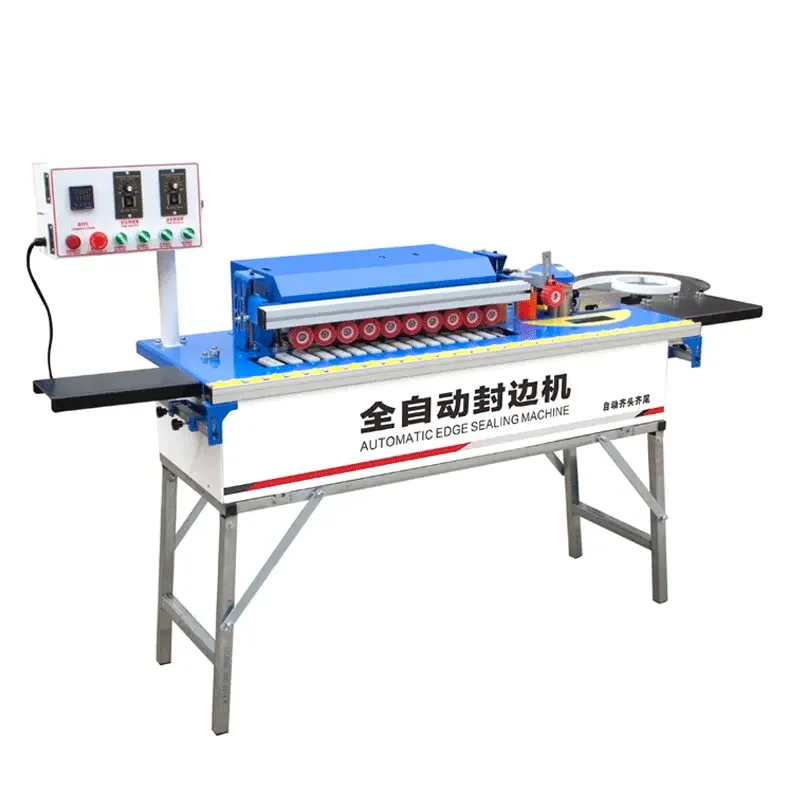
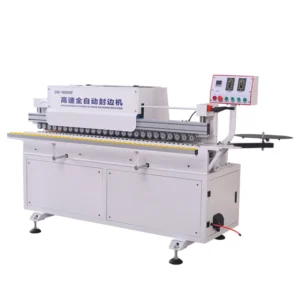
Voltage-Configurable Design — the DW102 ships with selectable 220V or 380V input and multilingual control panels, verified before dispatch to match your local grid and operator language.
Technical Specifications
| Parameter |
Value |
| Model |
DW102 |
| Product Type |
Automatic Edge Banding Machine |
| Total Power |
3800W |
| Voltage Options |
220V / 380V / customization available |
| Trimming Power |
650W × 2 stations |
| Polishing Power |
180W × 2 stations |
| Vacuum Power |
1200W |
| Edge Motor Power |
20W |
| Transmission Motor Power |
60W |
| Air Source Pressure |
0.5–0.8 MPa |
| Glue Pot Capacity |
1000 ml |
| Edge Banding Height |
0–50 mm |
| Edge Banding Thickness |
0.3–3 mm |
| Minimum Sheet Length |
25 cm |
| Minimum Sheet Width |
5 cm |
| Product Size |
128 × 47 × 69 cm |
| Product Weight |
75 kg |
| Key Features |
Curved and straight edge banding, edge trimming, polishing, automatic head and tail cutting, integrated vacuum extraction |
Application Suitability
| Application |
Material or Output |
| Cabinet door edge finishing |
MDF and plywood panels with PVC or veneer banding |
| Custom furniture panel processing |
Particleboard and blockboard with melamine strip edges |
| Curved panel edge banding |
Shaped furniture components requiring contoured edge treatment |
| Small-batch workshop production |
Polymer door panels and solid wood edge applications |
Why the Voltage Question Should Come Before the Price on Any Edge Banding Machine Specifications Sheet
Confirming local voltage and frequency before ordering prevents a machine from arriving as dead weight on your shop floor.
I have seen woodworking shops in South America and Southeast Asia take delivery of edge banders wired for a grid that does not match their facility. The machine sits unpowered for weeks while transformers are sourced or the unit is sent back for rewinding. A 3800W system like the DW102 draws meaningful current, and running it on an incompatible supply risks motor burnout before the first panel is edged. The Edge Banding Machine specifications you compare should always list the exact voltage and frequency your facility supplies [NEED_CITE: voltage and frequency standards by export market]. Asking this question at the quotation stage costs nothing; discovering the mismatch at the crate-opening stage costs weeks of production time.

Power Distribution Across Processing Stations
The 3800W total system power is divided across six functional zones. The two trimming motors at 650W each handle the bulk of material removal, cutting excess PVC or veneer flush with the panel surface. Polishing stations at 180W per unit follow with a finer finish pass. The 1200W vacuum system runs concurrently to extract trimmings and dust at the cutting point. Understanding where power goes helps you evaluate whether the Edge Banding Machine specifications align with your workshop's electrical capacity and whether a dedicated circuit is needed.
Compact Footprint and Small-Panel Capability
At 128 × 47 × 69 cm and 75 kg, this unit fits into workshops where floor space limits the installation of larger automated lines. The minimum sheet dimensions of 25 cm length and 5 cm width mean small cabinet components, drawer fronts, and narrow shelf panels can be edged without manual clamping or workaround fixtures. This range matters for custom furniture shops processing varied batch sizes where panel dimensions change from job to job [NEED_CITE: typical panel size ranges in custom cabinet manufacturing].
Trimming, Polishing, and Edge Thickness Range
The dual trimming stations remove overhanging banding material from both the top and bottom edges in a single pass. Polishing wheels then smooth the transition between banding and panel face. The 0.3–3 mm edge banding thickness range covers thin melamine strips for budget cabinet interiors as well as thicker PVC and veneer for visible furniture surfaces. A 1000 ml glue pot provides enough adhesive volume for continuous runs without frequent refills, which matters when you are processing a batch of panels back to back.
What Happens When Specifications Are Ignored at Purchase
Shops that skip the specification review often discover problems only after the machine is bolted to the floor. A control panel in an unreadable language stalls commissioning while operators guess at settings. Inadequate air supply pressure causes inconsistent trimming depth, leaving visible glue lines on finished panels. Panels fed at the wrong speed produce chipped edges that fail downstream assembly checks. These issues trace directly back to decisions that should have been made during the quotation stage [NEED_CITE: common commissioning failures in imported woodworking machinery].
Why Procure the DW102 From This Source
Voltage and language customization are confirmed in writing at the quotation stage, not discovered as surprises at delivery. The four-stage quality control process includes a pre-shipment test run on actual panel material matching your specification. Patented cutting mechanisms hold verified tolerances that you can measure on sample panels before the machine leaves the factory. Engineer-led configuration recommendations ensure the DW102 is matched to your actual board density and edge material, not just a generic catalog spec. Factory visits are welcomed so you can witness the assembly and testing process in person.
Documentation & Verification
- CE declaration of conformity applicable to the DW102 model
- Electrical schematic confirming your specified voltage and frequency
- Factory test record on your actual panel thickness and edge material
- Operation manual in your selected language covering all DW102 functions
- Spare parts list with part numbers for trimming blades and polishing wheels
Installation, Commissioning & Support
- Requires a dedicated circuit matching confirmed 220V or 380V supply for the 3800W total load
- Compressed air connection at 0.5–0.8 MPa needed for pneumatic trimming and clamping functions
- Arrives assembled; place on level floor within the 128 × 47 × 69 cm footprint and connect utilities
- First-run parameter setup includes glue temperature calibration for your specific banding material thickness
- Trimming blade replacement and polishing wheel change intervals documented in the supplied maintenance manual
What to Prepare Before Requesting a Quotation
Share the panel materials you process most often, including board type, thickness, and density. Confirm your facility voltage and frequency, and specify the control panel language your operators need. If you run both straight and curved panels, note the minimum radius and smallest panel dimensions in your typical job mix so the configuration recommendation accounts for your actual work.
Frequently Asked Questions
Q: How do I match the DW102 edge banding thickness range to my material?
A: The 0.3–3 mm range covers most PVC, veneer, and melamine strips used in cabinet and furniture production. Thin melamine around 0.4 mm suits interior cabinet components, while 1–2 mm PVC works for visible edges on desks and shelving. Confirm your exact banding material and thickness at quotation so the feed pressure and trimming depth are set accordingly before shipment.
Q: What voltage and frequency details must I confirm before ordering?
A: Provide your facility supply voltage, phase configuration, and frequency in Hz. The DW102 supports 220V and 380V with customization available for other requirements. A mismatch between machine wiring and local supply can damage motors or prevent startup entirely. We confirm these details on the electrical schematic before production begins so the machine arrives ready to connect.
Q: Which languages are available for the control panel and manual?
A: Chinese, English, and Spanish are standard options, with other languages available on request. Specify your preferred language during the quotation stage so the control panel labels and operation manual match what your operators can read. Receiving documentation in an unfamiliar language delays commissioning and increases the chance of incorrect parameter settings.
Q: How do I evaluate trimming and polishing quality before shipment?
A: Request a sample processing test using your actual panel material and edge banding stock. The factory runs your material through the DW102 and ships the finished samples for your inspection. Check edge flushness, glue line visibility, and polishing smoothness against your quality standard. This test reveals any mismatch between machine settings and your substrate before the order is finalized.