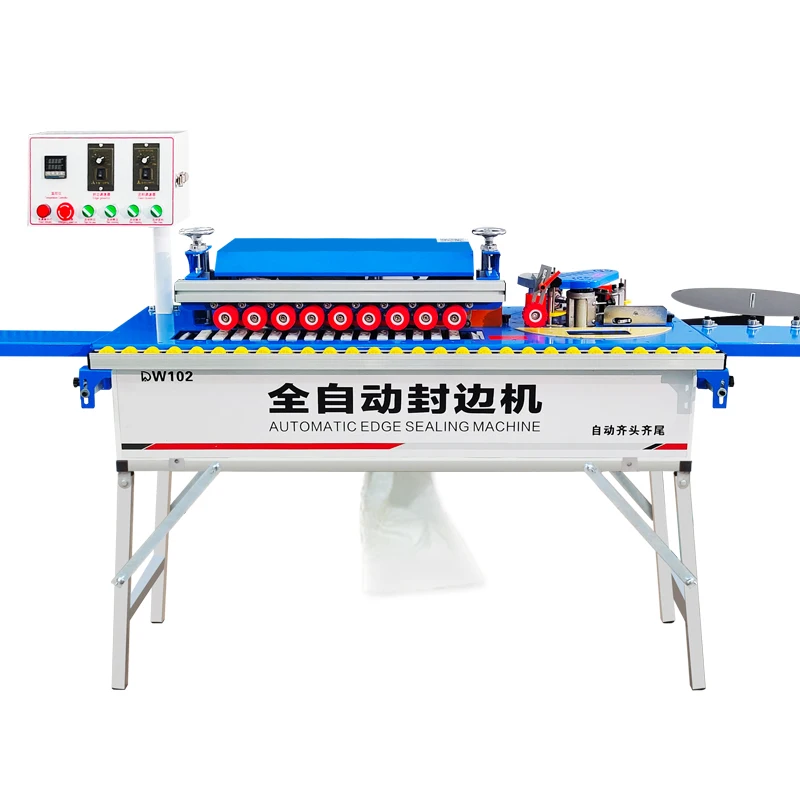
Voltage-First Configuration — every DW102 automatic edge banding machine leaves the factory with electrical parameters matched to the buyer's verified grid supply, eliminating the commissioning delays that occur when voltage and frequency are assumed rather than confirmed.
Technical Specifications
| Parameter |
Value |
| Model |
DW102 |
| Product Type |
Automatic Edge Banding Machine |
| Total Power |
3800W |
| Voltage |
220V/380V/customization |
| Minimum Sheet Length |
25 cm |
| Minimum Sheet Width |
5 cm |
| Edge Banding Height |
0–50 mm |
| Edge Banding Thickness |
0.3–3 mm |
| Edge Power |
20W |
| Transmission Power |
60W |
| Trimming Power |
650W × 2 |
| Polishing Power |
180W × 2 |
| Vacuum Power |
1200W |
| Glue Pot Capacity |
1000 ml |
| Air Source Pressure |
0.5–0.8 MPa |
| Overall Dimensions (L×W×H) |
128 × 47 × 69 cm |
| Net Weight |
75 kg |
| Assembly State |
Standalone / benchtop-class footprint |
| Language Options |
Chinese & English default; monolingual English, Spanish or other languages available on request |
| Plug Options |
EU, USA, AU, UK |
| Key Features |
Curved and straight edge banding, edge trimming, polishing, automatic head and tail cutting, integrated vacuum extraction |
Application Suitability
| Application |
Material or Output |
| Cabinet door edge finishing |
MDF and particleboard panels with PVC edge banding 0.3–3 mm |
| Custom furniture small-batch production |
Plywood and blockboard with polymer edge materials |
| Joinery workshop first automation step |
Straight and curved profiles on wood panels up to 50 mm thickness |
| Polymer door panel edge treatment |
PVC and compatible polymer banding within the stated thickness envelope |
| Prototype and sample panel preparation |
Single-panel runs on mixed substrates including MDF, plywood and particleboard |
Why Voltage Confirmation Must Precede Every DW102 Edge Banding Machine Order
An edge bander specified without a verified electrical match is a production line waiting to stall.
I learned this after a machine arrived at a Colombian workshop with a 380V motor wired for a facility running 220V/60Hz. The motor could not reach operating speed, the trimming stations chattered instead of cutting, and the client spent weeks sourcing a step-up transformer while orders backed up. The DW102 edge banding machine specifications include voltage configurability between 220V and 380V, but that range only protects the buyer when the destination grid is confirmed before production begins [NEED_CITE: voltage and frequency standards by export market]. Frequency mismatches are equally damaging — a 50Hz motor on a 60Hz supply overspeeds and overheats, while the reverse leaves trimming and polishing stations underpowered.

How the DW102 Edge Banding Machine Specifications Map to Selection Decisions
Technical buyers shortlisting equipment on paper need every parameter expressed in measurable terms. The DW102 edge banding machine specifications define the material envelope — 0.3–3 mm banding thickness, 0–50 mm panel height, minimum sheet dimensions of 25 cm by 5 cm — so a workshop can confirm whether its typical panel sizes fall within the machine's working range before committing to a purchase order.
Trimming and Polishing Station Configuration
The dual 650W trimming motors and dual 180W polishing motors represent a complete trim-and-finish cycle in a single pass. For a production manager comparing models, the combined station layout means the panel exits the machine with edges trimmed flush and surfaces polished, without requiring a secondary finishing step. This matters when throughput depends on minimizing the number of handling points between the edge bander and the assembly bench [NEED_CITE: typical panel furniture production workflow stages].
Reading the Numbers That Define Edge Quality
The 0.3–3 mm edge banding thickness range determines which PVC and polymer materials the machine can feed and bond. Thinner banding around 0.3 mm suits lightweight cabinet internals, while 3 mm covers exposed furniture edges that receive impact during use. The 1000 ml glue pot capacity supports continuous runs on small to medium batches without frequent refilling, and the 0.5–0.8 MPa air source pressure requirement defines the compressor specification the workshop must already have in place. The integrated 1200W vacuum system handles chip extraction at the machine level, reducing reliance on a central dust collection system in smaller workshops where space limits ductwork runs.
The Cost of Skipping the Specification Cross-Check
When a buyer selects an edge bander based on price alone and discovers afterward that the panel thickness range does not match their board stock, the machine sits idle while they source a different model. Language mismatches on the control panel delay commissioning further — an operator who cannot read the interface cannot adjust glue temperature or feed rate, and the first production run yields scrap instead of finished panels [NEED_CITE: operator interface language requirements in machinery export]. These failures are preventable when specification verification happens at the quotation stage rather than at the receiving dock.
What Manufacturing Depth Means for This Machine
The DW102 is built within a product family that spans entry-level to full-function pre-milling models, so a workshop scaling production can move to a higher-tier machine from the same manufacturer without retraining service staff on a new platform. Voltage and plug customization are standard rather than special-order options, meaning a buyer in a 220V/60Hz market receives a machine configured for their grid without an intermediary transformer. A four-stage quality process covers incoming material inspection through pre-shipment testing, and every machine ships with a factory test record run on the buyer's specified substrate. Engineering support is available to recommend configuration based on the buyer's panel mix and production volume, with formal quotations typically issued within one working day.
Documentation & Verification
- Machine specification sheet confirming DW102 voltage, frequency and plug type for your destination market
- Electrical schematic with voltage confirmation document issued before production begins
- Factory test record showing trim and polish results on your sample substrate and edge material
- Operation and maintenance manual delivered in the agreed language at the time of shipment
- Spare parts list with part numbers matching the as-built DW102 configuration
Installation, Commissioning & Support
- Benchtop-class footprint at 128 × 47 × 69 cm allows placement against a workshop wall without a dedicated foundation pad
- Dedicated circuit required matching the confirmed DW102 voltage, with the 3800W total power draw verified against local breaker ratings
- Ships as a standalone unit at 75 kg — two personnel can position it without overhead lifting equipment
- First-run commissioning includes setting air source pressure within the 0.5–0.8 MPa range and verifying glue pot temperature for the specified banding material
- Control panel language confirmed before build so the operator interface matches the workshop's working language on arrival
Before You Request a Quotation
To configure a DW102 that matches your line, share your typical panel substrate and thickness range, the edge banding material and thickness you run most often, and a photo of your workshop distribution board nameplate showing voltage and frequency. If your operation uses a language other than Chinese or English, specify the required control panel language so the interface is built accordingly.
Frequently Asked Questions
Q: How do I confirm the DW102 feed speed and station configuration match my production volume?
A: Share your typical panel dimensions, daily batch volume and substrate mix. The engineering team will assess whether the DW102 working envelope and station layout align with your throughput requirement or whether a higher-tier model in the same product family is more appropriate.
Q: What voltage and frequency details must I confirm before the DW102 is built?
A: Provide a photo of your facility's main distribution board nameplate showing voltage, phase and frequency. The machine is configured to match — whether 220V/60Hz, 380V/50Hz or another combination — and a voltage confirmation document is issued before production.
Q: Which control panel languages are available beyond the default Chinese and English?
A: Monolingual Spanish and other languages are available on request. The language is set during production so the operator interface arrives in the correct language, avoiding commissioning delays caused by unreadable menus and parameter labels.
Q: What substrates and edge materials fall within the DW102 working range?
A: The machine handles MDF, blockboard, particleboard, plywood and polymer door panels with PVC or compatible polymer edge banding from 0.3 to 3 mm thick and up to 50 mm in height, covering most cabinet and custom furniture edge finishing requirements.
Q: How does the DW102 footprint and weight affect workshop installation?
A: At 128 × 47 × 69 cm and 75 kg, the machine occupies a benchtop-class footprint suitable for compact workshops. It requires a dedicated electrical circuit matching the confirmed voltage and an air compressor capable of sustaining 0.5–0.8 MPa pressure.