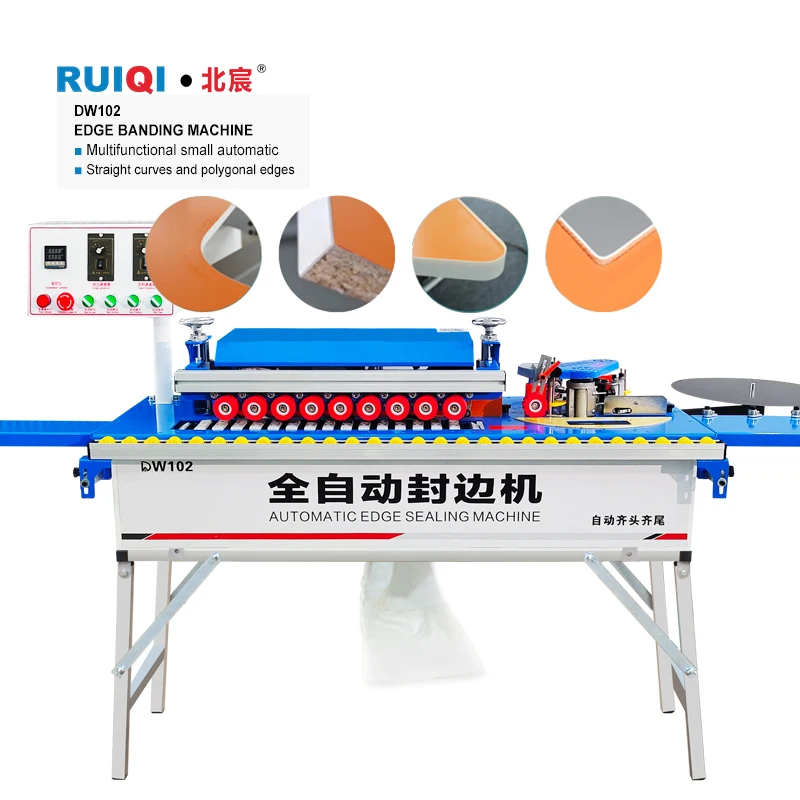
Voltage Customization as Standard — the DW102 edge bander ships with confirmed electrical specifications matched to your facility before production begins, eliminating commissioning failures caused by mismatched power supplies.
Technical Specifications
| Parameter |
Value |
| Model |
DW102 |
| Product Type |
Edge Banding Machine |
| Total Power |
3800W |
| Voltage Options |
220V / 380V / customization available |
| Trimming Power |
650W × 2 |
| Polishing Power |
180W × 2 |
| Vacuum Power |
1200W |
| Transmission Power |
60W |
| Edge Power |
20W |
| Glue Pot Capacity |
1000ml |
| Edge Banding Thickness Range |
0.3–3mm |
| Edge Banding Height Range |
0–50mm |
| Minimum Sheet Length |
25cm |
| Minimum Sheet Width |
5cm |
| Air Source Pressure |
0.5–0.8 MPa |
| Machine Dimensions |
128 × 47 × 69 cm |
| Machine Weight |
75 kg |
| Key Features |
Curved and straight edge banding, edge trimming, polishing, automatic head and tail cutting, vacuum hold-down |
Application Suitability
| Application |
Material or Output |
| Custom cabinet door edging |
MDF and plywood panels with PVC or melamine edge banding |
| Small-batch curved furniture components |
Blockboard and solid wood panels up to 50mm edge height |
| Workshop-scale panel finishing |
Particleboard shelving and carcass parts for bespoke joinery |
| Polymer door edge processing |
Polymer composite panels requiring curved and straight trimming |
Why the Voltage Question Must Come Before the Price on Any Edge Banding Machine Specifications Sheet
Confirming local voltage and frequency before ordering prevents a machine from arriving electrically incompatible with your workshop supply.
I once saw a compact edge bander sit idle for weeks on a factory floor because the buyer focused entirely on the purchase cost and skipped the electrical verification step. The machine was wired for a three-phase 380V supply, but the workshop only had single-phase 220V available at that station. Rewiring the facility cost more than the machine itself. [NEED_CITE: voltage and frequency standards by export market] When you are evaluating edge banding machine specifications, the voltage line in the table is not a formality — it determines whether the unit can power on at all.
Mapping the DW102 Power Distribution to Workshop Constraints
The 3800W total power draw is split across trimming, polishing, vacuum, and transmission stations rather than concentrated in a single spindle motor. The dual 650W trimming motors provide adequate torque for trimming PVC and thin wood veneer on MDF substrates, while the 180W polishing motors handle final surface finishing without burning the edge. For a small workshop running on a limited electrical panel, this distributed load means the edge banding machine specifications should be reviewed against your available circuit capacity before installation.
Air Supply and Minimum Panel Dimensions in Practice
The 0.5–0.8 MPa air pressure requirement drives the pneumatic cylinders for head and tail cutting and the vacuum hold-down system. A compressor delivering stable pressure within this band is necessary for consistent edge placement. [NEED_CITE: pneumatic supply requirements for woodworking edge banders] On the material side, the 25cm minimum sheet length and 5cm minimum width define the smallest offcut this machine can process — useful to know if your production includes narrow drawer sides or small cabinet dividers that would otherwise require manual edge finishing.
How Trimming and Polishing Stations Shape Edge Quality
The two-station trimming setup with 650W motors per head addresses both the leading and trailing edges in a single pass. This matters when processing curved panels, where the grain direction changes continuously and a single trimming pass would leave tear-out on one side. The 0.3–3mm edge thickness range covers standard PVC, ABS, and thin wood veneer banding materials commonly used in custom furniture. Edge banding machine specifications often list this range without context — the practical implication here is that 3mm solid wood edging is the upper boundary, and heavier veneer profiles would need a different machine class.

The Cost of Skipping Specification Verification
When a technical buyer approves an order based on a brochure without requesting a factory test on their actual substrate, the first sign of trouble appears during installation. Glue lines become visible on high-density particleboard because the glue pot temperature was never matched to the board's surface absorption rate. Panels fail during assembly because the trimming tolerance was never verified against the material. These are not warranty claims — they are specification gaps that could have been closed with a pre-shipment test record. [NEED_CITE: edge quality defects from unverified machine-substrate pairing]
Why Source This Edge Bander Through Ruiqi
In-house manufacturing with patented cutting mechanisms means the trimming heads on the DW102 are produced and inspected under one roof, not assembled from third-party sub-contracts. The four-stage QC process covers incoming material inspection through to pre-shipment functional testing, so each unit is verified before crating. Voltage and control panel language are configured per order, not selected from a fixed menu. An engineer reviews your production requirements and issues a formal quotation with confirmed specifications within 24 hours. Factory visits are welcomed for buyers who want to witness the machine running their own panel stock before committing.
Documentation & Verification
- CE declaration of conformity specific to the DW102 configuration
- Machine specification sheet confirming your selected voltage and frequency
- Electrical schematic with circuit diagram matching the delivered unit
- Factory test record on your specified panel material and edge banding type
- Operation and maintenance manual in the language your operators use
Installation, Commissioning & Support
- 128 × 47 × 69 cm footprint requires a level floor area with clearance for panel infeed and outfeed
- Dedicated circuit matching the confirmed 220V or 380V supply with appropriate breaker rating for the 3800W total draw
- Machine ships fully assembled; connect pneumatic supply at 0.5–0.8 MPa and electrical supply on arrival
- Initial parameter setup covers glue pot temperature, feed rate, and trimming depth for your substrate
- Trimming and polishing consumables identified in the spare parts list for early reorder planning
Before You Request a Quote
To match the DW102 to your production accurately, share the panel materials you process most frequently, the edge banding type and thickness you run, and your facility voltage and frequency. If your workshop handles both straight and curved components, note the approximate ratio so the configuration can account for changeover frequency. Specify the operator language for the control panel and whether you need documentation in the same language.
Frequently Asked Questions
Q: How do I determine the correct voltage and plug type for my region?
A: Share your facility's supply voltage, phase configuration, and frequency with the engineering team before order confirmation. The DW102 supports 220V and 380V configurations with customization available for other regional standards. The machine is built and wired to match your confirmed specification, and the electrical schematic provided reflects the delivered configuration exactly.
Q: What are the practical limits of the 25cm by 5cm minimum panel dimensions?
A: These minimums define the smallest workpiece the vacuum hold-down and feed system can grip reliably. Narrow drawer sides, small shelf brackets, and cabinet dividers within these dimensions can be processed. Panels smaller than these thresholds will not feed consistently and should be edge-finished by hand or on a dedicated small-parts station.
Q: How does the 1000ml glue pot capacity affect production scheduling?
A: A 1000ml glue pot suits batch-style production with intermittent pauses rather than continuous high-volume runs. For full-day production on large orders, plan scheduled refills into your workflow to avoid glue starvation mid-batch. The refill interval depends on the edge thickness, panel perimeter, and glue application rate set during commissioning.
Q: What spare parts should I stock for the trimming and polishing stations?
A: The trimming and polishing stations use consumable cutters and buffing wheels that wear with use. A spare parts list is included with the machine identifying these items by part number. Ordering a starter set of trimming blades and polishing wheels with the initial shipment reduces downtime when first replacements are needed.
Q: How can I verify edge finishing quality on curved versus straight panels before shipment?
A: Request a factory test using samples of your actual panel material and edge banding. The test should include both straight and curved cuts to demonstrate trimming consistency across changing grain directions. Pre-shipment verification covers glue adhesion, trimming cleanliness, and polishing finish on both geometries before the machine is packed.