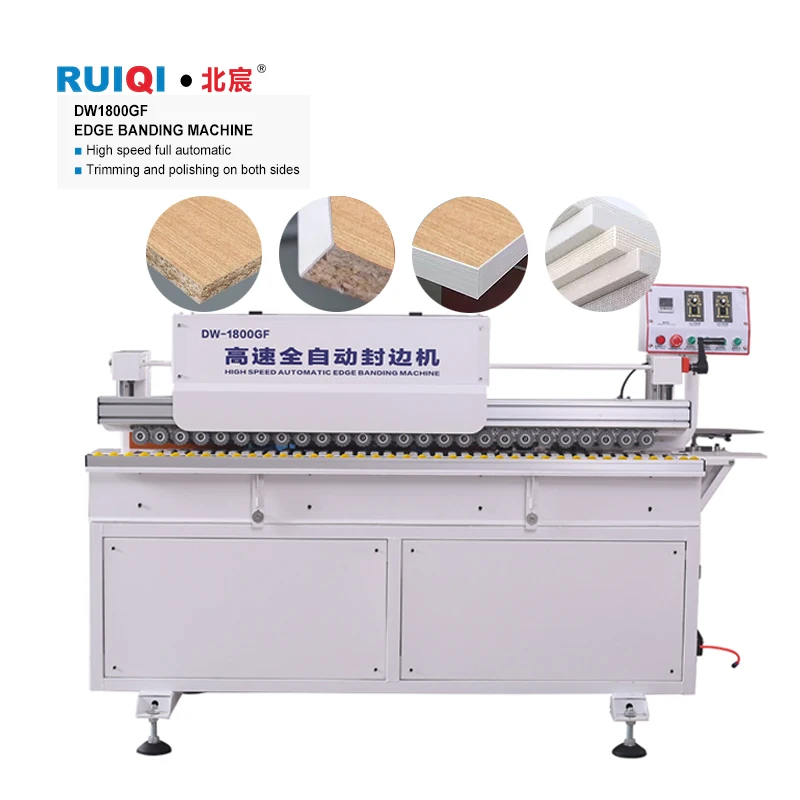
Verified tolerance and power configuration — The DW1800 edge bander holds ±0.02mm trimming accuracy through proprietary cutting mechanisms, backed by factory test records covering your exact panel thickness before dispatch.
Technical Specifications
| Parameter |
Value |
| Model |
DW1800 |
| Product Type |
Automatic Edge Banding Machine |
| Total Power |
4.9 kW |
| Voltage & Frequency Options |
380V / 220V / 415V (50/60 Hz to be confirmed) |
| Feed Speed |
0–14 m/min |
| Edge Banding Thickness Range |
0.3–3 mm |
| Edge Banding Height Range |
0–50 mm |
| Minimum Panel Length |
20 cm |
| Minimum Panel Width |
10 cm |
| Trimming Motors |
800 W × 2 at 24,000 r/min |
| Polishing Motors |
380 W × 2 |
| Transmission Power |
180 W |
| Edge Feed Power |
160 W |
| Vacuum Power |
550 W |
| Glue Pot Capacity |
4,000 ml |
| Air Source Pressure |
0.4–0.6 MPa |
| Overall Dimensions (L×W×H) |
220 × 65 × 125 cm |
| Net Weight |
320 kg |
| Control Language Options |
Chinese, English (other languages customizable) |
| Plug Options |
EU, USA, AU, UK |
| Assembly State |
Fully assembled |
| Key Features |
Double-sided gluing, top and bottom trimming, top and bottom polishing, front and rear alignment, flexible edge scraping, dust extraction |
Application Suitability
| Application |
Material or Output |
| Cabinet door edge finishing |
MDF and melamine-faced particleboard with PVC edge banding |
| Custom furniture panel processing |
Plywood and ABB boards with veneer strips 0.3–3 mm thick |
| Workshop-scale panel production |
Solid wood panels and organic glass plates for joinery projects |
| Shelving and carcass edging |
Particleboard substrates requiring double-sided glue application |
Why Voltage Confirmation Must Come Before the Quotation
Machines that arrive with the wrong voltage sit idle for weeks while transformers are sourced or motors are swapped — a delay no production schedule can absorb.
I have stood in workshops in Lagos where a brand-new edge bander was plugged into a 220V single-phase supply while the motor plate read 380V three-phase. The contactor tripped within minutes. The operator assumed the machine was defective. In reality, the purchase order was placed without anyone verifying the facility's incoming supply. The DW1800 Automatic Edge Banding Machine specifications sheet gives you three voltage options — 380V, 220V, and 415V — but selecting the correct one requires knowing your local frequency as well. [NEED_CITE: voltage and frequency standards by export market] A 380V motor wound for 50 Hz will overheat on a 60 Hz supply even if the voltage matches, because the magnetic flux density shifts outside its design envelope. This is why the specification confirmation step in the ordering process exists: to lock down voltage, frequency, and plug type before the machine enters assembly.

Matching Feed Rate to Your Upstream Panel Saw
The 0–14 m/min feed speed range on this Automatic Edge Banding Machine is not just a maximum number — it is a dial that synchronizes with your cutting station. If your sliding table saw produces twelve panels per minute at a given size, setting the feed rate too low creates a bottleneck at the bander infeed. Setting it too high means the glue roller cannot maintain uniform transfer, and you start seeing starved glue lines on the trailing edge. The variable speed control lets the operator find the exact throughput match after the first few test panels.
Trimming Motor Rating and Edge Finish Quality
Clean edge trimming depends on motor power and spindle speed working together. The dual 800 W trimming motors running at 24,000 r/min cut through PVC and veneer banding without chipping the substrate edge. On MDF, a lower spindle speed tends to tear the fiber rather than shear it, leaving a rough surface that requires extra sanding downstream. [NEED_CITE: MDF edge trimming surface finish requirements] The 24,000 r/min rating places the DW1800 in a range where both rigid PVC and thin melamine strips can be trimmed in a single pass without secondary handwork.
Reading the Specs That Actually Affect Assembly
Edge banding thickness coverage from 0.3 to 3 mm means this machine handles the full material spectrum a typical furniture factory encounters. Thin 0.3 mm melamine requires precise pressure roller adjustment to avoid crushing, while 3 mm solid PVC demands more from the trimming cutters and additional polishing time. The 4,000 ml glue pot capacity supports extended production runs — on a typical 2 mm PVC job at moderate feed speeds, the pot sustains continuous operation before requiring a refill, reducing thermal cycling that degrades adhesive performance. The air source requirement of 0.4–0.6 MPa is standard for pneumatic pressure rollers and scraper actuation, but workshops in regions with undersized compressors should verify their supply volume, not just pressure. Insufficient air volume causes the pressure rollers to pulse, leaving periodic marks on softer edge materials.
What Happens When Panel Size and Machine Range Do Not Align
I visited a carpentry shop that purchased a compact edge bander for small drawer components, then tried feeding full wardrobe side panels through it. The 220 cm bed length handled the panels physically, but the 10 cm minimum width specification was ignored when they attempted to edge narrow cleats. The feeding chain could not grip the material, and the panels drifted into the trimming station misaligned. Every Automatic Edge Banding Machine specification sheet lists minimum panel dimensions for a reason — they represent the physical limits of the conveyor and pressure system. Running material outside those limits does not just produce bad edges; it risks jamming the feed chain and damaging the trimming cutters. [NEED_CITE: edge bander minimum panel dimensions and feed chain engagement]
Why Procurement Verification Stops Here
The manufacturer operates an in-house production facility with patented cutting mechanisms, meaning the DW1800 is not rebranded from a third-party assembler. The four-stage quality control process — incoming material inspection, in-process checks, finished product verification, and pre-shipment testing — includes a factory test record run on your specified panel thickness and edge material. Voltage, control language, and plug configuration are confirmed as standard customization options, not afterthought add-ons. The engineer-led configuration process delivers a formal quotation with confirmed specifications rather than a catalog price list, reducing the chance of receiving equipment mismatched to your facility. [NEED_CITE: ISO 9001 quality management system for machinery manufacturing]
Documentation & Verification
- CE declaration of conformity covering the DW1800 edge bander safety requirements
- Factory test record using your specified panel thickness and edge banding material
- Electrical schematic with confirmed voltage, frequency, and motor wiring diagram
- Machine specification sheet listing all trimming and polishing motor ratings
- Operation and maintenance manual in your operator's confirmed language
- Spare parts list with part numbers for trimming cutters, glue rollers, and scraper blades
Installation, Commissioning & Support
- Requires a dedicated 4.9 kW circuit at the confirmed voltage with proper grounding
- Overall footprint of 220 × 65 cm plus operator clearance and infeed/outfeed space
- Arrives fully assembled — commissioning involves pneumatic connection at 0.4–0.6 MPa and power-up
- First-run parameter setting includes feed speed calibration and trimming depth adjustment
- Glue pot heating element requires a warm-up cycle before the first production panel enters
- Dust extraction port must be connected to a shop vacuum system rated for fine MDF particulate
Preparing Your Inquiry
To receive an accurate configuration for the DW1800, provide your primary panel materials and edge banding types, along with your daily production volume. Confirm your facility's incoming voltage and frequency so the correct motor winding is installed. Specify your preferred control panel language and plug type to eliminate on-site modifications after delivery.
Frequently Asked Questions
Q: How do I confirm the correct voltage configuration before placing an order?
A: Check your facility's main distribution board for the available phase and voltage, then confirm the frequency with your local utility. The DW1800 supports 380V, 220V, and 415V configurations, but the frequency must also be specified. The supplier provides an electrical schematic with the confirmed motor winding details before production begins, giving your electrician the documentation needed to verify compatibility.
Q: How does the 0–14 m/min feed speed relate to my existing panel saw output?
A: Calculate your saw's average cycle time per panel, then determine how many panels per minute reach the banding station. Set the DW1800 feed speed to match that rate. Running faster than your upstream supply starves the infeed; running slower creates a queue. The variable speed control allows fine adjustment during the first production shift to find the balanced throughput point.
Q: What effect do the dual trimming stations have on edge quality across different materials?
A: The two 800 W trimming motors at 24,000 r/min handle both the top and bottom edges in one pass. On MDF, this spindle speed produces a clean shear cut without fiber tearing. On plywood, the same speed prevents veneer splintering at the exit point. The flexible edge scraping station that follows removes any residual burr, reducing the need for manual finishing on both material types.
Q: What air supply does the DW1800 need for stable pneumatic operation?
A: The machine requires compressed air at 0.4–0.6 MPa delivered through a dedicated line. Beyond pressure, verify that your compressor can sustain adequate volume — undersized compressors cause pressure drops when multiple pneumatic actuators cycle simultaneously. This results in inconsistent pressure roller contact and uneven glue transfer. A receiver tank upstream of the machine helps buffer these demand fluctuations.
Q: How do I cross-check the panel and edge banding range against my material schedule?
A: Compare your thinnest and thickest edge banding materials against the 0.3–3 mm range, and your panel dimensions against the 20 cm minimum length and 10 cm minimum width. If any material in your schedule falls outside these boundaries, flag it during the inquiry stage. The specification sheet and factory test record should cover your actual material range before the machine ships.