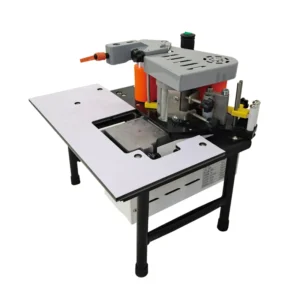
Station-Level Power Transparency — every trimming, polishing and transmission motor rating is published so you can verify capacity against your panel substrate before committing to an order.
Technical Specifications
| Parameter |
Value |
| Model |
DW400 |
| Product Type |
Manual Edge Banding Machine |
| Rated Power |
3800W |
| Voltage & Frequency |
220V/380V/customization |
| Trimming Motor Power |
650W × 2 |
| Polishing Motor Power |
180W × 2 |
| Transmission Motor Power |
60W |
| Edge Banding Motor Power |
20W |
| Vacuum Power |
1200W |
| Edge Banding Thickness |
0.3–3mm |
| Edge Banding Height |
0–50mm |
| Minimum Sheet Length |
25cm |
| Minimum Sheet Width |
10cm |
| Air Source Pressure |
0.5–0.8 MPa |
| Glue Pot Capacity |
1000ml |
| Overall Dimensions (L×W×H) |
116 × 47 × 69 cm |
| Net Weight |
70kg |
| Language Options |
Chinese, English, Spanish or other languages customizable |
| Plug Options |
EU, USA, AU, UK |
| Assembly State |
Fully assembled, wooden case packed |
| Standard Functions |
Straight edge banding, trimming, polishing |
Application Suitability
| Application |
Material or Output |
| Cabinet door and carcass edge finishing |
Medium density fiberboard, particleboard |
| Custom furniture small-panel processing |
Plywood, blockboard |
| Polymer door profile edging |
Polymer door panels |
| Joinery workshop production runs |
Wood panels with PVC or veneer edge banding |
Why Voltage Must Be Locked Before Edge Banding Machine Specifications Are Finalized
A machine wired for the wrong supply will not run, and rewiring on site delays commissioning by weeks.
I once watched a fully automatic edge bander sit idle in a Dubai workshop for over twenty days because the contract listed 380V while the facility ran 415V at 50Hz. The transformer tripped on first start-up, panels piled up on the floor, and the client lost an entire production cycle. That incident reshaped how I approach every quotation — voltage and frequency confirmation now comes before any discussion of feed speed or trimming power [NEED_CITE: voltage and frequency standards by export market]. When evaluating edge banding machine specifications, the electrical compatibility check should be the first gate, not an afterthought tagged onto the shipping documents.

Mapping Motor Ratings to Substrate Hardness
The DW400 allocates 650W to each of its two trimming motors, which provides adequate torque for cleanly shearing PVC and thin laminate banding on MDF and particleboard substrates. When you move to denser materials such as blockboard or plywood with resin-impregnated veneer, the trimming motors must sustain load without stalling, and the published wattage lets you calculate that margin before purchase. Comparing edge banding machine specifications at the individual station level, rather than relying on total rated power alone, reveals whether a given model can handle your specific material mix throughout a full shift.
Compressed Air as a Continuous Demand, Not a Peak Rating
The 0.5–0.8 MPa air supply requirement means your workshop compressor must sustain that pressure band continuously, not just reach it momentarily. In smaller joinery shops I have visited, an undersized compressor causes the pressure cylinder on the trimming station to hesitate mid-pass, leaving a visible step on the banding edge. Verify your compressor's duty cycle and tank reserve against the DW400's demand curve, especially if other pneumatic tools share the same line [NEED_CITE: pneumatic system sizing for woodworking workshops]. A dedicated regulator at the machine inlet prevents pressure dips from affecting banding quality.
Tolerance Verification Through Published Dimensions
The minimum sheet dimensions of 25cm length and 10cm width define the smallest cabinet component this machine can process, which directly affects whether a joinery shop can handle drawer fronts and narrow filler strips without reverting to hand trimming. The 0–50mm edge banding height range covers standard 18mm board stock as well as thicker worktop profiles. Cross-referencing these edge banding machine specifications against your actual cut list prevents the situation where a machine arrives and immediately encounters panels it cannot accept.
The Hidden Cost of Overlooking Station-Level Power Allocation
When a buyer evaluates only total rated power, an underpowered polishing station may go unnoticed until finished panels show micro-scratches on high-gloss PVC banding. I have seen workshops attempt to compensate by slowing feed rate, which then creates a bottleneck at the trimming station and extends cycle times across the entire batch. The DW400's 180W × 2 polishing motors and 60W transmission motor are listed individually so that production managers can match each station's capacity to their material and quality requirements. Discovering a power deficit after installation means either living with inconsistent edge quality or investing in a replacement machine entirely [NEED_CITE: edge finishing defects caused by insufficient polishing power].
Why Procurement Through a Specification-Focused Channel Matters
Every DW400 leaves the facility with a factory test record run on the buyer's specified panel thickness and banding material, so performance is verified before crating. Voltage and plug configuration — EU, USA, AU, or UK — are confirmed against the buyer's electrical schematic before production begins, eliminating the on-site rewiring scenario I described earlier. The operation and maintenance manual is produced in the operator's agreed language, whether English, Spanish, or another option, ensuring commissioning is not delayed by translation gaps. A four-stage quality control process covers incoming material inspection through pre-shipment verification. Engineer-led configuration recommendations are provided within 24 hours of inquiry, matching machine capability to actual workshop requirements rather than pushing a default package.
Documentation & Verification
- CE declaration of conformity covering the DW400 manual edge banding machine
- Factory test record on your specified panel thickness and banding material before dispatch
- Electrical schematic confirming voltage, frequency, and plug type for your facility
- Operation and maintenance manual in your operator's confirmed language
- Spare parts list with trimming and polishing motor specifications for local sourcing
Installation, Commissioning & Support
- Position the 116 × 47 × 69 cm unit on a level floor with clearance for panel infeed and offfeed
- Connect to a dedicated circuit matching confirmed voltage — 220V or 380V as specified at order
- Machine ships fully assembled; place on workshop floor and connect power and air supply
- Set glue pot temperature and trimming depth during first run using your actual panel stock
- Verify 0.5–0.8 MPa air pressure stability with a gauge at the machine inlet before production begins
- Replace trimming blades and polishing pads per the maintenance schedule in the supplied manual
What to Include With Your Inquiry
Provide your panel material type, thickness range, and the edge banding stock you intend to use so the configuration can be matched to your process. Confirm your facility voltage, frequency, and preferred plug type to prevent electrical incompatibility on arrival. Specify the control panel language your operators require, and indicate whether you need a factory test run on your actual material before shipment.
Frequently Asked Questions
Q: How can I verify the trimming and polishing motor power is sufficient for my panel material?
A: Request the station-level motor breakdown — the DW400 lists 650W × 2 for trimming and 180W × 2 for polishing — and compare these against your substrate hardness and banding thickness. If you process dense blockboard with thick veneer, confirm with the engineer that these ratings sustain continuous load without feed rate reduction.
Q: What voltage and plug configuration should I specify for my workshop?
A: Check your facility's supply voltage and frequency before ordering. The DW400 supports 220V or 380V with customization available, and plug options include EU, USA, AU, and UK standards. Provide the exact values so the electrical schematic is confirmed before production begins.
Q: Does the 25cm × 10cm minimum sheet size limit small cabinet component processing?
A: The DW400 accepts panels as small as 25cm long and 10cm wide, which covers most drawer fronts, shelf brackets, and filler strips. If your production includes narrower components, confirm with the engineer whether an auxiliary fixture can extend the workable range.
Q: What compressor capacity is needed to maintain 0.5–0.8 MPa continuously?
A: Your compressor must sustain 0.5–0.8 MPa at the machine inlet throughout the production shift, not just at peak. Install a dedicated regulator and check the compressor duty cycle rating, especially if other pneumatic tools share the same air line in your workshop.
Q: Can the control panel language be matched to my operator's preference?
A: The DW400 supports Chinese, English, Spanish, and other customizable language options. Specify the required language at inquiry stage so the manual and control panel labels are prepared accordingly and verified during the pre-shipment inspection.


![DW802 Automatic Edge Banding Machine | Technical Guide 记录 ID 14183,数字和为 1+4+1+8+3=17 17 mod 6 = 5,对应句式:[站点修饰词] [品类词] – [规格或产能限定] 角色:技术选型类,池=[Specifications, Technical Guide, Model Selection],长度 3 17 mod 3 = 2,选中:Model Selection 草稿:Model Selection Automatic Edge Banding Machine – DW802 4200W PVC MDF 字符数:66](https://ruiqiwoodmachine.com/wp-content/uploads/2026/05/H9322a2861acd4beb869461711bad6c51H-1-300x300.webp)