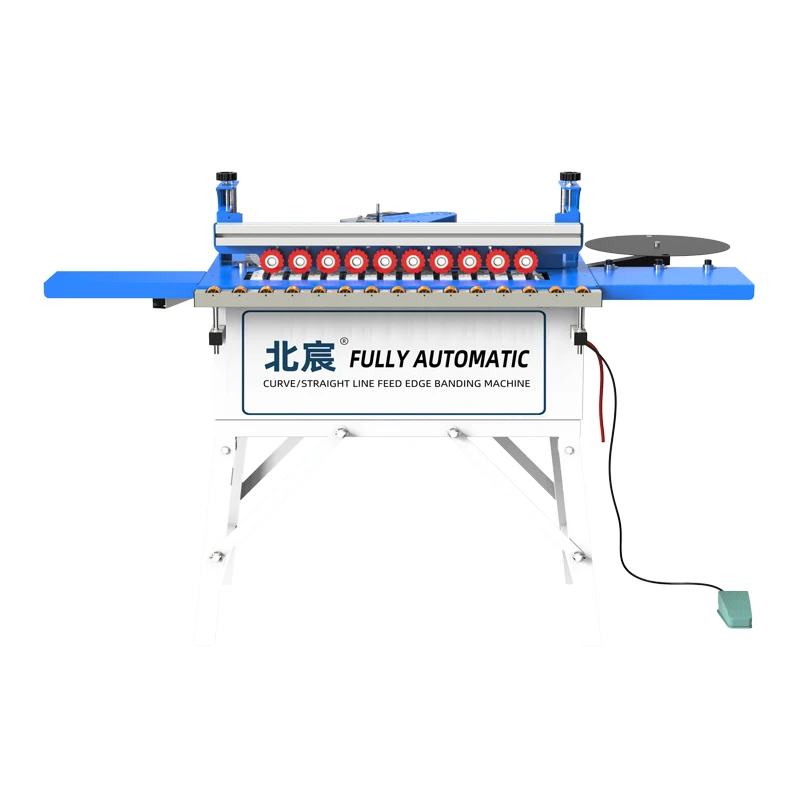
Engineer-Led Configuration Review — Every quotation for the DW770 is checked against your actual voltage, control language, and panel feed height before the machine leaves the factory, eliminating the most common cause of commissioning delays.
Technical Specifications
| Parameter |
Value |
| Model |
DW770 |
| Product Type |
Automatic Mini Edge Banding Machine |
| Rated Power |
1200 W |
| Voltage & Frequency |
220 V (frequency to be confirmed at order) |
| Overall Dimensions (L × W × H) |
77 × 49 × 45 cm |
| Net Weight |
51 kg |
| Panel Minimum Length |
25 cm |
| Panel Minimum Width |
3 cm |
| Edge Banding Height |
0–50 mm |
| Edge Banding Thickness |
0.3–3 mm |
| Edge Trimming Power |
20 W |
| Air Supply Requirement |
0.5–0.8 MPa |
| Tape Feeding Mode |
Fully automatic tape feeding |
| Glue Pot Capacity |
1000 ml |
| Standard Features |
Curved and straight edge banding |
| Feed Speed |
(basis to be confirmed) |
| Panel Thickness Range |
(basis to be confirmed) |
| Tolerance |
(basis to be confirmed) |
| Language Options |
Chinese and English, customizable to other languages |
| Plug Options |
EU, USA, AU, UK |
Application Suitability
| Application |
Material or Output |
| Cabinet door and drawer front banding |
MDF and particleboard with 0.4–2 mm PVC edge |
| Small-radius curved panel trimming |
Plywood and shaped MDF with veneer or PVC tape |
| Joinery workshop short-run production |
Solid wood panels with thin veneer edge banding |
| Small-part furniture component finishing |
Narrow stock down to 3 cm width and 25 cm length |
What "Plug and Play" Really Means When You Unbox a Mini Edge Bander
A machine that runs on day one is one whose voltage, plug, control language, and air pressure were confirmed before it shipped.
The DW770 Automatic Mini Edge Banding Machine specifications look compact on paper, but I have watched small workshops lose entire shifts chasing a compressor that could not hold the required 0.5 MPa, or staring at a control screen written in a language the operator never learned to read. These are not engineering failures — they are specification gaps that should have been closed at the quotation stage. When a technical buyer selects a compact bander, the risk is not the machine's capability; it is the invisible mismatch between what the workshop can supply and what the machine demands [NEED_CITE: common commissioning delays in imported woodworking machinery].

Matching Air Supply to Pneumatic Demand
The DW770 requires a steady 0.5–0.8 MPa from your shop compressor to hold the pressure roller and trimming cylinder in position throughout each pass. If your existing compressor is sized only for nail guns or blow-off nozzles, the pressure drops below the minimum during continuous cycling and the edge tape begins to lift at the trailing end. Before committing to this Automatic Mini Edge Banding Machine, verify that your compressor delivers the required pressure at the flow rate the machine draws during sustained operation.
Panel Minimum Dimensions Define Your Real Production Envelope
A 25 cm minimum length and 3 cm minimum width set the lower boundary of what this machine can physically grip and feed through the banding station. Small-part production — drawer sides, shelf brackets, narrow divider strips — often falls below these limits on competing units, forcing operators to gang pieces together or trim by hand afterward. If your cutting list includes components near or below these dimensions, you need to know this before the machine arrives, not after your first batch fails to feed [NEED_CITE: minimum workpiece dimensions and feeding mechanics in edge banding].
Reading the Glue Pot and Banding Thickness Together
The 1000 ml glue pot and the 0.3–3 mm banding thickness range work as a pair. A full pot at the correct temperature maintains a stable melt viscosity long enough to complete a batch without reheating mid-run, while the thickness range tells you which PVC and veneer tapes the feed mechanism and pressure roller can handle. Thicker 3 mm PVC demands more glue and higher roller pressure than 0.4 mm veneer, so the Automatic Mini Edge Banding Machine specifications must be evaluated against the actual tape you stock in your workshop.
Tolerance, Substrate, and Downstream Assembly
Edge banding tolerance on MDF behaves differently than on plywood because the substrate density and surface porosity change how the glue penetrates and how the trimming cutter engages. A tolerance value stated without naming the test substrate is incomplete. Request the factory test record for the specific panel material you run most often, and measure the banded edge yourself before approving the shipment [NEED_CITE: edge banding tolerance measurement methods across panel substrates].
The Hidden Cost of Skipping Voltage Confirmation
A 220 V machine shipped to a facility wired only for 110 V single-phase will not start, and rewiring the workshop or running a dedicated transformer adds cost and delay that the original quotation never included. Confirm your facility's voltage, phase, and frequency at the inquiry stage so the electrical schematic and motor winding match your supply from the moment the machine is plugged in.
Why Source This Configuration Here
In-house manufacturing with a proprietary cutting mechanism keeps tolerance verifiable at the factory rather than left to third-party assembly. The four-stage quality control process includes a pre-shipment test on your specified panel and edge material, producing a documented result you can review before the crate closes. Voltage, plug type, and control language are configured as standard line items, not aftermarket add-ons, so the machine you receive matches the environment it enters. Engineer-led configuration review ensures the quotation reflects your actual workshop conditions rather than a default build.
Documentation & Verification
- Machine specification sheet confirming DW770 feed speed, panel thickness range, and tolerance values
- Electrical schematic and voltage confirmation matched to your facility supply
- Factory test record showing edge banding output on your specified panel and tape material
- Operation and maintenance manual delivered in your operator's language before shipment
- CE declaration of conformity and ISO 9001 certificate included with shipping documents
Installation, Commissioning & Support
- Requires a flat floor area of roughly 77 × 49 cm with clear access on the feed and exit sides
- 220 V single-phase supply on a dedicated circuit rated above 1200 W to prevent voltage drop
- Arrives fully assembled; only air hose connection and glue pot loading needed before first run
- First-cycle glue temperature and feed speed verified against your panel stock during commissioning
- Spare edge trimming cutter and glue pot seal included for early maintenance intervals
Requesting a Configuration Proposal
Provide your most common panel substrate, edge tape material and thickness, and the voltage and frequency at your facility so the quotation reflects a build you can commission immediately. If your cutting list includes parts near the 25 cm × 3 cm minimum, share those dimensions so we can confirm feed stability before production begins.
Frequently Asked Questions
Q: What feed speed does the DW770 achieve, and how does it compare to full-size edge banders for throughput planning?
A: Feed speed for the DW770 is confirmed on the machine specification sheet and depends on the banding thickness and panel substrate in your application. As a compact unit, it is designed for short-run and small-part production rather than continuous high-volume output, so throughput planning should be based on your actual batch sizes rather than a peak line-speed figure.
Q: Can the 220 V supply be customized to other voltages or three-phase configurations for different markets?
A: Voltage and plug configuration are confirmed at the quotation stage. The standard build is 220 V single-phase with EU, USA, AU, or UK plug options. If your facility operates on a different voltage or requires three-phase power, specify this in your inquiry so the motor winding and electrical schematic are adapted before assembly begins.
Q: What is the verified edge banding tolerance on MDF and particleboard substrates?
A: Tolerance is documented in the factory test record, which is run on your specified panel material before dispatch. MDF and particleboard differ in density and glue absorption, so the verified value depends on the substrate you actually process. Request the test record as part of your pre-shipment documentation package.
Q: How do I match glue pot temperature and banding material selection to my panel substrate?
A: The 1000 ml glue pot temperature must be set according to the hot-melt adhesive recommended for your edge tape material — PVC, ABS, or veneer each have different optimal melt points. The operation manual provided in your language includes a temperature reference table, and the factory test record confirms the setting used for your sample panels before shipment.
Q: What control panel language options are available, and can the interface be customized before shipment?
A: The DW770 ships with Chinese and English control interfaces as standard. Additional languages can be configured during production if specified at the quotation stage. Confirming the operator's language before the machine is built prevents the commissioning delays I have seen when an unreadable screen halts the first production run.