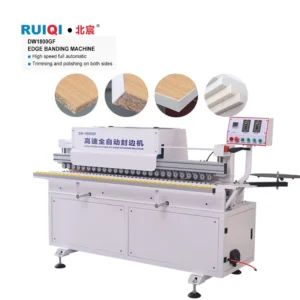
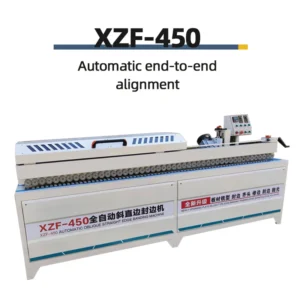
Specification-first configuration — every power rating, voltage option, and dimensional limit verified before the quotation is issued, eliminating on-site commissioning surprises for the DW802 edge bander.
Technical Specifications
| Parameter |
Value |
| Model |
DW802 |
| Product Type |
Automatic Edge Banding Machine |
| Total Power |
4200W |
| Voltage |
220V / 380V / customization available |
| Feed Speed |
(basis not stated in source) |
| Minimum Sheet Length |
25 cm |
| Minimum Sheet Width |
10 cm |
| Edge Banding Height Range |
0–50 mm |
| Edge Banding Thickness Range |
0.3–3 mm |
| Trimming Power |
800W × 2 motors |
| Polishing Power |
180W × 2 motors |
| Edge Power |
140W |
| Transmission Power |
140W |
| Vacuum Power |
1200W |
| Glue Pot Capacity |
4000 ml |
| Air Source Pressure |
0.4–0.8 MPa |
| Conveyor Belt Material |
Silica gel |
| Overall Dimensions (L×W×H) |
130 × 60 × 95 cm |
| Net Weight |
135 kg |
| Panel Materials |
MDF, particleboard, solid wood board, ecological board, plywood |
| Language Options |
Chinese and English standard; additional languages available on customization |
| Plug Options |
EU, USA, AU, UK |
| Key Features |
Edge banding, trimming, polishing, automatic head and tail cutting, vacuum assist |
Application Suitability
| Application |
Material or Output |
| Custom furniture panel edge sealing |
MDF and particleboard with PVC or melamine edge banding |
| Small-scale cabinet door production |
Plywood and ecological board with veneer strips up to 3 mm |
| Home decoration workshop processing |
Solid wood board straight-edge sealing at bench scale |
| Joinery startup transitioning from manual to machine |
Mixed panel substrates in short batch runs |
Why "Edge Banding Machine Specifications" Must Be Verified Before You Sign
A quoted spec sheet only matters if every value is confirmed against your actual panel substrate, local voltage, and operator language before production begins.
I spent years on the service side before moving into technical sales, and the most expensive machine failures I witnessed were not mechanical — they were specification mismatches discovered after the crate was opened. A workshop in the Yangtze Delta region received an edge bander wired for a voltage frequency that did not match their supply; the machine sat idle for weeks while a transformer was sourced [NEED_CITE: voltage and frequency standards by export market]. The DW802 automatic edge bander is configurable across voltage, plug type, and control language, but those configurations must be locked in writing before the build starts. When buyers skip the edge banding machine specifications verification step, the cost of correction falls entirely on the production schedule.

Matching Trimming and Polishing Power to Your Substrate
The DW802 allocates 800W to each of two trimming motors and 180W to each of two polishing stations. On dense MDF, dual 800W trimming motors maintain clean cuts through the full 0.3–3 mm edge banding thickness range without bogging down at feed transitions. Particleboard behaves differently — its lower density means trimming requires less peak torque, but surface tear-out along the glue line demands that polishing wheels engage with consistent pressure. Reviewing these edge banding machine specifications against your primary substrate determines whether the factory default tooling will hold tolerance or whether alternative trimming blades should ship with the machine.
Glue Pot Capacity and Continuous Run Planning
A 4000 ml glue pot on the DW802 sets the boundary for how long the machine runs between refills during a production batch. For a workshop running short custom cabinet runs, this capacity typically covers a full shift without interruption. Larger batch environments processing hundreds of linear meters of edge banding per day will need to schedule refill intervals to avoid cold glue joints [NEED_CITE: hot melt adhesive open time and temperature stability]. Confirming the glue type and its working temperature against the DW802's heating system before shipment prevents mid-run adhesion failures on the shop floor.
How Core Specifications Translate to Production Outcomes
The 0–50 mm edge banding height range and 0.3–3 mm thickness range define the material envelope the DW802 can physically process. If your schedule includes 2 mm PVC for cabinet carcasses and 0.6 mm melamine for shelving, both fall within this envelope — but the trimming tool setup differs between the two. The 0.4–0.8 MPa pneumatic requirement means the machine needs a compressor capable of sustaining pressure at the upper range when multiple pneumatic actuators cycle simultaneously; an undersized compressor causes intermittent trimming faults that look like machine defects but are actually air supply starvation. The silica gel conveyor belt provides grip on smooth-faced panels like melamine-coated MDF, reducing slippage at the infeed. Tolerance values for the DW802 are not published in the current specification sheet (basis not stated in source), so requesting a factory test record on your specific panel and edge banding combination is the only way to verify dimensional accuracy before the machine leaves the floor.
The Hidden Cost of Skipping Pre-Delivery Verification
I once saw a small furniture workshop receive an edge bander with control panel labels entirely in a language the operators could not read. Commissioning stalled for days while translated overlays were produced locally — days of lost production on a machine that was mechanically ready to run [NEED_CITE: operator interface language requirements in industrial machinery exports]. When the pneumatic supply was later found to fall below the machine's minimum pressure threshold, the trimming station began leaving ragged edges on PVC banding, and the team spent weeks blaming the machine rather than the compressor. These are not rare edge cases; they are the direct result of treating edge banding machine specifications as a formality rather than a verification checklist.
Why Technical Buyers Source the DW802 Here
In-house manufacturing with patented cutting mechanisms means the DW802's trimming assembly is built and tested under one roof, not assembled from third-party sub-components with unclear provenance. Voltage and plug configuration from 110V to 440V with EU, USA, AU, and UK plug options are confirmed at the quotation stage, not guessed at the packing stage. The four-stage quality control process covers incoming material inspection through pre-shipment verification, so the machine you receive matches the specification sheet you approved. Engineer-led configuration recommendations arrive within 24 hours of your inquiry, meaning the technical review happens before the commercial commitment. Factory visits are welcomed for buyers who want to witness a test run on their own panel material before issuing the purchase order.
Documentation & Verification
- Machine specification sheet with verified DW802 power ratings and dimensional limits for your records
- Electrical schematic confirming voltage, frequency, and plug type matched to your facility supply
- Factory test record running your specific panel substrate and edge banding material before dispatch
- Operation and maintenance manual provided in the language specified at the order stage
- Spare parts list with part numbers for trimming blades, polishing wheels, and glue pot components
- CE declaration of conformity and ISO 9001 certificate included with customs documentation
Installation, Commissioning & Support
- The DW802's 130 × 60 × 95 cm footprint requires a level floor with clearance on the infeed and outfeed sides for panel handling
- Confirm a dedicated circuit matching the confirmed voltage and the 4200W total power draw before the machine arrives
- Shipped fully assembled; position, level, and connect pneumatic supply at 0.4–0.8 MPa before first power-on
- Initial commissioning includes trimming blade alignment verification and glue temperature calibration for your edge banding material
- Trimming blades and polishing wheels are wear items; the spare parts list identifies replacements to stock from day one
Before You Request a Quotation
Send your primary panel material type, typical panel dimensions, and the edge banding material and thickness you run most often. Confirm your facility voltage, frequency, and plug type, along with the language your operators need on the control panel. If you are integrating the DW802 into an existing line, share the upstream panel saw model and downstream boring station so the feed characteristics can be evaluated for throughput compatibility.
Frequently Asked Questions
Q: What is the verified edge banding tolerance on MDF versus particleboard for the DW802?
A: Tolerance values for the DW802 are not published in the current specification sheet (basis not stated in source). The only way to obtain a verified tolerance figure is to request a factory test record run on your specific panel substrate and edge banding material combination before the machine ships.
Q: Which voltage and frequency configurations are confirmed before production begins?
A: The DW802 supports 220V, 380V, and custom voltage configurations with EU, USA, AU, and UK plug options. Your local voltage and frequency are confirmed in writing at the quotation stage, and the electrical schematic is included in the documentation package to verify the match before dispatch.
Q: How is the control panel language specified, and can it change after delivery?
A: Chinese and English are standard on the DW802; additional languages are available through customization at the order stage. Language configuration is locked before production. Post-delivery changes may require a control system update, so confirming operator language requirements early avoids commissioning delays.
Q: What panel thickness range does the DW802 accept given the 0–50 mm edge banding height limit?
A: The 0–50 mm figure describes the edge banding strip height the machine can apply, not the panel thickness capacity. Panel thickness range for the DW802 is not stated in the current specification sheet (basis not stated in source) and should be confirmed with the factory against your actual panel schedule.
Q: How do I confirm the DW802 throughput matches my downstream CNC boring station?
A: Feed speed for the DW802 is not published in the current specification sheet (basis not stated in source). Share your downstream station model and target batch size at the inquiry stage so the engineering team can evaluate line throughput compatibility and flag any potential bottleneck before the order is placed.

![【目标站角色】:ruiqiwoodmachine.com → SPECIFICATION AND SELECTION → 技术选型类角色 【修饰词池】:Specifications / Technical Guide / Model Selection 【记录ID数字之和】:1+4+1+8+9 = 23 【句式结构】:23 % 6 = 5 → [站点修饰词] [品类词] – [规格或产能限定] 【修饰词选取】:23 % 3 = 2 → Model Selection JT160 Sliding Table Saw with Edge Banding – Model Selection](https://ruiqiwoodmachine.com/wp-content/uploads/2026/05/H4aa4463034de438483fbbf76b1e49b3aF-1-300x300.webp)