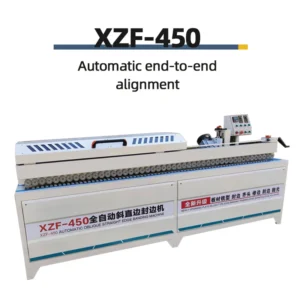
Edge banding machine
Wood Based Panels Edge Banding Machine | Specifications
XZF450 Automatic Edge Banding Machine, 9.5 kW Total Power, 0-12 m/min Feed...
View Details<p><strong>XZF-450 Automatic Edge Banding Machine, 9.5KW, 0.3-3mm Edge Thickness, 0-12m/min Feed Speed</strong> — delivers seven integrated stations from pre-milling to polishing in a single pass.</p> <ul> <li>Pre-milling at 4KW ensures clean substrate prep; 30°/45°/60° edge profiling supports MDF, plywood, particleboard and melamine panels</li> <li>Configurable voltage (380V/415V) and multilingual control panels match local installation requirements</li> </ul> <p>Backed by four-stage QC with pre-shipment verification and formal engineering quotation within 24 hours.</p>
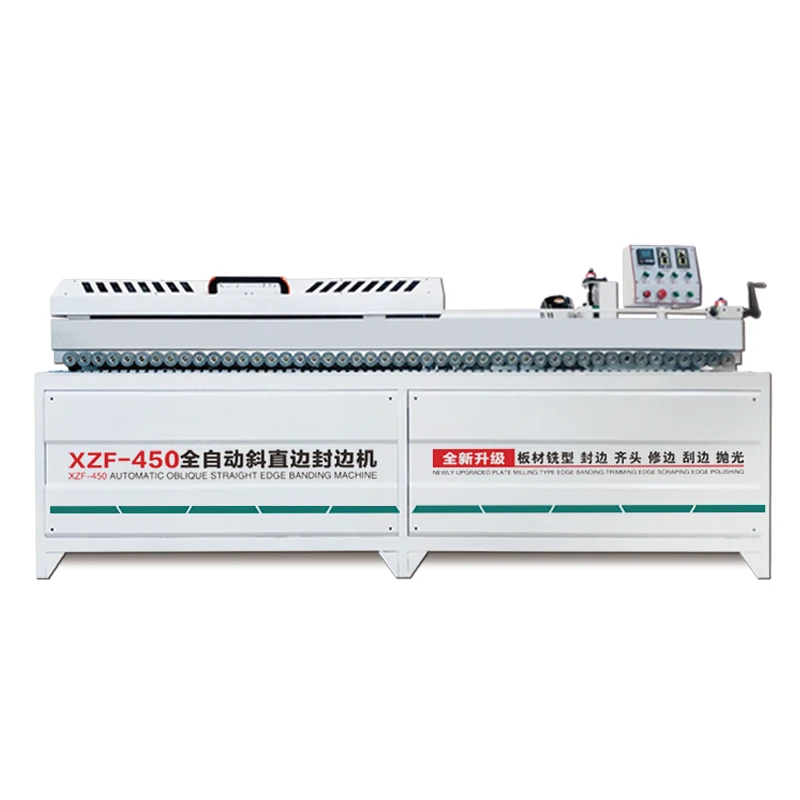
<p><strong>XZF-450 Automatic Edge Banding Machine, 9.5KW, 0.3-3mm Edge Thickness, 0-12m/min Feed Speed</strong> — delivers seven integrated stations from pre-milling to polishing in a single pass.</p> <ul> <li>Pre-milling at 4KW ensures clean substrate prep; 30°/45°/60° edge profiling supports MDF, plywood, particleboard and melamine panels</li> <li>Configurable voltage (380V/415V) and multilingual control panels match local installation requirements</li> </ul> <p>Backed by four-stage QC with pre-shipment verification and formal engineering quotation within 24 hours.</p>
Quality Assured
Multi-stage QC inspection
Custom Config
Voltage, logo, language
Global Shipping
100+ countries served
After-Sales Support
Remote & spare parts
Precision-Ground Mechanisms — verified tolerance achieved through in-house machining and four-stage QC on every XZF-450 before dispatch.
| Parameter | Value |
|---|---|
| Model | XZF-450 |
| Product Type | Automatic Edge Banding Machine |
| Total Power | 9.5 kW |
| Voltage | 380V / 415V (configurable) |
| Pre-milling Motor | 4 kW |
| Trimming Power | 2.2 kW × 2 |
| Polishing Power | 0.4 kW × 2 |
| Edge Feed Power / Speed | 0.16 kW / 0–12 m/min |
| Transmission Power / Speed | 180 W / 0–12 m/min |
| Vacuum Power | 550 W |
| Edge Banding Height | 0–50 mm |
| Edge Banding Thickness | 0.3–3 mm |
| Minimum Sheet Length | 30 cm |
| Minimum Sheet Width | 15 cm |
| Glue Pot Capacity | 4000 ml |
| Air Source Pressure | 0.5–0.7 MPa |
| Product Size | 300 × 65 × 135 cm |
| Product Weight | 430 kg |
| Standard Functions | Plate milling, 30/45/60° edge banding, trimming, scraping, polishing, high-power vacuuming |
| Control Panel Language | Chinese and English (other languages customizable) |
| Plug Options | EU, USA, AU, UK |
| Application | Material or Output |
|---|---|
| Cabinet door and carcase edge finishing | MDF, melamine-faced board, particleboard |
| Custom furniture panel processing | Plywood, blockboard, solid wood board |
| Polymer door edge profiling | Polymer composite panels with PVC or veneer banding |
| Bevel-edge joinery components | 30°/45°/60° angled edge banding on wood-based substrates |
Confirming local supply voltage and frequency eliminates the single most common cause of machine idle time after arrival.
I once worked with a panel processor who received a 380V unit at a site wired for 415V three-phase. The motor contactors tripped repeatedly during the first week, and the glue pot never reached stable temperature. The edge banding quality suffered — visible glue lines, poor adhesion on particleboard edges — and the workshop lost days before an electrician re-tapped the transformer. Asking about automatic edge banding machine specifications only makes sense once your site voltage is locked in [NEED_CITE: voltage and frequency standards by export market].
The XZF-450 runs at 0–12 m/min with independent transmission and edge feed drives. On melamine-faced MDF, operators typically set the feed closer to the upper range because the substrate is dimensionally stable and the pre-milled surface accepts glue evenly. Particleboard with higher moisture content demands a slower pass — t*edge before the pressure roller sets the banding. This Automatic Edge Banding Machine gives you that adjustability without changing mechanical stops.
Pre-milling, 30/45/60° edge application, end trimming, rough and fine trimming, scraping, and polishing all happen sequentially on a single conveyor bed. The 4 kW pre-milling motor removes saw marks and surface irregularities before the glue station, which matters when your panels arrive from a sliding table saw with minor tear-out. Skipping pre-milling on plywood often leaves a visible ridge under thin PVC banding — something the scraping and polishing stages alone cannot correct [NEED_CITE: woodworking surface preparation standards for edge adhesion].
Edge banding height of 0–50 mm and thickness of 0.3–3 mm covers standard PVC, ABS, and wood veneer tapes used in cabinet production. The 4000 ml glue pot holds enough EVA hot-melt for extended runs without frequent refill interruptions. Air consumption at 0.5–0.7 MPa drives the pneumatic pressure rollers and trimming cutters — undersized compressors cause the trimming stations to chatter, leaving witness marks on the workpiece edge. The 550 W vacuum system captures dust at the milling and trimming zones; without extraction, fine MDF dust accumulates on the polishing wheels and re-deposits on finished panels.
When a buyer orders an edge bander without specifying panel thickness range or edge material, the machine may arrive with pressure rollers set for 2 mm PVC while the factory actually runs 0.4 mm veneer. The result is crushed veneer edges and rejected panels. Similarly, control panels shipped in a language the operator cannot read delay commissioning — the crew guesses at glue temperature settings, and adhesion failures appear weeks later in the field. These are not machine defects; they are specification gaps that surface only after installation [NEED_CITE: machinery operator interface language requirements].
In-house manufacturing with patented cutting mechanisms means the pre-milling and trimming spindles are built and tested on-site, not outsourced as generic assemblies. Voltage and plug configuration — EU, USA, AU, UK — are confirmed at order stage so the machine arrives wired for your panel. The four-stage QC process runs each XZF-450 through actual panel stock before crating, generating a factory test record you can review. Engineer-led configuration starts with your material list and daily volume, not a catalogue default. Multilingual control panels are set before shipment, matching the operators who will run the line.
Send your typical panel material, thickness range, and the edge banding tape you use most often. Include your local voltage and frequency so the electrical system is built to match. If you run multiple edge profiles — straight, 45° bevel, or contoured — note which stations you need active. A sample panel shipped to the factory allows a test run on your actual substrate before the machine is finalized.
Q: How do I confirm the 0–12 m/min feed speed suits my edge banding material? A: Thicker PVC and ABS tapes generally run well at higher feed speeds because they resist deformation under the pressure rollers. Thin wood veneer requires slower feeds to prevent cracking at the trimming stage. The XZF-450 transmission and edge feed drives are independently adjustable, so you can fine-tune both to your specific material combination during commissioning.
Q: What happens if my site voltage does not match the standard 380V/415V? A: Voltage and frequency must be confirmed before production begins. The XZF-450 electrical system is configurable, and the correct transformer tapping, motor winding, and control components are installed at the factory. Shipping a machine set for the wrong voltage leads to motor overheating, contactor failure, and inconsistent glue temperature.
Q: Can the control panel display a language other than Chinese or English? A: Yes, the control interface supports additional languages by request. Specify your preferred language at the quotation stage so the HMI software is loaded and tested before dispatch. Operators working in a familiar language reduce setup errors and respond faster to fault codes during production.
Q: Does the XZF-450 handle my minimum panel size? A: The machine accepts sheets as short as 30 cm and as narrow as 15 cm. Panels below these dimensions may not engage all conveyor rollers simultaneously, which affects feed stability. For very small offcuts, a manual edge banding approach or a dedicated small-part fixture is typically recommended instead.
Q: How does the 30/45/60° edge banding option affect assembly quality? A: Bevel edge banding at 45° or 60° is common for cabinet doors and decorative panels where angled joints meet. The XZF-450 applies banding at these angles in the same automated pass as straight edges, maintaining consistent glue coverage and trimming accuracy across all profiles your joinery requires.
20+ Years Experience
Trusted by 100+ countries worldwide
Full OEM/ODM
Custom logo, voltage & panels
Lifetime After-Sales
12-month warranty + spare parts
25-45 Day Lead Time
Flexible MOQ, on-time delivery
Fill in your requirements and our team will respond with a formal quotation within 24 hours. We speak English and Spanish.
Response within 24 hours on business days
Or WhatsApp us for instant reply
Serving 100+ countries globally
XZF450 Automatic Edge Banding Machine, 9.5 kW Total Power, 0-12 m/min Feed...
View DetailsProducts DescriptionXZF450 45 degree full-automatic edge banding machine has 7 functions. including...
View DetailsST-50 Portable Edge Banding Machine, 0.3–3mm banding thickness, 220V/380V, curved and straight...
View DetailsDW-3600GF Fully Automatic Edge Banding Machine, 380V, 4.9 kW, 0–14 m/min Feed...
View DetailsOur global sales team is ready to assist. Get a formal quotation, technical specs, and OEM/ODM options within 24 hours.