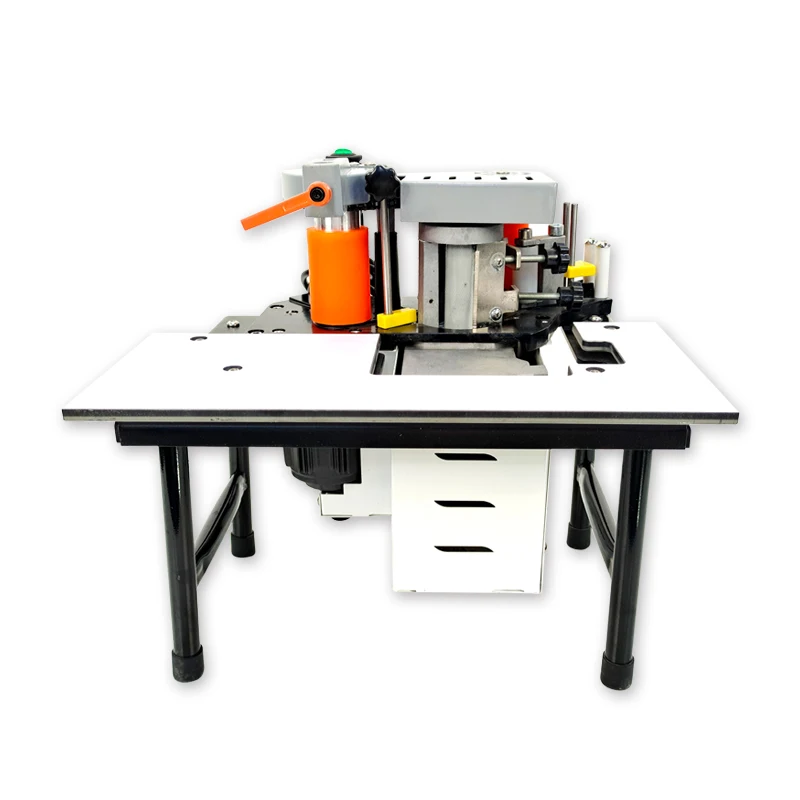
Voltage-Confirmed Before Shipment — every XC01 / ST-30 portable edge banding machine leaves the factory with an electrical schematic matched to the buyer's local grid, eliminating the three-week transformer delay that stalls production lines.
Technical Specifications
| Parameter |
Value |
| Model |
XC01 / ST-30 |
| Product Type |
Portable Manual Edge Banding Machine |
| Total Power |
1000W |
| Voltage |
220V / 380V / customization available |
| Edge Type |
Curved and straight edge banding |
| Minimum Sheet Length |
25 cm |
| Minimum Sheet Width |
3 cm |
| Edge Banding Height |
0–50 mm |
| Edge Banding Thickness |
0.3–3 mm |
| Edge Power |
20W |
| Air Source Pressure |
0.5–0.8 MPa |
| Glue Pot Capacity |
1000 ml |
| Product Size |
38 × 35 × 35 cm |
| Product Weight |
12 kg |
| Suitable Edge Banding Tape |
ABS, PVC, Melamine, Veneer |
| Certification |
CE, ISO 9001 |
Application Suitability
| Application |
Material or Output |
| Custom cabinet door edging |
MDF and particleboard with PVC or ABS tape |
| Curved profile furniture components |
Plywood and shaped MDF with melamine tape |
| On-site interior decoration finishing |
Solid wood panels and veneer edge banding |
| Small-batch joinery production |
Mixed substrates with 0.3–3 mm tape thickness |
| Prototype and sample room work |
Short-run panels requiring both curved and straight edges |
Why the Voltage Question Must Come Before the Portable Edge Bander Order
A machine that cannot plug into your workshop's power supply is a 12 kg paperweight until an electrician rewires the shop.
I learned this the hard way after configuring a full automatic edge bander for a custom wardrobe factory without double-checking the local frequency. The unit arrived, the contactor chattered, and the line sat idle while the client arranged a transformer retrofit — three weeks of lost output on cabinet doors alone. With portable edge banding machine specifications, the risk is the same in miniature: a 220V unit shipped to a 380V three-phase site, or a 50 Hz motor running on 60 Hz, will overheat or refuse to start. That is why every XC01 / ST-30 order is cross-checked against the buyer's declared voltage and frequency before the glue pot is filled for the factory test. [NEED_CITE: voltage and frequency standards by export market]
Dual-Profile Capability in a Single Portable Chassis
Most small workshops own separate jigs for straight and curved edges, swapping tooling and losing time between batch runs. The XC01 / ST-30 handles both profiles on one platform, so a cabinetmaker can edge a rectangular shelf and then move to a radius-cornered tabletop without repositioning the workpiece to a different station. This matters when portable edge banding machine specifications are being compared for a shop that handles mixed geometry orders daily.
Glue Pot Sizing Versus Batch Interruptions
The 1000 ml glue pot is sized for continuous short-run work rather than high-volume line production. For a joinery crew banding twenty cabinet doors in a morning, one fill is typically sufficient to complete the batch without pausing to reheat and replenish adhesive. Shops moving to larger volumes can plan refill intervals around the pot capacity rather than discovering mid-shift that the reservoir runs dry every forty minutes. [NEED_CITE: hot melt adhesive open time and pot capacity considerations]
Reading the Numbers That Actually Define Output Quality
Edge banding thickness range from 0.3 mm to 3 mm determines which tape materials the machine can feed without crushing thin veneer or stalling on thick ABS. A 0.3 mm melamine tape requires gentle feed pressure and precise temperature control; a 3 mm PVC tape demands more torque and a wider glue gap. The 0–50 mm height range covers standard 18 mm particleboard as well as thicker worktops, meaning the same unit serves both cabinet carcase panels and kitchen countertop edging. Air source pressure between 0.5 and 0.8 MPa drives the feed rollers and trimming mechanism — too low and the tape drifts during application, too high and thin substrates can chatter against the fence. Minimum sheet dimensions of 25 cm length and 3 cm width set the lower boundary for small offcuts and narrow stile pieces that larger automatic machines cannot grip.

The Hidden Cost of Skipping the Specification Cross-Check
A portable bander bought on price alone often arrives with a control panel in a language the operator cannot read, turning commissioning into a guessing game. Worse, a unit wired for a single voltage leaves the buyer sourcing a step-up transformer or rewiring the workshop circuit — costs that erase any initial savings. When the edge thickness range does not match the tape stock already in the shop, the crew ends up hand-trimming every piece, defeating the purpose of buying a machine in the first place. These are not rare edge cases; they show up repeatedly when portable edge banding machine specifications are reviewed only after the crate is opened. [NEED_CITE: common commissioning failures in imported woodworking machinery]
Why Buyers Source This Model Through Our Configuration Process
Every XC01 / ST-30 is built in-house with a patented cutting mechanism, so tolerance claims can be verified on the factory floor rather than taken on faith. Voltage and plug configuration — EU, USA, AU, UK — are confirmed at the quotation stage, not guessed at packing. The four-stage quality control sequence includes a pre-shipment test run on the buyer's specified tape material, with photographs and a signed test record in the crate. Engineer-led configuration means the recommendation accounts for the substrate mix and daily volume the buyer actually runs, not just the machine's maximum rated capacity. A formal quotation with full portable edge banding machine specifications is typically issued within one working day of receiving the inquiry. [NEED_CITE: CE machinery directive requirements for industrial equipment]
Documentation & Verification
- CE declaration of conformity covering the XC01 / ST-30 portable unit
- Electrical schematic with confirmed voltage, frequency, and plug type for your market
- Factory test record showing edge banding on your specified tape and panel thickness
- Machine specification sheet with all parameter values verified before order confirmation
- Operation and maintenance manual in the language you designate at inquiry stage
- Spare parts list with consumable glue pot and feed roller part numbers identified
Installation, Commissioning & Support
- Requires a dedicated 220V or 380V circuit matching the confirmed configuration; no shared breaker with welding equipment
- Footprint of 38 × 35 × 35 cm fits a standard workbench; ensure 50 cm clearance behind for tape roll loading
- Air compressor must deliver 0.5–0.8 MPa at the machine inlet; install a regulator and moisture trap upstream
- First commissioning includes glue temperature calibration for your specific ABS, PVC, or melamine tape stock
- Glue pot cleaning schedule provided based on 1000 ml capacity and your expected weekly operating hours
- Spare feed rollers and edge trimming blades shipped with the unit for initial replacement cycle
What to Include in Your Inquiry
Send us the panel materials you work with — MDF, particleboard, plywood, or solid wood — along with typical sheet dimensions and the edge tape types in your inventory. Confirm your workshop voltage, phase, and frequency so the correct motor and plug are fitted before dispatch. Let us know the control panel language your operators need, and whether you want a sample test run on your own tape stock before the machine ships.
Frequently Asked Questions
Q: How do I confirm the voltage and frequency match my workshop before ordering?
A: Provide your local supply voltage, phase, and frequency at inquiry stage. We cross-check against the XC01 / ST-30 motor rating and issue an electrical schematic confirming the match. A voltage confirmation document is included in the shipping paperwork so your electrician can verify the circuit before first power-on.
Q: What are the minimum and maximum panel dimensions this machine handles?
A: The XC01 / ST-30 accepts sheets as short as 25 cm and as narrow as 3 cm, with edge banding height from 0 to 50 mm. This covers standard cabinet panels, narrow stiles, and thicker worktop edges. For panels outside this range, a larger stationary edge bander may be needed.
Q: Which edge banding tape materials are compatible with this portable unit?
A: The machine runs ABS, PVC, melamine, and veneer tapes between 0.3 mm and 3 mm thick. Glue pot temperature and feed pressure are adjusted during commissioning to match your specific tape stock, ensuring clean adhesion without scorching thin veneer or under-bonding thick PVC profiles.
Q: How do I choose between 220V and 380V for my workshop setup?
A: Most single-phase small workshops use 220V, while sites with three-phase industrial supply may prefer 380V for balanced loading. We configure the motor and wiring to your declared supply at the order stage. If your site has both options, the 220V version offers simpler plug-and-run setup on a standard outlet circuit.
Q: What language options exist for the control panel and manual?
A: The control panel labels and the operation manual can be produced in the language you specify at inquiry — common requests include English, Spanish, Arabic, and Russian. Confirming this before production avoids commissioning delays caused by unreadable instructions when the machine arrives on site.