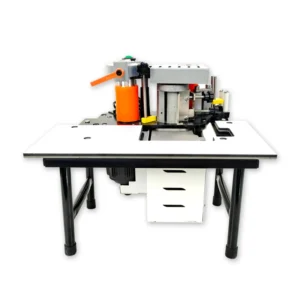
Configurable Voltage Verification — every JL-1 Wood Hinge Boring Machine ships with an electrical schematic matching your confirmed three-phase supply, eliminating the most common cause of motor burnout on export orders.
Technical Specifications
| Parameter |
Value |
| Model |
JL-1 |
| Product Type |
Wood Hinge Boring Machine |
| Total Power |
1.5 kW |
| Voltage & Frequency |
380V/415V three-phase four-wire (configurable from 110V to 440V) |
| Large Drill Diameter |
35 mm |
| Small Drill Diameter |
3 mm |
| Product Size |
70 × 56 × 145 cm |
| Product Weight |
55 kg |
| Guide Rail |
Precision guide rails for sliding |
| Foot Switch Control |
Yes |
| Vacuum Power |
External vacuum connection |
| Language Options |
Chinese and English (other languages customizable) |
| Plug Options |
EU, USA, AU, UK |
| Structure Customization |
Available |
Application Suitability
| Application |
Material or Output |
| Cabinet door hinge cup drilling |
MDF and particleboard panels, 18–25 mm thickness |
| Wardrobe door hinge hole opening |
Plywood and melamine-faced chipboard |
| Small drill dowel positioning |
Solid wood and MDF for cabinet carcass joints |
| Custom furniture hinge boring |
PVC and veneer-edged panels after edge banding |
Why the Voltage Question Should Come Before the Price on Any Wood Hinge Boring Machine
Confirming your workshop supply voltage is the single most important step before committing to a hinge boring machine order.
I spent years commissioning woodworking lines across Southeast Asia, and the pattern is painfully predictable: a machine arrives rated at one voltage, the factory supply reads differently, and the main motor burns out within the first hour of operation. For a small hinge boring unit like the JL-1, a voltage mismatch does not just mean a tripped breaker — it means rewinding or replacing the spindle motor while your cabinet door line sits idle. That is why I now insist on photographing the workshop distribution board nameplate before any configuration is locked in [NEED_CITE: voltage and frequency standards by export market]. The JL-1 Wood Hinge Boring Machine specifications include a baseline 380V/415V three-phase four-wire supply, but this is configurable across a wide range so the unit matches what your panel actually delivers, not what the utility company says it should.

Drill Size Coverage and What It Means for Cabinet Hardware
The JL-1 carries a 35 mm large drill for standard European-style hinge cups and a 3 mm small drill for dowel or pilot holes. This dual-specification setup covers the majority of concealed hinge systems used in modern cabinet and wardrobe production. When comparing Wood Hinge Boring Machine specifications across different suppliers, verify whether the quoted drill sizes match the hinge hardware your assembly line actually uses — switching hinge brands later may require a different cup diameter.
Foot Switch Operation and Repeatable Positioning
Hands-free foot switch control lets the operator load and clamp panels without releasing the workpiece, which matters when you are running batches of identical cabinet doors. The precision guide rail sliding mechanism provides repeatable positioning across consecutive pieces, reducing the drift that causes misaligned hinge cups and rejected panels downstream. This mechanical approach to positioning avoids the cost and complexity of a full CNC system while still delivering the consistency a dedicated hinge boring station requires.
Reading the Power and Footprint Numbers Together
The 1.5 kW total power rating keeps the JL-1 within the capacity of a standard workshop circuit, meaning most small joinery operations can run it without installing a dedicated high-amperage feed. Combined with the 70 × 56 × 145 cm footprint and 55 kg weight, this unit slots into a compact cell between the panel saw and the assembly bench. The external vacuum connection means dust extraction depends on your existing central system or a standalone extractor — the machine does not impose additional electrical load for onboard suction. For production managers matching Wood Hinge Boring Machine specifications to workshop infrastructure, these numbers together define whether the JL-1 fits your floor plan and electrical panel without modification [NEED_CITE: CE machinery directive requirements for industrial equipment].
The Hidden Cost of Underspecified Electrical Documentation
When a boring machine arrives without a confirmed voltage label and a matching electrical schematic, the first sign of trouble is often a tripped thermal overload or a winding that smells of burnt insulation. In my experience coordinating equipment for joinery workshops, the factories that skip this verification step are the same ones losing days to emergency transformer rentals or motor rewind shops. The JL-1 configuration process requires voltage and frequency confirmation before production begins, so the machine that arrives on your floor is built for the electricity your workshop actually has.
Why This Configuration Process Works for Technical Buyers
The engineer-led configuration recommendation means your panel thickness range, hinge hardware type, and production volume are reviewed before a formal quotation is issued — typically within 24 hours. The JL-1 is available with customizable structure, plug type, and control panel language, so the unit that ships matches both your operators and your local electrical code. A four-stage quality check covering incoming material through pre-shipment verification is standard, and factory test records on your specific panel material are available before dispatch. Patented cutting mechanisms across the broader product family reflect the same attention to tolerance that applies here to drill positioning. Factory visits are welcomed if you want to witness the JL-1 running your sample panels before signing off.
Documentation & Verification
- Machine specification sheet listing confirmed drill diameter and positioning parameters for your hinge hardware
- Electrical schematic with voltage and frequency matching your photographed distribution board nameplate
- Factory test record on your specified MDF or particleboard panel thickness before dispatch
- Operation and maintenance manual in the language your operators read, included with shipment
- CE declaration of conformity and ISO 9001 certificate supplied with customs documentation package
- Spare parts list identifying drill bits, guide rail components, and foot switch elements
Installation, Commissioning & Support
- Dedicated 1.5 kW circuit with correct amperage breaker for the confirmed 380V/415V or custom voltage supply
- Level floor placement within the 70 × 56 cm footprint, no special foundation or anchor bolts required
- External vacuum hose connection to your existing dust extraction system before first operation
- Drill head alignment verification and guide rail lubrication during initial commissioning run
- Foot switch and safety interlock function check included in the operator training walkthrough
- Replacement drill bits and guide rail wear parts identified in the included spare parts list
What to Include When Requesting a Quotation
Send a photo of your workshop distribution board nameplate so the voltage and frequency can be confirmed before the JL-1 is configured. Specify the hinge cup diameter your cabinet hardware requires, the panel materials and thickness range you process, and the control panel language your operators need. If you are integrating this unit into an existing saw and edge banding line, note the upstream throughput so the boring station can be matched accordingly.
Frequently Asked Questions
Q: How do I verify drill positioning accuracy before placing an order?
A: Request a factory test record showing the JL-1 boring into your specific panel material and thickness. The test uses your hinge cup diameter and measures hole position against the precision guide rail reference, providing documented tolerance data rather than a general claim.
Q: What voltage options exist beyond the standard 380V/415V supply?
A: The JL-1 is configurable from 110V to 440V across various frequency standards. Provide a photo of your distribution board nameplate during inquiry so the correct voltage, phase, and plug type are confirmed before production begins.
Q: Can the control panel and manual be provided in a language other than English or Chinese?
A: Yes, multilingual control panels and operation manuals are available as part of the standard customization options. Specify your required language during the quotation stage so all documentation ships in the correct version.
Q: What are the external vacuum requirements for dust extraction?
A: The JL-1 connects to an external vacuum system rather than using an onboard extractor. Confirm your workshop dust collection capacity and hose diameter during configuration so the connection matches your existing infrastructure.
Q: How does hinge boring cycle time align with panel saw output?
A: Cycle time depends on panel size, hinge count per door, and operator loading speed. Share your upstream panel saw throughput and the number of hinges per typical door during inquiry so the JL-1 Wood Hinge Boring Machine specifications can be evaluated against your line balance requirements [NEED_CITE: woodworking production line throughput matching principles].