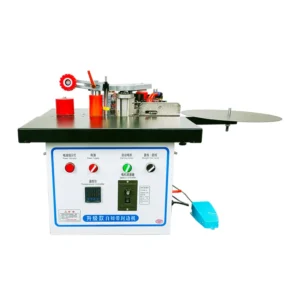
Compact Footprint, Full Finishing — the DW102 manual edge banding machine integrates trimming, polishing, and head-tail cutting into a 75kg unit configured to your workshop's voltage before dispatch.
Technical Specifications
| Parameter |
Value |
| Model |
DW102 |
| Product Type |
Manual Edge Banding Machine |
| Total Power |
3800W |
| Voltage |
220V / 380V / customization available |
| Edge Banding Height Range |
0–50mm |
| Edge Banding Thickness Range |
0.3–3mm |
| Minimum Sheet Length |
25cm |
| Minimum Sheet Width |
5cm |
| Air Source Pressure |
0.5–0.8MPa |
| Glue Pot Capacity |
1000ml |
| Trimming Power |
650W × 2 |
| Polishing Power |
180W × 2 |
| Vacuum Power |
1200W |
| Edge Feed Power |
20W |
| Transmission Power |
60W |
| Product Size |
128 × 47 × 69cm |
| Product Weight |
75kg |
| Key Features |
Curved and straight edge banding, automatic head and tail cutting, integrated trimming and polishing, vacuum assist |
| Control System |
Manual operation |
| Language Options |
Chinese, English (other languages customizable) |
| Plug Options |
EU, USA, AU, UK |
| Assembly State |
Fully assembled |
| Standards |
CE, ISO 9001 |
Application Suitability
| Application |
Material or Output |
| Custom furniture panel edging |
MDF, particleboard, plywood with PVC or veneer banding |
| Cabinet door curved profiles |
Blockboard and solid wood panels with 0.3–3mm edge material |
| Whole-house customization workshops |
Polymer doors and shaped furniture components |
| Small-batch joinery production |
Mixed straight and curved panels down to 25cm × 5cm |
Why the Voltage Question Must Come Before the Quotation
A machine wired for the wrong frequency will not just underperform — it will damage motors and leave your operator stranded with no local recourse.
I worked the assembly floor before moving into technical sales here in Shandong, and one pattern shows up repeatedly in field complaints. A workshop orders a manual edge banding machine based on catalogue specifications, the unit ships, and only at commissioning does the electrician discover the three-phase supply does not match the motor winding [NEED_CITE: voltage and frequency standards by export market]. The glue pot takes longer to reach temperature, the trimming motors run hot, and within weeks the vacuum pump fails. The manual edge banding machine specifications on paper were correct, but the electrical confirmation step was skipped to save time on the order.

Electrical Configuration Matched to Your Grid Before Production
Every DW102 order begins with a confirmed electrical schematic showing voltage, frequency, and plug type matched to the destination market. Whether your workshop runs on 220V single-phase or 380V three-phase, the wiring is set at the factory so the machine arrives ready to connect. This step is non-negotiable in our quotation process because rewinding a motor after arrival costs more than the machine itself in some regions.
Trimming and Polishing Stations That Complete the Edge in One Pass
The dual trimming stations at 650W each remove excess banding material from both top and bottom faces, while the 180W polishing pair cleans the residual glue line to a finish ready for assembly. For workshops handling both PVC and thin veneer materials, the manual edge banding machine specifications include a thickness range from 0.3mm to 3mm — meaning you switch jobs without swapping tooling. The 1000ml glue pot holds enough adhesive for a full shift of intermittent small-panel work without constant refills.
Reading the Numbers That Actually Matter for Small-Panel Work
The 0–50mm edge banding height range covers standard panel thicknesses used in cabinet and furniture production, while the 25cm minimum length and 5cm minimum width define the lower boundary for what the feed mechanism can grip reliably. The 0.5–0.8MPa air pressure requirement drives the pneumatic clamping and head-tail cutting actuators — insufficient pressure causes incomplete cuts on curved sections [NEED_CITE: pneumatic pressure requirements for edge banding actuators]. The 1200W vacuum unit holds the banding strip against the glue surface during manual feeding, which matters most on curved profiles where gravity alone cannot maintain contact. Total connected load of 3800W means the DW102 can typically share a workshop circuit with other small machines, but a dedicated breaker is advisable to prevent voltage drops during trimming motor startup.
What Happens When Specifications Are Ignored at Order Stage
Workshops that skip the voltage and air pressure confirmation often discover problems only after the first production run. The trimming motors overheat on undervoltage, producing chatter marks on the edge instead of a clean cut. Insufficient air pressure causes the automatic head-tail cutter to stall mid-cycle, leaving ragged ends that require manual cleanup and defeat the purpose of mechanization [NEED_CITE: common edge banding defects from inadequate air supply]. The glue pot temperature fluctuates when the heating element operates outside its designed voltage range, leading to inconsistent adhesion across the batch. These are not manufacturing defects — they are specification mismatches that a five-minute conversation before ordering would have prevented.
Why Technical Buyers Choose This Source
In-house manufacturing with patented cutting mechanisms means the trimming stations on the DW102 are built and tested under the same roof, not sourced from a third-party integrator. Four-stage quality control covering incoming material through pre-shipment verification ensures the unit you receive matches the manual edge banding machine specifications confirmed at order. Voltage, plug type, and control panel language are configured before assembly — not adapted after arrival. Engineer-led configuration means the quotation you receive within 24 hours reflects your actual panel dimensions and edge material, not a generic catalogue price. Factory visits are welcome so you can witness the DW102 running on your specified materials before committing to the order.
Documentation & Verification
- CE declaration of conformity covering the DW102 electrical and mechanical safety requirements
- Electrical schematic confirming your specified voltage, frequency, and plug configuration
- Factory test record showing curved and straight edge results on your panel material
- Machine specification sheet detailing trimming motor ratings and air pressure tolerances
- Operation and maintenance manual in your operator's agreed language
- Spare parts list identifying trimming cutters, polishing wheels, and glue pot seals
Installation, Commissioning & Support
- Footprint of 128 × 47 × 69cm requires only a standard workbench area with 0.5m clearance on each side
- Dedicated circuit rated for 3800W total load with the confirmed voltage and breaker specification
- Fully assembled delivery — no on-site mechanical assembly required, only electrical connection and air hose hookup
- First-run parameter setting for glue temperature, feed speed, and trimming depth based on your edge material
- Operator training covering curved-profile feeding technique and pneumatic pressure adjustment
- Spare trimming cutters and polishing wheels included for initial production runs
What We Need to Quote You Accurately
Send us the panel materials you process most often — MDF, particleboard, plywood, or a mix — along with the edge banding thickness range you use. Confirm your local voltage, frequency, and the plug type standard in your market. Tell us whether your operators need the control labels and manual in a language other than English or Chinese. If you have irregular curved profiles beyond standard radii, share a sample drawing so we can verify the DW102 handles the geometry before we issue the formal quotation.
Frequently Asked Questions
Q: How do I match voltage and plug type to my local electrical standard?
A: Confirm your workshop supply voltage, phase, and frequency at the inquiry stage. The DW102 is configurable across 220V and 380V with plug options for EU, USA, AU, and UK markets. An electrical schematic confirming the exact wiring is provided before production begins, so there are no surprises at commissioning.
Q: What panel dimensions and edge banding thicknesses does the DW102 accept?
A: The unit handles panels from 25cm minimum length and 5cm minimum width, with edge banding heights from 0 to 50mm. Edge material thickness runs from 0.3mm veneer up to 3mm PVC. Both curved and straight profiles are supported within these ranges.
Q: Can the operation manual and control labels be provided in my operator's language?
A: Chinese and English are standard, with other languages available on request. The manual covers daily operation, glue pot maintenance, trimming adjustment, and troubleshooting — all written for the operator rather than the engineer. Confirm your language preference when placing the order.
Q: What air supply pressure is required and how does it affect edge quality?
A: The DW102 requires 0.5–0.8MPa clean, dry air to operate the pneumatic clamping and head-tail cutting functions. Pressure below the minimum causes incomplete cuts on curved sections, while excessive pressure accelerates seal wear. A basic filter-regulator on your compressor line protects the pneumatic components.
Q: How can I verify edge trimming and polishing performance before shipment?
A: A pre-shipment factory test runs the DW102 on sample panels matching your specified material and edge thickness. The test record documenting trimming finish and polishing quality ships with the machine. Factory visits for live witness testing are also arranged on request.

![FX-20 Portable Mini Automatic Edge Banding Machine | Technical Guide 记录 ID 数字和:1+0+3+3+7=14 14 mod 6 = 2 → 句式:[品类词] [机型号或规格] | [站点修饰词] 14 mod 3 = 2 → 修饰词:Model Selection (技术选型池第 3 个) 字符数:67 (含空格)](https://ruiqiwoodmachine.com/wp-content/uploads/2026/05/Hbccc1a81daf24c7bb35fb4f2b45d1a10n-1-300x300.webp)