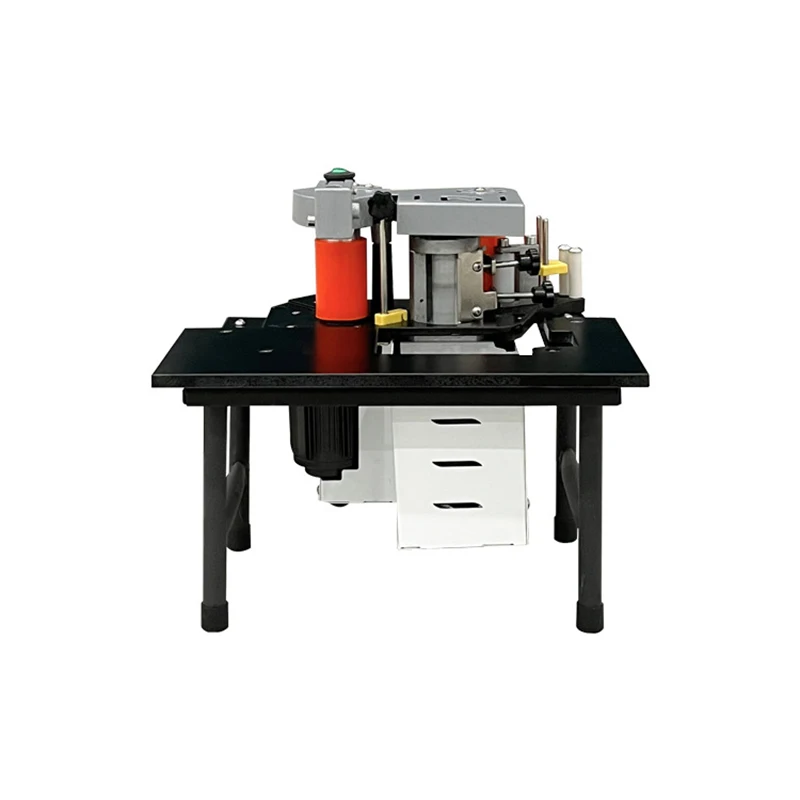
Verified Tolerance Data — every portable edge bander we ship leaves with a factory test record showing measured deviation on your specified panel thickness, so you know the numbers before the crate arrives.
Technical Specifications
| Parameter |
Value |
| Product Type |
Portable Edge Banding Machine |
| Shape of Edge-banding Plates |
Curved, Straight and Special-shaped Sheet |
| Edge Thickness Range |
0.3–3 mm |
| Edge Sealing Speed |
0–6 m/min |
| Edge Sealing Height |
7–60 mm |
| Gluing Method |
Double-sided gluing |
| Glue Pot Volume |
1000 ml |
| Machine Weight |
14 kg |
| Feed Speed |
0–6 m/min |
| Warranty |
One year |
Application Suitability
| Application |
Material or Output |
| Small joinery workshop edge finishing |
MDF and plywood panels with PVC edge banding |
| On-site cabinet installation touch-up |
Curved and special-shaped particleboard edges with veneer strips |
| Custom furniture prototype runs |
Solid wood panels and plywood with 0.3–3 mm banding material |
| Mobile carpentry and fit-out work |
Lightweight panels requiring double-sided glue adhesion on site |
Why the Voltage Question Must Come Before the Portable Edge Banding Machine Specifications
Confirm your site voltage and frequency before you look at feed speed or glue pot capacity.
I spent years on the assembly floor before moving into technical sales, and the most expensive mistakes I have witnessed were not about tolerance or feed rate — they were about power supply. One Southeast Asian buyer received a compact bander wired for a three-phase configuration his workshop simply did not have. The local electrician spent two weeks rewiring the panel, and the entire installation schedule slipped [NEED_CITE: voltage and frequency standards by export market]. When you review portable edge banding machine specifications, the electrical data is the first line that matters, because a unit that cannot be plugged in cannot be evaluated on anything else.
Matching Feed Speed to Operator Skill and Panel Geometry
The 0–6 m/min feed speed on this portable edge banding machine is manually controlled, which means the operator decides the pace in real time. On straight runs of particleboard or MDF, a steady hand at 4–5 m/min keeps the glue transfer even and the banding seated flat. On curved profiles and inside corners, dropping to 1–2 m/min gives the adhesive time to bond before the banding is asked to follow the radius. This variability is the reason workshops choose a portable unit over a fixed-feed automatic machine when the work involves mixed geometries.
Double-Sided Gluing and Substrate Adhesion
Double-sided gluing applies adhesive to both the panel edge and the back of the banding strip simultaneously. On porous substrates like particleboard, this approach fills the open surface structure on both sides, producing a bond that holds up when the panel is later machined or handled during assembly [NEED_CITE: adhesive bond strength on particleboard versus MDF substrates]. Veneer banding benefits particularly from double-sided application because the thin wood layer absorbs glue quickly; having adhesive on the panel edge as well ensures a continuous film. The 1000 ml glue pot provides enough capacity for sustained runs on small batches without requiring mid-job refills.
Reading the Numbers That Actually Affect Edge Quality
The edge sealing height of 7–60 mm defines the panel thickness window this unit can handle. A 16 mm MDF shelf and a 40 mm solid-wood tabletop both fall within that range, but the operator must adjust feed pressure and speed differently for each. Edge thickness capacity of 0.3–3 mm covers standard PVC, ABS and wood veneer strips, though the 3 mm upper limit demands slower feed to allow full adhesive wetting on thicker banding. Because this is a manual-feed portable edge banding machine, the operator's consistency directly influences the glue-line uniformity — a factor that no specification sheet can fully guarantee, which is why requesting a factory test record on your own panel samples is a practical verification step before committing to an order.

The Hidden Cost of Skipping Voltage and Frequency Confirmation
A portable bander is often purchased as a supplementary unit, which makes it tempting to place the order quickly without the same diligence applied to a main production line. Yet the compact electrical enclosure on a 14 kg machine leaves little room for field rewiring if the internal transformer does not match the site supply. Operators who attempt to run a unit on mismatched frequency experience motor overheating within the first few hours, and the damage typically falls outside warranty coverage [NEED_CITE: motor winding failure from frequency mismatch in small industrial equipment]. Asking for a written voltage and frequency confirmation document — and matching it to your workshop's measured supply — removes this risk entirely.
What You Gain by Sourcing This Class of Equipment Here
In-house manufacturing with patented cutting mechanisms means the trimming and finishing components on this portable edge banding machine are developed and tested under the same roof, not assembled from unrelated third-party sub-assemblies. Four-stage quality control covers incoming material inspection, in-process checks, finished-product verification and pre-shipment testing, so the unit you receive has been run on actual panel stock before crating. Voltage, frequency and plug type are configured per order — EU, AU, UK, USA or CN options are available — and each configuration is confirmed in writing before production begins. An engineer-led recommendation process ensures the unit is matched to your panel material and edge profile rather than sold as a generic SKU, and the formal quotation is typically issued within 24 hours of inquiry.
Documentation & Verification
- CE declaration of conformity covering the portable edge banding machine electrical and mechanical safety scope
- ISO 9001 certificate for the manufacturing quality management system
- Machine specification sheet listing verified feed speed, edge thickness range and glue pot parameters
- Electrical schematic and voltage confirmation document matched to your site supply before dispatch
- Factory test record on your specified panel thickness and banding material before crating
- Operation and maintenance manual supplied in the agreed operator language
Installation, Commissioning & Support
- Verify single-phase power circuit with correct amperage rating before unboxing the 14 kg unit
- Review double-sided glue pot heating procedure and initial temperature setting in the supplied manual
- Run test pieces on scrap MDF to confirm 0–6 m/min feed speed feels stable before processing finished panels
- Check 7–60 mm edge sealing height adjustment against your thickest and thinnest stock on day one
- Keep spare glue rollers and trimming blades from the included parts list within reach of the workstation
- Schedule glue pot cleaning after every 40 hours of operation to prevent adhesive carbonisation
Before You Request a Quotation
To match this portable edge banding machine to your workshop, share the panel materials you process most often — MDF, plywood, particleboard or solid wood — along with the typical thickness range and whether your edges are straight, curved or a mix. Confirm your local voltage and frequency, as well as the plug standard required. If you run specific PVC or veneer banding thicknesses, note the exact millimetre values so the engineer can verify compatibility with the 0.3–3 mm edge thickness capacity and recommend the appropriate feed speed window.
Frequently Asked Questions
Q: How do I confirm the portable edge bander will work with my workshop power supply?
A: Provide your local voltage, frequency and plug type at inquiry stage. The engineering team issues a written voltage confirmation document listing the exact electrical configuration of your machine. This document should be cross-checked against a measured reading at your workshop outlet before the unit is shipped, eliminating the risk of receiving equipment that cannot be energised on arrival.
Q: Can this unit handle both PVC and wood veneer edge banding?
A: The 0.3–3 mm edge thickness range covers standard PVC, ABS and wood veneer strips. Veneer benefits from the double-sided gluing method because the porous wood surface absorbs adhesive rapidly. For veneer at the thicker end of the range, a slower manual feed speed allows full adhesive wetting and produces a consistent glue line.
Q: What specification data should I request to verify tolerance before ordering?
A: Ask for a factory test record that shows measured edge banding deviation on your specific panel material and thickness. This document is produced during pre-shipment testing and gives you numerical proof of glue-line uniformity and trimming accuracy before the machine leaves the factory, rather than relying on catalogue claims alone.
Q: What spare parts and consumables should I plan for?
A: The spare parts list included with the machine covers glue rollers, trimming blades and glue pot seals. For consumables, confirm the hot-melt adhesive type recommended for your banding material and substrate combination. Keeping a small stock of replacement rollers and the correct adhesive pellets prevents unplanned downtime during production runs.
Q: What does the operator need to know for first-time setup?
A: The operator should review the glue pot heating procedure and temperature range in the manual, then run scrap panels at low feed speed to gain confidence with the manual feed control. Checking edge sealing height adjustment against both the thinnest and thickest panel in the shop ensures the unit is correctly configured before processing finished workpieces.