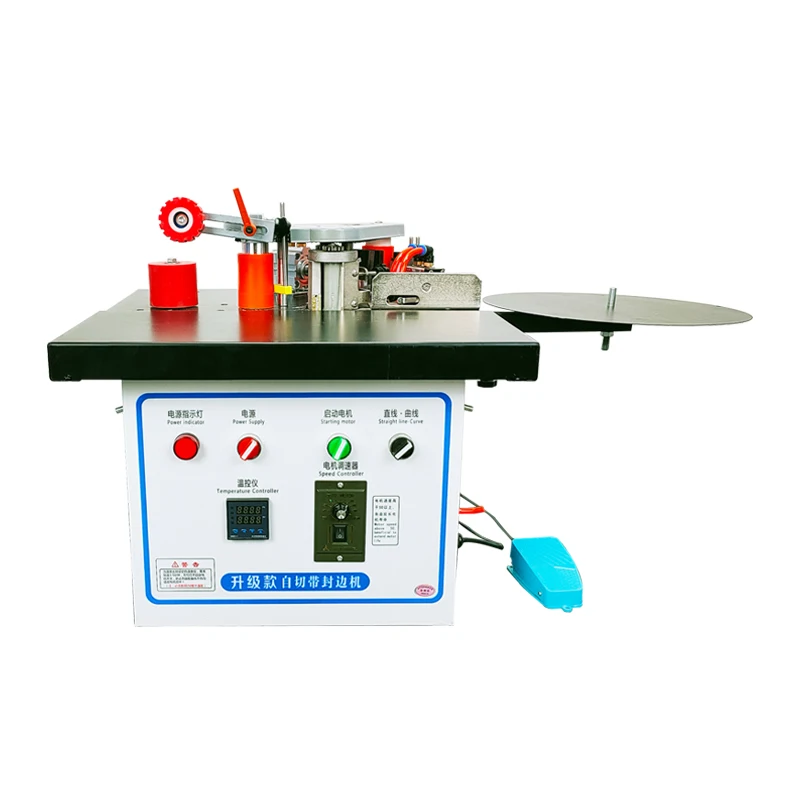
Voltage-First Configuration — every ST-50 parameter confirmed against your workshop supply before production starts, eliminating dead-on-arrival electrical mismatches.
Technical Specifications
| Parameter |
Value |
| Model |
ST-50 |
| Product Type |
Portable Mini Edge Banding Machine |
| Total Power |
1000W |
| Voltage |
220V / 380V / Customizable |
| Edge Banding Mode |
Curved and Straight |
| Edge Banding Thickness Range |
0.3–3 mm |
| Edge Banding Height Range |
0–50 mm |
| Minimum Sheet Length |
25 cm |
| Minimum Sheet Width |
3 cm |
| Air Source Pressure |
0.5–0.8 MPa |
| Glue Pot Capacity |
1000 ml |
| Edge Trimming Power |
20W |
| Product Dimensions |
50 × 50 × 47 cm |
| Net Weight |
22 kg |
| Language Options |
Chinese, English (other languages customizable) |
| Plug Options |
EU / USA / AU / UK |
Application Suitability
| Application |
Material or Output |
| Small-scale furniture repair |
MDF and particleboard panels with PVC edge banding |
| Home decoration production |
Plywood and ecological board with veneer or melamine edges |
| Compact joinery workshop |
Solid wood board edge sealing on curved and straight profiles |
| Cabinet touch-up and rework |
Pre-cut panels requiring on-site or benchtop edge finishing |
Why the Voltage Question Should Come Before the Price on Any Edge Banding Machine Specifications Sheet
A machine wired for the wrong frequency will burn its motor within the first week — no amount of build quality can compensate for an electrical mismatch.
I have seen portable edge banders arrive at overseas workshops with motors configured for 50 Hz while the local grid runs at 60 Hz, or with single-phase wiring sent to a facility expecting three-phase. The unit powers on but overheats under load, the glue pot never reaches working temperature, and the feed stalls mid-panel [NEED_CITE: voltage and frequency standards by export market]. For a compact machine like the ST-50, where every parameter is tightly packed into a 22 kg chassis, thermal stress hits harder and faster than on a full-size automatic bander. Verifying the Edge Banding Machine specifications against your facility's actual supply — including frequency, not just voltage — is the single most important step before placing an order.

Mapping the 0.3–3 mm Edge Thickness Window to Real Board Stock
The ST-50 covers 0.3 mm to 3 mm edge banding thickness, which spans the most common materials a small workshop encounters. Thin PVC at 0.4 mm suits particleboard cabinet components, while 2 mm solid wood veneer strips are typical for visible furniture edges. The 1000 ml glue pot provides sufficient adhesive volume for batch runs on a benchtop unit without constant refilling, though operators working with thicker veneer should plan for more frequent top-ups. Matching the edge banding machine specifications to your most frequent material combination prevents the two most common failures on compact units: insufficient glue coverage on thick stock and heat damage to thin PVC on narrow panels.
Air Pressure and Its Effect on Edge Adhesion Quality
The 0.5–0.8 MPa air source requirement places this portable unit firmly in the compressor-equipped workshop category. Below 0.5 MPa, the pressure roller fails to maintain consistent contact, leaving visible gaps along the glue line — a defect that only shows up after trimming [NEED_CITE: pneumatic pressure requirements for edge banding adhesion]. Above 0.8 MPa, excessive force can crush soft PVC edges or push thin veneer out of alignment on curved profiles. Operators should install a dedicated regulator at the machine inlet rather than relying on the workshop's main line, which often fluctuates when other pneumatic tools cycle on and off.
How Dimensional Minimums Define What the ST-50 Can and Cannot Process
The 25 cm minimum sheet length and 3 cm minimum sheet width set hard boundaries on what fits through the feed path. Small drawer sides, narrow cabinet dividers, and offcut shelves from larger panel saws typically clear these limits without issue. However, cleats, spacer blocks, and decorative moulding strips shorter than 25 cm will jam the infeed guide. The 50 mm edge banding height ceiling accommodates standard 18 mm and 25 mm panel thicknesses with clearance above and below the trim unit. Technical buyers cross-referencing edge banding machine specifications should measure their smallest recurring workpiece before committing to this model, since rework on undersized pieces accounts for a disproportionate share of returns on portable banders.
The Hidden Cost of Skipping the Compatibility Check
Ordering a portable bander without verifying the panel thickness range, voltage, and air supply against your actual production conditions leads to a cascade of downstream failures. A machine that cannot reach full glue pot temperature on an undervoltage supply will produce edge bonds that peel during transport or within weeks of installation. Panels with visible glue lines force the assembly team to sand and re-glue by hand, negating any time the machine was supposed to save [NEED_CITE: root causes of edge banding delamination in field service reports]. On curved edges, an air pressure mismatch causes the roller to skip, creating a wavy bond line that no amount of manual trimming can correct. These problems are not defects in the machine — they are mismatches between the machine's specifications and the workshop's reality.
Why Technical Buyers Source the ST-50 Here
In-house manufacturing with patented cutting mechanisms ensures tolerance claims are traceable to actual production records, not imported spec sheets. Voltage, plug type, and control panel language are confirmed at the quotation stage, so the ST-50 ships wired for your exact facility. The four-stage QC process — incoming material, in-process, finished product, and pre-shipment verification — catches electrical and mechanical discrepancies before the crate is sealed. An engineer-led configuration review within 24 hours means your panel dimensions, edge material, and available utilities are factored into the recommendation, not an afterthought. Factory visits are welcomed, allowing buyers to witness sample processing runs on their own board stock before the order enters production.
Documentation & Verification
- Machine specification sheet with confirmed voltage, frequency, and plug type for your region
- Electrical schematic and voltage confirmation document signed before production release
- Factory test record showing edge banding results on your specified panel thickness and material
- Operation and maintenance manual in the language agreed at order confirmation
- Spare parts list matched to the ST-50 configuration shipped, with part numbers for reordering
Installation, Commissioning & Support
- Requires a dedicated 220V or 380V circuit matching the confirmed frequency; no shared breaker with compressors
- Air line must deliver 0.5–0.8 MPa through a dedicated regulator at the machine inlet
- Arrives fully assembled; place on a stable bench rated for at least 50 kg to absorb vibration
- First run should calibrate glue pot temperature against your specific adhesive and edge material
- 1000 ml glue pot needs draining and flushing if the machine sits idle beyond the adhesive pot life
How to Structure Your Inquiry for a Fast, Accurate Quotation
Send your typical panel material, thickness range, and the edge banding type you run most often — PVC, ABS, veneer, or melamine. Include your workshop's voltage, phase, and frequency so the electrical configuration is locked before production [NEED_CITE: CE machinery directive requirements for industrial equipment]. If you process curved profiles, specify the minimum radius you work with so the feed path can be validated. Mention the language your operators read and the plug standard in your region to finalize the documentation and wiring scope.
Frequently Asked Questions
Q: How do I verify the ST-50 voltage and frequency match my workshop supply?
A: Confirm your facility's voltage, phase, and frequency with your electrician, then provide these three values at the inquiry stage. The configuration is documented on the electrical schematic and voltage confirmation sheet before production begins, so the machine ships wired correctly for your grid.
Q: What panel thickness and edge materials does the ST-50 handle within its specification range?
A: The machine covers 0–50 mm panel thickness and 0.3–3 mm edge banding thickness, accommodating PVC, ABS, veneer, and melamine on MDF, particleboard, plywood, and solid wood. Always verify your thickest recurring panel against the 50 mm ceiling before ordering.
Q: How can I confirm edge quality and tolerance before committing to a production order?
A: Request a factory test record or arrange a sample processing run using your own panel stock and edge material. The pre-shipment verification step includes a documented edge quality check against the agreed specification.
Q: What documentation ships with the ST-50?
A: Each unit ships with a machine specification sheet, electrical schematic, factory test record, operation and maintenance manual in the agreed language, a spare parts list, and packing photographs. Customs documentation support is included for export shipments.
Q: How does the ST-50 compare to larger automatic edge banders on throughput limits?
A: The ST-50 is designed for compact workshops and repair operations where portability and curved-edge capability matter more than line speed. For continuous production volumes, a full-size automatic bander with multiple trimming stations is the appropriate configuration.