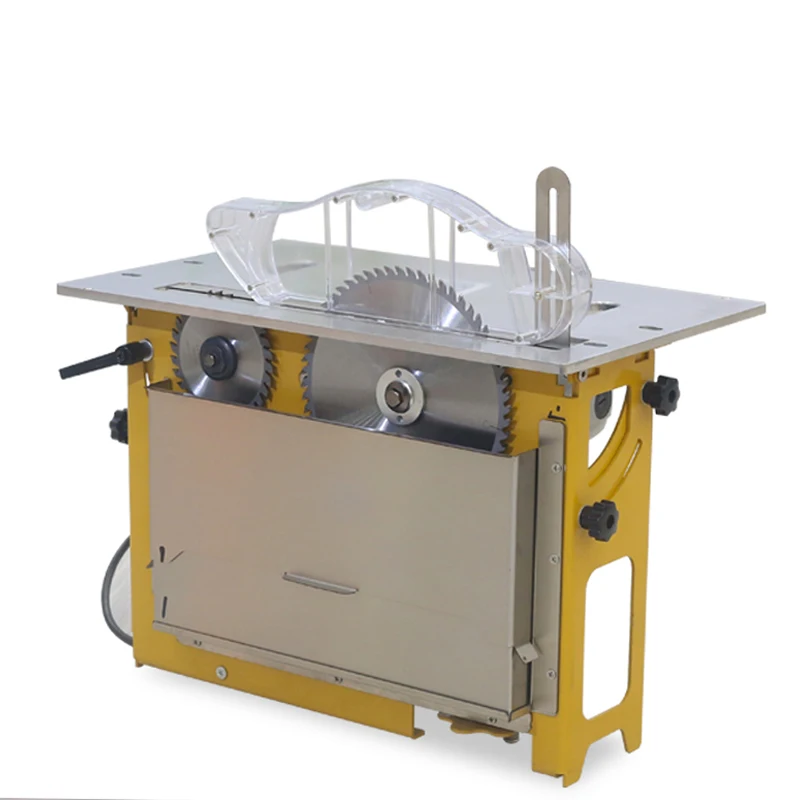
Specification-Led Configuration — every published parameter on this portable sliding table panel saw specifications page maps directly to a testable machine capability, so you can verify cutting performance against your actual panel stock before committing to an order.
Technical Specifications
| Parameter |
Value |
| Product Type |
Portable Sliding Table Panel Saw |
| Total Power |
6200W |
| Main Saw Power |
3000W |
| Main Saw Speed |
3800r/min |
| Main Saw Diameter |
20CM |
| Sub Saw Power |
2000W |
| Sub Saw Speed |
13000r/min |
| Vacuum Cleaner Power |
1200W |
| Maximum Plank Cutting Length |
2.44M (basis not stated in source) |
| Maximum Plank Cutting Thickness |
4CM (basis not stated in source) |
| Product Weight |
22KG |
| Product Size |
50×30×38CM |
| Voltage & Frequency |
Configurable from 110V to 440V |
| Language Options |
Chinese and English standard; other languages customizable |
Application Suitability
| Application |
Material or Output |
| On-site interior fit-out panel sizing |
MDF, particleboard, plywood up to standard sheet formats |
| Small workshop cross-cutting and rip-cutting |
Laminated and raw solid wood panels |
| Furniture assembly preparation cuts |
Melamine-faced chipboard and veneered board |
| Joinery workshop guided sliding cuts |
Plywood and blockboard for cabinet components |
What "2.44M Cutting Length" Actually Means for Your Panel Stock
A published cutting length only becomes meaningful when matched against your panel format, material density, and required edge quality.
I once had a custom cabinet maker send me a cutting schedule assuming any saw rated for 2.44M could handle his full sheet stock at production pace. The portable sliding table panel saw specifications looked adequate on paper, but when we ran his recycled particleboard through a test cut, the scoring blade could not maintain a clean edge at full travel length. The issue was not the machine — it was the mismatch between substrate density and the scoring blade configuration [NEED_CITE: scoring blade selection relative to panel substrate density]. Requesting a sample cut on your actual material before shipment eliminates this class of failure entirely.

How the Dual-Motor Layout Affects Cut Edge Quality
The 3000W main saw running at 3800r/min handles the through-cut, while the 2000W scoring sub-saw at 13000r/min pre-scores the bottom surface of laminated panels. This speed differential is what prevents chip-out on melamine and veneer faces. When portable sliding table panel saw specifications list both motors, the scoring speed matters more than main saw speed for visible-edge work. A slower sub-saw leaves tear-out that forces secondary sanding downstream.
Matching the 20CM Blade Diameter to Your Material Stack
A 20CM main saw blade determines both maximum cutting depth and available tooth configurations. For particleboard and MDF, a higher tooth count produces cleaner edges but generates more heat, requiring controlled feed rates. For solid wood rip-cuts, fewer teeth with aggressive hook angles clear chips faster. The blade diameter also sets the arbor size and available bore compatibility, which affects your ongoing consumable sourcing. Always confirm blade bore specifications before ordering replacement stock [NEED_CITE: saw blade bore standards for portable panel saws].
Reading the Power Distribution Across Three Loads
The 6200W total power breaks into three independent circuits: main saw at 3000W, scoring saw at 2000W, and vacuum extraction at 1200W. This distribution matters because on-site electrical circuits in many markets cannot sustain simultaneous draw from all three motors without dedicated breakers. A portable unit marketed for job-site use must align with the available single-phase amperage at your installation points. Voltage confirmation before dispatch prevents the scenario where the machine arrives and trips every breaker in the workshop.
The Real Cost of Skipping Voltage and Frequency Verification
Machines shipped without confirmed local voltage and frequency arrive as dead weight. I have seen portable panel saws of this class sit in crates for weeks while the buyer sourced step-up transformers that then introduced voltage fluctuation under load, damaging the main saw motor winding [NEED_CITE: voltage fluctuation damage to induction motors in woodworking equipment]. The 110V to 440V configurable range means the factory can wire the unit correctly, but only if the buyer provides the exact supply specification during the quotation stage. A two-minute confirmation call prevents a multi-week delay.
Why Configuration Verification Belongs Before the Purchase Order
Every portable panel saw leaves the factory with a specific voltage wiring, control panel language, and blade configuration. These choices are irreversible without rewiring or component replacement. The factory test record should document cutting accuracy on a material sample matching your production stock, not a generic MDF coupon. This verification step separates a machine that commissions in one day from one that requires on-site troubleshooting and blade experimentation.
Documentation & Verification
- Machine specification sheet confirming cutting length and thickness on your panel format
- Electrical schematic matching your confirmed local voltage and frequency supply
- Factory test record documenting cut accuracy on your specified panel material
- Operation and maintenance manual in your agreed control panel language
- Spare parts list with blade bore sizes and motor part numbers for local sourcing
Installation, Commissioning & Support
- Requires a dedicated circuit rated for the 6200W total draw across all three motors
- 22KG weight allows single-person positioning but demands a stable, level work surface
- Vacuum cleaner hose routing must be configured before first cut to prevent dust recirculation
- Scoring blade alignment verification required on-site after transport vibration
- Initial test cuts on your actual panel stock to confirm edge quality before production use
- Spare scoring blades and main saw blades should be ordered with the machine to avoid downtime
What to Include in Your Inquiry
Provide your primary panel material type, typical sheet dimensions, and the thickness range you process most frequently. Confirm your workshop or job-site voltage and frequency, and specify whether the control panel language needs to match a particular operator group. If you are replacing an existing saw, share the current cutting tolerance requirements so the configuration can be validated against your downstream assembly expectations.
Frequently Asked Questions
Q: How do I verify cutting tolerance on this portable saw before shipment?
A: Request a factory test record that documents cut accuracy on a sample of your actual panel material. The test should include dimensional measurement at multiple points along the full cutting travel, not just a short cross-cut. This record confirms the machine performs within tolerance on your specific substrate before it leaves the factory.
Q: What voltage configurations are available and how do I specify correctly?
A: The machine supports voltage configuration from 110V to 440V. Provide your exact supply voltage and frequency during the quotation stage so the factory wires all three motor circuits correctly. An electrical schematic and voltage confirmation document will be included with your shipment for local electrical inspection compliance.
Q: Can the control panel and manual be provided in a language other than Chinese or English?
A: Yes, control panel labels and the operation manual can be customized to your preferred language. Specify this requirement during the configuration stage so the documentation and interface are prepared before assembly. Standard bilingual configuration is Chinese and English, with other languages available on request.
Q: How does the 2.44M cutting length apply to wider panel formats?
A: The published maximum cutting length covers standard sheet formats up to 2.44M in the travel direction. Panels exceeding this length require repositioning and a second pass, which introduces alignment dependency. Confirm your typical panel dimensions during inquiry so the cutting workflow can be validated for your production requirements.
Q: How should I select the scoring blade for laminated versus raw panel substrates?
A: The 2000W scoring sub-saw at 13000r/min requires different blade tooth configurations depending on your material. Laminated panels need a fine-tooth scoring blade to prevent chip-out on the visible face, while raw particleboard or plywood can use a standard configuration. Specify your primary material during ordering so the correct blade ships with the machine.