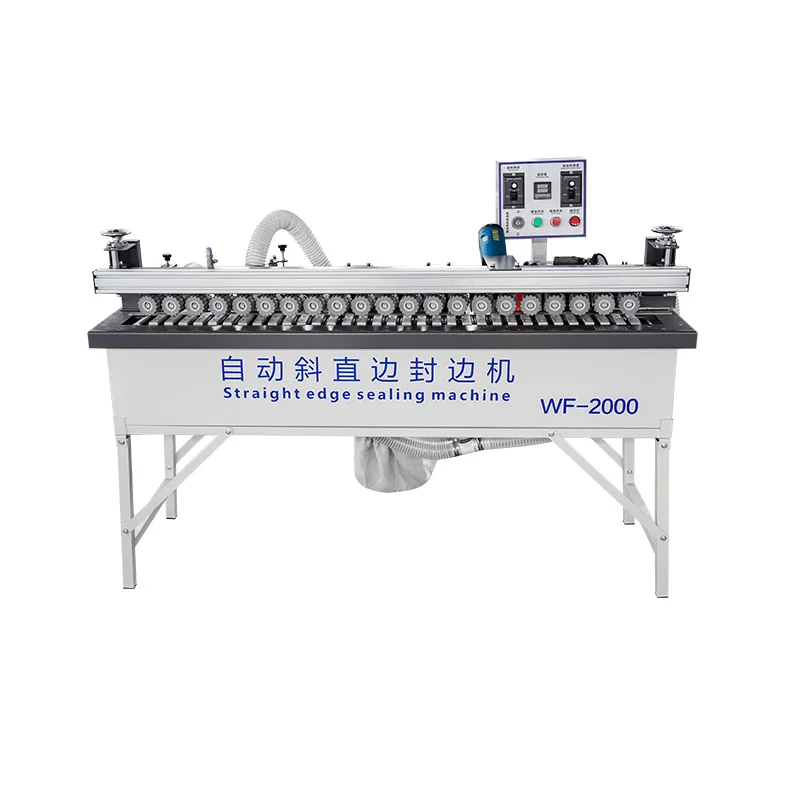
Verified Tolerance Mapping — Every WF-2000 specification is cross-referenced against actual panel processing requirements before configuration sign-off.
Technical Specifications
| Parameter |
Value |
| Model |
WF-2000 |
| Product Type |
Automatic Edge Banding Machine |
| Overall Dimensions (L×W×H) |
2100×600×630mm |
| Net Weight |
137kg |
| Panel Thickness Range |
18-25mm |
| Edge Strip Thickness |
1.2mm |
| Rated Voltage |
220V |
| Rated Power |
6.17KW |
| Rated Air Pressure |
0.4-0.6MPa |
| Feed Speed |
0-14m/min |
| Pressing System |
8 pressing rollers |
| Functional Stations |
Gluing device, Trimming device, Polishing device |
| Key Features |
Automatic plate feeding, Slotted edge banding function, Hot air heating process, Elastic profiling trimming, Self-contained vacuum device, Aluminum alloy pressure beam, Automatic belt breaking |
Application Suitability
| Application |
Material or Output |
| Cabinet door edge finishing |
PVC edge banding on MDF and particleboard substrates |
| Custom furniture panel edging |
Plywood and melamine-faced board with 1.2mm strip |
| Small workshop batch production |
Solid wood panels within 18-25mm thickness range |
| Joinery startup operations |
Board substrates requiring gluing, trimming, and polishing |
Why the Voltage Question Should Come Before the Automatic Edge Banding Machine specifications
A machine wired for the wrong grid frequency will underperform from day one, and no amount of on-site adjustment fixes a fundamental power mismatch.
I have seen workshops receive edge banders that technically powered on but ran feed motors at reduced torque because the frequency was never confirmed against local supply. The operator assumed the machine was defective when in reality the 220V rating matched but the 50Hz versus 60Hz difference altered motor behavior entirely. Before any Automatic Edge Banding Machine specifications are finalized for order, voltage and frequency must be documented in writing against your facility's actual supply. [NEED_CITE: voltage and frequency standards by export market]
Matching Feed Speed to Your Actual Board Mix
The 0-14m/min variable feed on the WF-2000 exists because different substrates demand different throughput rates. Dense particleboard with high resin content requires slower feeding to allow the hot air heating process adequate dwell time for adhesive activation. Lighter MDF panels can run toward the upper range without compromising bond integrity. When evaluating Automatic Edge Banding Machine specifications, confirm your most common board type falls within the feed window where glue curing completes before the pressing rollers release.
Panel Thickness Limits and What Falls Outside
With an 18-25mm panel thickness range, this model covers the majority of cabinet and furniture carcass stock. However, thinner drawer bottom panels at 12mm or thicker worktop substrates at 38mm fall outside the clamping envelope of the aluminum alloy pressure beam. The beam adjusts manually, and its travel limits define the boundary. Buyers comparing Automatic Edge Banding Machine specifications across models should map their entire board inventory against the stated range, not just the most common sheet size. [NEED_CITE: standard panel thickness categories in furniture manufacturing]
Pressing Station Count and Bond Quality
The 8 pressing rollers work sequentially to maintain contact pressure across the full panel width as the edge strip cools. Fewer rollers create gaps where the strip can lift before adhesive sets, particularly on wider panels or when ambient workshop temperature is low. The hot air heating process softens the adhesive layer on the edge strip, and the roller train holds position until thermal transfer completes. This station arrangement directly affects whether visible glue lines appear on finished edges.

The Cost of Skipping the Configuration Confirmation
When a workshop orders based on brochure specs without confirming actual board density and edge strip material, the machine arrives configured for a production scenario that does not match reality. Feed speed may be set too high for the adhesive type in use, causing strip delamination during trimming. The self-contained vacuum device may be adequate for light MDF dust but overwhelmed by dense particleboard swarf volume. These mismatches surface only after installation, when production deadlines are already pressing. [NEED_CITE: common edge banding defects from configuration mismatch]
What the Specification Sheet Actually Tells You
Beyond raw numbers, the WF-2000's rated power of 6.17KW indicates simultaneous operation of the gluing heater, feed motor, trimming spindle, and polishing motor without tripping thermal protection. The 0.4-0.6MPa air pressure requirement means your compressor must deliver stable pressure at the machine inlet, not just at the compressor outlet. Long air lines with multiple junctions drop pressure, and insufficient supply causes the 8 pressing rollers to lose clamping force mid-cycle.
Why Specification Verification Matters at This Level
The WF-2000 occupies the range where small workshops transition from manual edge banding to automated processing. At this stage, a single misconfigured parameter compounds across every panel produced. The four-stage QC process covers incoming material, in-process assembly, finished product testing, and pre-shipment verification — but the factory test record must reflect your specific board sample, not a generic test piece. Engineer-led configuration review ensures the quoted spec matches actual requirements before production begins. [NEED_CITE: CE machinery directive requirements for industrial equipment]
Documentation & Verification
- CE declaration of conformity covering the WF-2000's electrical and mechanical safety provisions
- Machine specification sheet with confirmed panel thickness and feed speed parameters
- Electrical schematic matching your confirmed 220V supply and frequency
- Factory test record using your submitted board sample and edge strip material
- Operation and maintenance manual in your operator's working language
Installation, Commissioning & Support
- Foundation must support the 137kg net weight plus dynamic load during feed acceleration
- Dedicated 220V circuit with isolation switch rated above 6.17KW continuous draw
- Machine ships assembled; positioning requires clearance for the 2100mm length
- First-run calibration of the 8 pressing rollers against your actual panel thickness
- Air supply line sized to maintain 0.4-0.6MPa at the machine inlet under load
What to Provide with Your Inquiry
Share your most common board substrate type, typical panel thickness, and the edge strip material you intend to run. Specify your local voltage and frequency at the panel board, and confirm the language your operators read. If you have existing upstream saws or downstream boring machines, note their feed height so the WF-2000 integrates without material handling conflicts.
Frequently Asked Questions
Q: How is edge banding tolerance verified on the WF-2000 before shipment?
A: The factory test record documents actual measurements taken during a production run using your submitted board sample. Tolerance values are recorded at multiple points along the edge strip after trimming and polishing. Request this record with your specific material before authorizing shipment rather than relying on published spec sheet claims alone.
Q: Can the WF-2000 handle edge strip thickness beyond 1.2mm?
A: The stated 1.2mm edge strip thickness reflects the standard configuration. Thicker solid wood strips require different pressing pressure and trimming tooling. Confirm your intended strip material and thickness during the quotation stage so the machine configuration matches your actual production requirement.
Q: What control panel language options are available for the WF-2000?
A: Multilingual control panels are available and must be specified at order stage. The default configuration may not match your operator's language. Confirm your requirement in writing before production begins to avoid commissioning delays from unreadable interface text.
Q: Does the self-contained vacuum device replace a central dust extraction system?
A: The built-in vacuum handles immediate dust capture at the trimming and polishing stations. A central extraction system may still be required depending on your workshop's air quality standards and production volume. Assess your facility's overall ventilation requirements separately from the machine's onboard extraction.
Q: What happens if my local power frequency differs from the machine configuration?
A: Motor speed and heater element behavior change with frequency mismatch. The feed motor may run faster or slower than calibrated, and the hot air heating process may not reach target temperature. Confirm both voltage and frequency in writing before the electrical schematic is finalized for your machine.