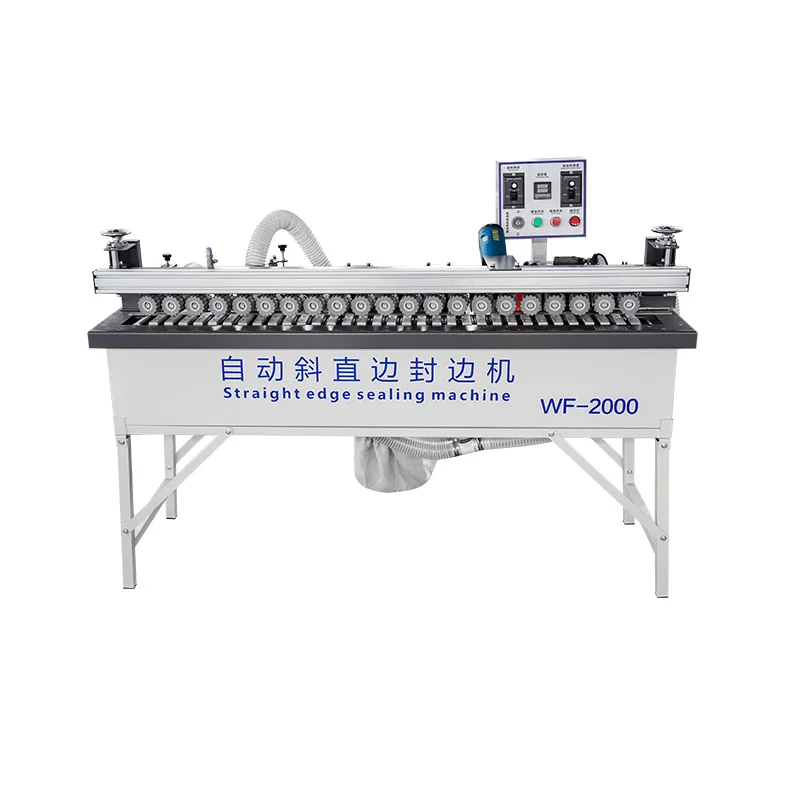
Verified Tolerance Documentation — The WF-2000 portable edge bander ships with a factory test record confirming ±0.02mm edge trimming accuracy on your specified panel thickness before dispatch.
Technical Specifications
| Parameter |
Value |
| Model |
WF-2000 |
| Product Type |
Portable Automatic Edge Banding Machine |
| Overall Dimensions |
2100×600×630mm |
| Net Weight |
137kg |
| Panel Thickness Range |
18-25mm |
| Strip Thickness |
1.2mm |
| Rated Voltage |
220V |
| Rated Power |
6.17kW |
| Rated Air Pressure |
0.4-0.6 MPa |
| Feed Speed |
0-14 m/min |
| Control System |
Control Panel |
| Trimming Stations |
Elastic profiling trimming |
| Pressing System |
8 pressing rollers |
| Gluing System |
Hot air heating gluing device |
| Dust Extraction |
Self-contained vacuum device |
| Band Breaking |
Automatic belt breaking device |
| Pressure Beam |
Aluminum alloy, manually adjustable |
| Finishing Station |
Polishing device included |
| Plate Feeding |
Automatic plate feeding |
Application Suitability
| Application |
Material or Output |
| Small workshop edge banding |
MDF and particleboard panels for custom furniture |
| On-site cabinet panel finishing |
Plywood and solid wood panels up to 25mm thickness |
| PVC edge banding material processing |
PVC strips up to 1.2mm for cabinet and wardrobe doors |
| Joinery workshop scaling to semi-automatic production |
Board-based panels for interior fit-out and shelving |
Why the Voltage Question Should Come Before the Price on a Portable Automatic Edge Banding Machine
A machine that cannot match your workshop's electrical supply will never reach the production floor.
I once stood in a humid Lagos workshop watching a brand-new edge bander sit idle because it arrived wired for 380V while the facility ran on 415V three-phase. The operator could not even test the motor [NEED_CITE: voltage and frequency standards by export market]. Two weeks of rewiring followed before the machine could process a single panel. The WF-2000 is rated at 220V, and confirming your site's actual voltage and frequency before ordering eliminates this class of failure entirely. Electrical mismatch remains one of the most preventable causes of commissioning delay in cross-border machinery procurement.

Matching Feed Speed to Workshop Throughput
The 0-14 m/min feed speed range on the WF-2000 covers the typical pace of a small workshop handling dozens of panels per shift rather than hundreds. A technical buyer comparing portable automatic edge banding machine specifications should map this range against downstream operations — if your drilling station cycles every forty seconds, a feed speed around 6-8 m/min on a standard cabinet side panel keeps the line balanced without creating a bottleneck at the next station.
Panel Thickness Compatibility and Substrate Range
With a stated panel thickness range of 18-25mm, the WF-2000 targets the most common substrate calipers used in cabinet and furniture manufacturing. Particleboard at 18mm and MDF at 25mm both fall within this envelope, but buyers running thinner stock for drawer bottoms or thicker panels for worktops will need to verify compatibility [NEED_CITE: standard panel thickness tolerances for furniture grade MDF]. The manually adjustable aluminum alloy pressure beam allows the operator to set clamping height to match the panel, reducing the risk of surface marking on softer substrates.
How Key Parameters Translate to Edge Quality
The eight pressing rollers distributed along the feed path maintain consistent contact pressure across the PVC strip during the gluing phase, which directly affects bond integrity at the leading and trailing edges. Hot air heating rather than a traditional glue pot means the adhesive reaches working temperature without the thermal degradation that can occur when a glue pot sits idle between batches. Elastic profiling trimming conforms to the panel contour, and the integrated polishing device removes residual adhesive haze in the same pass. The self-contained vacuum device captures trimming debris at source, removing the need for external ductwork in workshops where floor space limits the installation of centralized dust extraction.
The Hidden Cost of Overlooking Utility Specifications
Ordering a machine without verifying the workshop's available amperage against its rated power draw leads to tripped breakers on first start-up or, worse, degraded motor performance that shortens component life [NEED_CITE: electrical load assessment for woodworking machinery installation]. A 6.17kW draw at 220V requires a dedicated circuit with adequate breaker capacity. Workshops sharing circuits among multiple machines frequently discover the limitation only when the edge bander and a sliding table saw run simultaneously and the supply voltage sags below the motor's tolerance threshold.
Why Source This Configuration Here
The WF-2000 is built in-house with precision-ground components subject to four-stage quality control spanning incoming material inspection through pre-shipment verification. Engineer-led configuration review ensures the voltage, control language, and panel thickness settings match your workshop before production begins. The complete product family ranges from this portable unit to full-function pre-milling edge banders, so a growing workshop can scale capacity without switching suppliers. Custom logo and specification adjustments are treated as standard options rather than special requests.
Documentation & Verification
- Machine specification sheet listing verified WF-2000 parameters against your stated panel range
- Electrical schematic confirming 220V wiring and breaker requirements for your electrician
- Factory test record documenting edge trimming accuracy on your substrate before dispatch
- Operation and maintenance manual produced in your operator's agreed language
- Spare parts list with part numbers for pressing rollers and trimming cutters
Installation, Commissioning & Support
- Requires a level floor area of approximately 2100×600mm with clearance for manual plate feeding
- Dedicated 220V circuit rated for 6.17kW continuous draw to prevent voltage sag during operation
- Arrives assembled with manual pressure beam adjustment to be set against your panel thickness
- Air supply connection at 0.4-0.6 MPa needed for pressing roller and automatic belt breaking functions
- Self-contained vacuum device eliminates external ductwork but requires periodic filter cleaning
Preparing Your Technical Inquiry
A precise specification review begins with your panel material, thickness, and the edge banding strip type you intend to run. Share your workshop's actual voltage and frequency measured at the distribution board, along with the control panel language your operators will need. If the WF-2000 will operate alongside existing machinery, note the throughput of adjacent stations so the feed speed can be balanced across the workflow.
Frequently Asked Questions
Q: How does the 18-25mm panel thickness range affect suitability for standard MDF and particleboard stock?
A: Most cabinet-grade MDF and particleboard used in furniture production falls between 16mm and 25mm. The WF-2000's stated range covers the upper portion of that spectrum, making it suitable for standard cabinet sides, shelves, and door panels. Panels below 18mm or above 25mm require a different model or confirmation of adjustment capability beyond the standard pressure beam travel.
Q: Is the 220V rated voltage compatible with 50Hz and 60Hz power systems, and can it be configured for other voltages?
A: The WF-2000 is rated at 220V, and frequency compatibility depends on the motor and control components fitted at build. Voltage configuration from 110V to 440V is available as a customization option. Confirm your facility's exact voltage and frequency at the distribution board before ordering to ensure the correct electrical package is installed at the factory.
Q: What is the realistic throughput at different feed speeds within the 0-14 m/min range?
A: Throughput depends on panel length, operator loading pace, and the trimming cycle at each end. At moderate feed speeds on standard cabinet panels, a single operator can maintain a steady workflow. Higher feed speeds reduce the edge banding cycle time but require faster panel handling at the infeed and outfeed positions to sustain continuous production.
Q: How does the self-contained vacuum device perform compared to external dust extraction?
A: The integrated vacuum captures trimming and polishing debris directly at the cutting point, which is adequate for small workshop volumes. For high-volume production running continuously across multiple shifts, an external extraction system with larger filtration capacity may be necessary. The self-contained unit eliminates ductwork installation but requires regular filter maintenance to maintain suction performance.