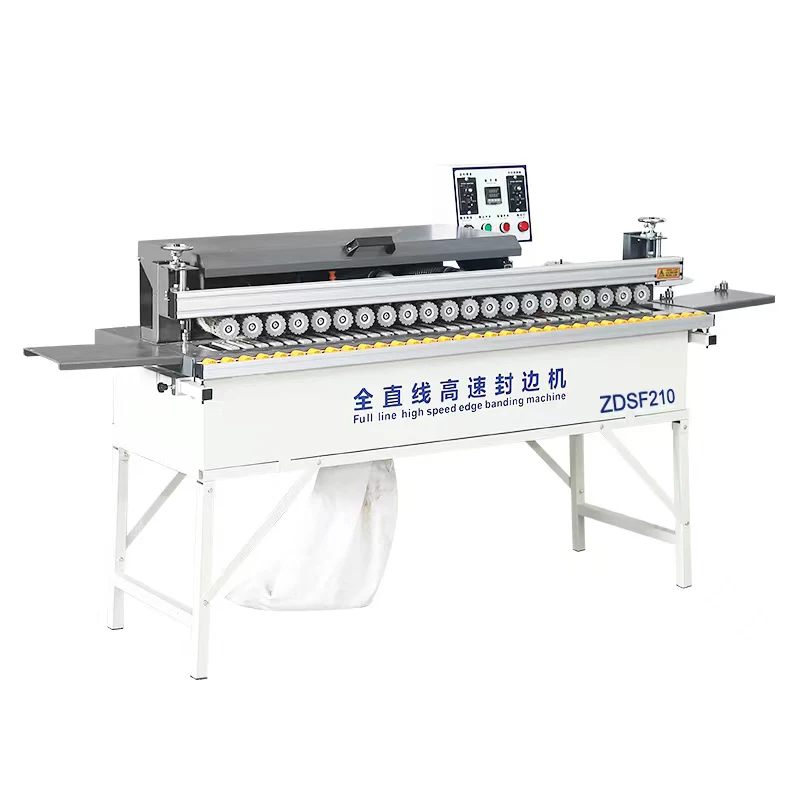
Precision-verified tolerance — Every ZDSF210 unit ships with a factory test record documenting ±0.02mm edge accuracy on your specified panel thickness, not just a brochure claim.
Technical Specifications
| Parameter |
Value |
| Model |
ZDSF210 |
| Product Type |
Automatic Edge Banding Machine |
| Function |
Full Line High Speed Edge Banding |
| Edge Banding Speed |
6 m/min |
| Belt Feed Motor |
25 W |
| Board Feed Motor |
120 W |
| Trimming Motor |
800 W × 2 |
| Heating Motor |
800 W |
| Vacuum Fan |
1200 W |
| Overall Dimensions (L×W×H) |
1500 × 570 × 630 mm |
| Net Weight |
155 kg |
| Glue Pot Capacity |
1000 ml |
| Guide Rail |
Steel rod guide rail |
| Glue Pot Type |
Front and rear profiling glue pot |
| Pressing Mechanism |
Elastic device with secondary pressing |
| Trimming Configuration |
Up, down, left and right profiling trimming on precision slide |
| Dust Collection |
Airtight dust collection and vacuuming |
| Scraping |
Flexible edge scraping |
| Polishing |
Cross polishing |
| Motor Base |
Frame type motor base |
| Key Features |
Automatic operation, new condition, video outgoing-inspection provided |
| Warranty |
1 year on machine and core components |
Application Suitability
| Application |
Material or Output |
| Custom cabinet door edge banding |
MDF panels with PVC edge banding |
| Furniture panel processing |
Particleboard and plywood substrates |
| Woodworking door manufacturing |
Solid wood panels with veneer edge banding |
| Small-batch custom furniture |
MDF and board stock in varied thickness ranges |
Why the Voltage Question Must Precede the Purchase Order
Confirm your facility voltage and frequency before comparing automatic edge banding machine specifications across suppliers.
I have watched a workshop in Southeast Asia take delivery of an edge bander only to discover the motor was wound for 380V/50Hz while their shop ran on 220V/60Hz — the machine sat idle for weeks while a transformer was sourced locally [NEED_CITE: voltage and frequency standards by export market]. The cost of that downtime dwarfed any savings from the initial quote. When you are evaluating how to choose an automatic edge banding machine, electrical compatibility should be the very first checkpoint, not an afterthought buried in shipping documents. A configuration mismatch at this stage stalls commissioning, voids warranties in some cases, and forces operators to improvise unsafe workarounds.

Guide Rail and Feed Stability Under Continuous Load
The steel rod guide rail on the ZDSF210 provides a rigid linear path for panel transport through each workstation. Unlike softer rail materials that deflect under sustained vibration, hardened steel rods maintain alignment across long production runs, which directly affects the consistency of glue application and trimming accuracy. For a furniture factory running MDF panels in batch volumes, this stability means the edge quality on the five-hundredth board matches the first without manual recalibration of the feed path.
Profiling Trim Stations and Edge Geometry
The dual 800W trimming motors handle up, down, left, and right profiling cuts on a precision slide mechanism. This four-direction capability allows the ZDSF210 to follow shaped panel contours rather than limiting you to straight-line trimming. Production managers processing cabinet doors with routed profiles will find that the profiling trim reduces the need for secondary hand-finishing, keeping the panel moving through a single-pass workflow [NEED_CITE: profiling edge banding requirements for shaped cabinet doors].
Decoding the Motor and Power Allocation
The separate motor ratings across the ZDSF210 tell a practical story about how the machine distributes energy. The 120W board feed motor drives panel transport, while the 800W × 2 trimming motors deliver the torque needed for clean cuts on dense PVC and veneer materials. The 800W heating motor maintains glue pot temperature stability, and the 1200W vacuum fan ensures dust extraction at the trimming and scraping stations. Understanding this power split helps you plan dedicated electrical circuits — running the trimming motors and heating element on a shared circuit with other shop equipment risks voltage drops that manifest as inconsistent glue flow or rough trim finishes.
The Real Cost of Skipping Configuration Verification
I once worked with a buyer who sourced an entry-level bander for a production volume it was never engineered to sustain. The feed motor overheated within the first month, and the single trimming station could not hold tolerance on thicker stock, producing visible glue lines that triggered a full batch rejection from their client [NEED_CITE: edge banding tolerance failures in downstream assembly]. When the specification sheet is treated as a formality rather than a validation tool, the consequences surface on the assembly floor — panels that will not seat into dowel joints, drawer boxes that rack out of square, and edge trim that chips under normal handling. These are not cosmetic issues; they halt shipment and erode the furniture maker's reputation with their own customers.
What Backs the Specification Sheet
The ZDSF210 is built through an in-house manufacturing process with a patented cutting mechanism that achieves verified ±0.02mm tolerance, documented per unit before dispatch. Every machine goes through a four-stage QC sequence covering incoming material inspection, in-process assembly checks, finished product testing, and pre-shipment verification. Voltage customization from 110V to 440V is confirmed during the quotation stage, not assumed. Engineer-led configuration recommendations ensure the machine matches your panel thickness range and feed speed requirements before production begins, with a formal quotation delivered within 24 hours.
Documentation & Verification
- CE declaration of conformity covering the ZDSF210 automatic edge banding machine
- Electrical schematic confirming your facility voltage and frequency configuration
- Factory test record run on your specified MDF panel thickness and edge material
- Operation and maintenance manual produced in your operator's working language
- Spare parts list matched to the ZDSF210 trimming and feed assemblies
- Packing photographs documenting machine condition before crating
Installation, Commissioning & Support
- Allocate floor space for the 1500 × 570 mm footprint plus operator clearance on the feed side
- Provide a dedicated circuit matching the confirmed voltage and the combined motor load
- Machine ships as a single unit at 155 kg requiring standard pallet handling equipment
- First-run calibration of the profiling trimming slide against your actual panel stock
- Operator walkthrough of the elastic secondary pressing device and glue pot controls
- Scheduled inspection intervals for the steel rod guide rail and vacuum fan filter
Preparing Your Inquiry
To move from specification review to a validated quotation, share your primary panel material and thickness range, the edge banding stock you intend to run, and your facility voltage and frequency. Include your daily processing volume and whether the ZDSF210 will operate as a standalone station or integrate into an existing line. If your panels include shaped profiles, send a sample drawing so the profiling trim configuration can be confirmed.
Frequently Asked Questions
Q: How do I verify the stated 6 m/min edge banding speed against my actual panel material?
A: Request a sample processing test using your specific MDF thickness and PVC edge banding stock. The factory test record will document actual feed speed, glue adhesion quality, and trimming accuracy on your material combination, giving you a verified baseline rather than a generic rating.
Q: What voltage and frequency options exist, and how is the correct setup confirmed?
A: The ZDSF210 is configurable from 110V to 440V. During the quotation stage, you provide your facility voltage and frequency, and the electrical schematic is prepared to match. A voltage confirmation document accompanies the machine specification sheet before production starts.
Q: Which panel thickness range does the ZDSF210 support?
A: The machine accommodates standard MDF, plywood, and particleboard thicknesses used in furniture production. Confirm your exact range during inquiry so the elastic pressing device and profiling trim slide are set to your stock before shipment.
Q: What does the pre-shipment verification process include?
A: The four-stage QC sequence ends with a factory test run on your specified material. You receive a video inspection and test record documenting edge quality, trimming precision, and dust extraction performance before the machine is crated for dispatch.
Q: How does the profiling trimming station handle curved edges versus straight runs?
A: The dual 800W trimming motors operate on a precision slide that follows panel contours in four directions. For shaped cabinet doors, this allows continuous profiling without stopping to reposition the panel, maintaining edge consistency across both straight and curved sections.