Verified Tolerance, Spec-for-Spec — every measurable parameter on the JL-1 is documented before dispatch, so your hinge boring accuracy is confirmed on paper and in practice.
Technical Specifications
| Parameter |
Value |
| Model |
JL-1 |
| Product Type |
Single Row Wood Boring Machine for Hinge Drilling |
| Total Power |
1.5 kW |
| Voltage & Frequency |
380V / 415V, three-phase four-wire |
| Control System |
Foot switch control |
| Large Drill Spindle |
35 mm |
| Small Drill Spindle |
3 mm |
| Overall Dimensions (L × W × H) |
70 × 56 × 145 cm |
| Net Weight |
55 kg |
| Dust Extraction |
External vacuum compatible |
| Language Options |
Chinese, English; custom languages available |
| Assembly State |
Fully assembled at factory |
| Panel Feed |
Manual positioning with precision guide rail |
Application Suitability
| Application |
Material or Output |
| Cabinet door cup hinge boring |
MDF and particleboard door panels, standard 35 mm hinge cups |
| Wardrobe and closet door production |
Laminated particleboard, pre-drilled for concealed hinge mounting |
| Loose leaf hinge hole drilling |
Solid wood and plywood door stiles requiring 3 mm pilot holes |
| Small-batch custom furniture runs |
Mixed substrate panels in joinery workshops transitioning from manual boring |
Why Voltage Confirmation Matters More Than the Quoted Price
A hinge boring machine that cannot start is a 55 kg paperweight, regardless of how competitive the invoice looked.
One of the most frequent failures I encounter when auditing workshop equipment is a motor wired for a supply it was never matched to. A 380V three-phase motor connected to a 220V single-phase outlet will hum, overheat, and trip its breaker within minutes — or worse, burn out the winding before anyone notices the mistake. The single row wood boring machine specifications you review on paper must align with the actual socket on your shop floor, and that alignment has to happen before the crate leaves the factory, not after. [NEED_CITE: voltage and frequency standards by export market]
Drill Head Configuration and Hinge Format Coverage
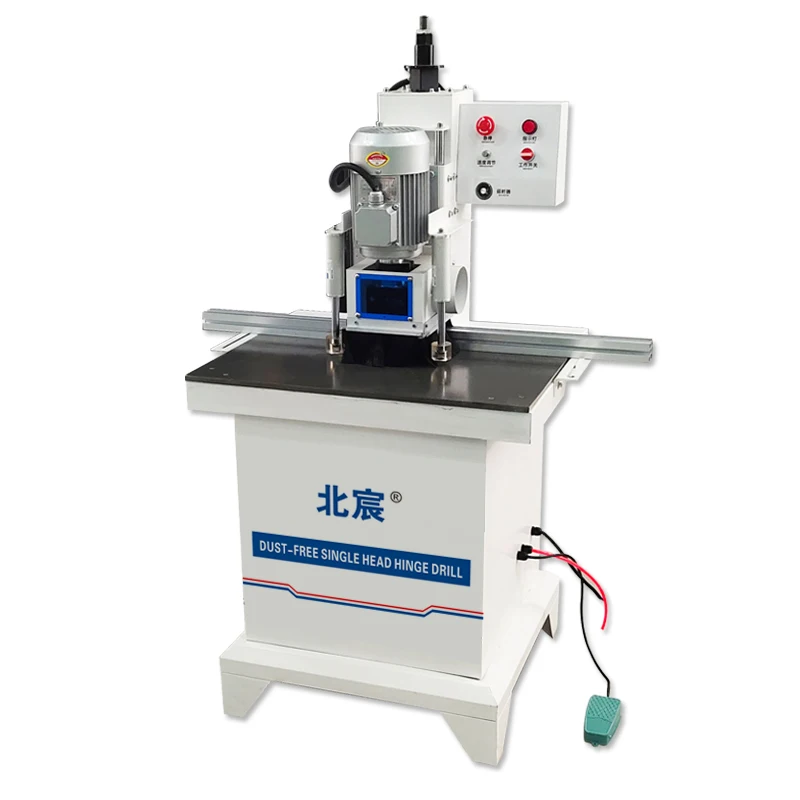
The JL-1 carries a 35 mm large spindle alongside a 3 mm small spindle on a single row head. This dual-drill arrangement covers the two most common operations in cabinet door hinge boring: the cup recess for the hinge body and the pilot hole for the mounting screw. Switching between hinge formats — from standard European cup hinges to smaller loose leaf variants — requires a bit change rather than a machine change. For workshops processing a mix of door styles across the same shift, that flexibility keeps the single row wood boring machine specifications relevant across multiple product lines without adding a second station to the floor plan.
Guide Rail Sliding and Positioning Repeatability
Manual hinge boring with a hand drill leaves positioning entirely to the operator's eye and a pencil mark. The JL-1 replaces that variability with a precision guide rail that constrains vertical and horizontal travel. The operator places the panel against the fence, slides the drill head to the marked position, and depresses the foot switch. The rail absorbs lateral drift, so the 35 mm cup hole lands at the same distance from the edge on the first panel and the fiftieth. This matters downstream: if the cup hole is off by even a couple of millimetres, the hinge arm sits crooked, the door hangs unevenly, and the assembler spends time shimming instead of hanging. [NEED_CITE: hinge mounting tolerance requirements for cabinet assembly]
Reading the Numbers That Actually Affect Your Output
The 1.5 kW total power rating tells you the motor can sustain continuous boring through standard-density particleboard and MDF without stalling. For higher-density substrates like moisture-resistant board or thick laminated panels, feed pressure should be adjusted by the operator to match resistance — the foot switch allows incremental depth engagement rather than a single plunge. The 380V / 415V three-phase requirement means this machine needs a dedicated circuit with proper phase balance; running it through an undersized extension lead will cause voltage drop at the motor terminal and inconsistent spindle speed. At 70 × 56 × 145 cm and 55 kg, the JL-1 occupies less floor space than a standard workbench and can be repositioned by two people when the workshop layout changes. The external vacuum port requires a separate extraction unit — plan your ducting route before installation day.

The Cost of Skipping the Substrate Conversation
I have seen workshops purchase a hinge borer based on a sample cut from standard 18 mm particleboard, then switch to high-density moisture-resistant board for a premium cabinet line — only to find the spindle bogs down and the cup hole tears at the laminate edge. The machine is not faulty; it is simply working outside the density envelope it was configured for. When the substrate changes, the drill bit type, feed pressure, and spindle speed all need to match. A conversation about your actual production materials — not just the sample you used to justify the purchase — prevents a machine that works perfectly in the factory test but struggles on your first real batch. [NEED_CITE: substrate density impact on boring tool life and hole quality]
What This Purchase Actually Includes
The JL-1 ships fully assembled, meaning the guide rail, drill spindles, and foot switch are aligned and tested as a unit before crating — not bolted together on your floor from separate boxes. Voltage and plug configuration are confirmed against your local supply standard before production begins, so the machine arrives ready to connect. The operation and maintenance manual is supplied in your agreed language, covering bit changes, rail lubrication, and motor maintenance specific to this model. Every unit passes a four-stage quality check spanning incoming material inspection, in-process assembly verification, finished product testing, and a pre-shipment functional run on your specified panel thickness range. Custom control language and branding options are available for distributors integrating the JL-1 into a broader equipment lineup.
Documentation & Verification
- CE declaration of conformity covering the JL-1 drill motor and control circuit
- Electrical schematic with confirmed voltage, frequency, and plug type for your market
- Factory test record showing drill alignment on your specified panel thickness
- Operation and maintenance manual translated into your workshop's working language
- Spare parts list with drill bit specifications and guide rail replacement intervals
- Pre-shipment photographic record of assembled unit and packing condition
Installation, Commissioning & Support
- Requires a dedicated 380V / 415V three-phase circuit with earth bonding for the 1.5 kW motor
- Footprint of 70 × 56 cm allows placement against a wall or between existing bench stations
- Machine arrives fully assembled; connect power, attach external vacuum, and run first test piece
- First commissioning includes verifying guide rail travel and drill depth on your actual panel stock
- External vacuum ducting must be routed before positioning; port location is fixed on the chassis
- Daily maintenance limited to guide rail wipe-down and drill bit inspection for edge wear
Before You Request a Quote
Tell us the panel materials you will be boring — MDF, standard particleboard, moisture-resistant board, or solid wood — and the thickness range across your door production. Confirm your workshop supply voltage and phase configuration so the motor winding and plug are matched before build. If your operators work in a language other than English or Chinese, specify that upfront so the manual and any control labels are prepared accordingly.
Frequently Asked Questions
Q: What panel thickness range does the JL-1 support for 35 mm hinge boring?
A: The JL-1 is configured for standard cabinet door panel thicknesses used in hinge cup drilling. The exact usable range depends on your drill bit length and the depth setting adjusted by the operator via the foot switch. Confirm your typical panel thickness during the quotation stage so the factory test record reflects your actual production material.
Q: How do I confirm the voltage and plug type match my workshop supply?
A: Provide your local supply voltage, frequency, and phase configuration during the inquiry. The JL-1 is built for 380V / 415V three-phase four-wire systems, and the plug type is selected to match your market standard — EU, USA, AU, or UK — before the machine enters production. An electrical schematic confirming these details is issued for your approval prior to build.
Q: Can the control panel and manual be supplied in a language other than English or Chinese?
A: Yes. The JL-1 language options include Chinese and English as standard, with custom language preparation available for the operation and maintenance manual and any control markings. Specify your required language at the quotation stage so translation and typesetting are completed before dispatch.
Q: What drill bit formats and hinge standards are compatible with the 35 mm and 3 mm spindles?
A: The 35 mm spindle accepts standard Forstner-style bits used for European cup hinge recesses. The 3 mm spindle handles twist drill bits for pilot and screw clearance holes. If your hinge system uses a non-standard cup diameter or a different pilot hole size, confirm the bit specification during configuration so the correct collet and spindle speed are verified.
Q: How is drill positioning accuracy verified before shipment?
A: Each JL-1 undergoes a pre-shipment functional test where the guide rail is cycled through its full travel and drill holes are bored into a test panel at multiple positions. The resulting hole locations are measured against the fence reference edge and documented in the factory test record, which ships with the machine so you can verify alignment on arrival.