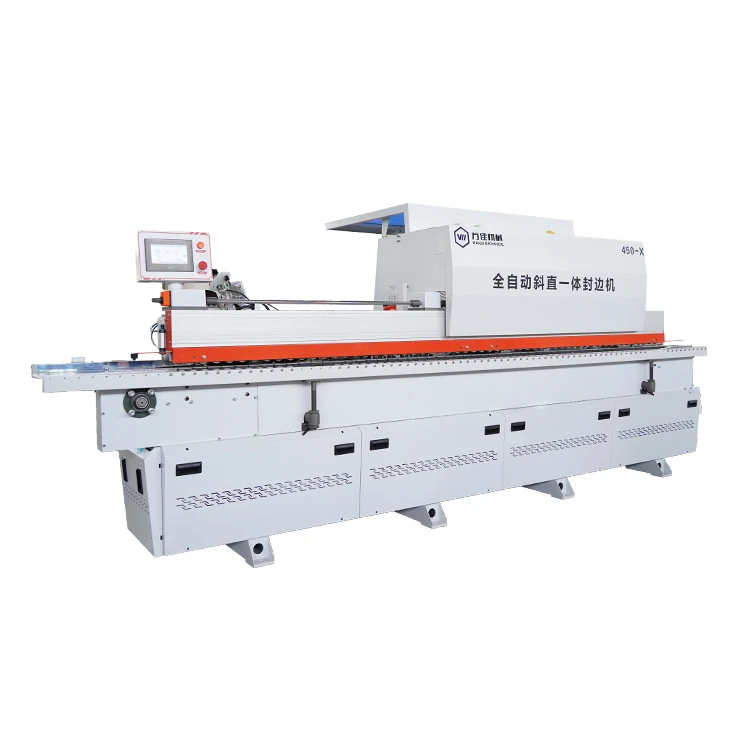
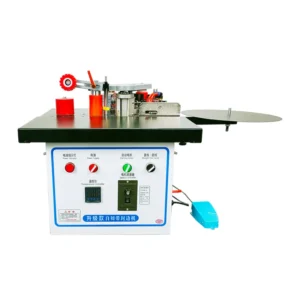
Verified Tolerance In-House — every feed and trim mechanism is precision-ground and inspected across four QC stages before dispatch, ensuring the ±0.02mm accuracy holds under real production loads.
Technical Specifications
| Parameter |
Value |
| Product Type |
Automatic Edge Banding Machine |
| Overall Dimensions (L×W×H) |
435 × 92 × 165 cm |
| Total Power |
17.5 kW |
| Voltage & Frequency |
380V / three-phase five-wire / 50Hz (source value — confirm target market voltage requirement) |
| Conveying Motor |
380V, 2.2 kW with frequency converter |
| Feed Speed |
0–12 m/min, variable speed |
| Glue Pot Capacity |
2000 mL |
| Glue Pot Heating Power |
1.2 kW |
| Glue Pot Use Temperature |
150–170°C |
| Heat Gun Power |
2 kW |
| Trimming Motor |
380V, 0.75 kW × 2 |
| Polishing Motor |
380V, 0.37 kW × 2 |
| Selection Motor |
380V, 4 kW |
| Milling Motor B |
380V, 3.5 kW |
| Edge Banding Thickness |
up to 1.2 mm |
| Panel Width Range |
>100 mm |
| Panel Length Range |
>250 mm |
| Control System |
Xinjie industrial touch screen with industrial inverter |
| Air Source Pressure |
0.6 MPa – 0.8 MPa |
| External Suction Port Diameter |
100 mm |
Application Suitability
| Application |
Material or Output |
| Custom furniture panel edge finishing |
Melamine-faced particleboard and MDF |
| Cabinet door and carcass production |
Plywood panels with PVC edge banding |
| Small to medium workshop panel processing |
Boards exceeding 100 mm width and 250 mm length |
| Batch edge banding for shelving and storage units |
Standard 18 mm, 22 mm and 25 mm thickness substrates |
Why the Voltage Question Must Precede Every Automatic Edge Banding Machine Specifications Review
A machine wired for the wrong grid will not start, regardless of how well it was built.
I spent years watching containers arrive at European workshops only for the electrician to shake his head at the main isolator. One Polish cabinet factory received a unit quoted at 380V when their facility ran 415V three-phase — the local transformer took three weeks to source, and the production schedule was already committed to a kitchen contract. Checking the Automatic Edge Banding Machine specifications against your facility supply is the single most important step before signing a purchase order [NEED_CITE: voltage and frequency standards by export market]. Mismatches in frequency are even less forgiving: a 50Hz motor forced onto a 60Hz supply runs hotter and faster than its bearings were designed for, shortening service life noticeably.

Mapping the Feed Speed to Your Line Rhythm
The 0–12 m/min variable feed speed, managed through a Xinjie industrial inverter, lets operators dial the line in to match what comes off the panel saw. Running thinner melamine boards at higher feed rates keeps throughput aligned with upstream cutting, while slowing down for heavier plywood panels gives the glue pot and pressure rollers adequate contact time. This flexibility matters when a single Automatic Edge Banding Machine specifications sheet needs to cover both a fast carcass run and a slower, detail-heavy door batch on the same shift.
Understanding What the Glue Pot Capacity Means in Practice
A 2000 mL glue pot running between 150°C and 170°C holds enough EVA adhesive to sustain a continuous run without pausing for reloads. The 1.2 kW heating element paired with the 2 kW heat gun keeps the adhesive within its working window even when the shop floor temperature drops in winter months. Operators who have dealt with smaller pots know the frustration of stopping mid-panel to top up — the temperature dip during that pause is exactly what causes the visible glue line on the next board [NEED_CITE: EVA adhesive open time and temperature stability].
Reading the Trim and Polish Motor Data Correctly
The two 0.75 kW trimming motors handle rough and fine trimming in sequence, removing the overhanging PVC strip and bringing the edge flush with the panel face. Downstream, the two 0.37 kW polishing motors clean any residual adhesive and buff the edge to a finished appearance. When you study Automatic Edge Banding Machine specifications, the number of active stations between trimming and polishing determines how many passes the edge receives — and that directly controls whether a cabinet door edge looks machined or hand-finished.
When the Wrong Panel Range Creates Downstream Rejects
Feeding boards narrower than 100 mm or shorter than 250 mm through a conveyor system designed for larger panels causes misalignment at the trimming station. The panel skews against the fence, and the trim cutters remove uneven amounts from each end — one side flush, the other still proud. In a furniture assembly context, that mismatch shows up as a gap when two edged panels meet at a corner joint, and no amount of clamping fixes it on the bench [NEED_CITE: panel furniture assembly tolerance requirements].
What Happens When Specifications Are Assumed Rather Than Confirmed
Ordering without verifying the air source pressure requirement of 0.6–0.8 MPa means discovering on commissioning day that your existing compressor cannot keep up. The pneumatic cylinders that raise the pressure beam and actuate the trimmers stutter, producing inconsistent edge contact. Similarly, overlooking the 100 mm external suction port means connecting to an undersized extraction line, and the fine PVC swarf from trimming accumulates around the feed chain — degrading tracking accuracy within the first week of operation.
Procurement Confidence Through Verified Build Quality
The manufacturer holds proprietary cutting mechanism patents that govern how the trimming stations achieve their tolerance, and this is documented rather than merely claimed. Voltage configuration from 110V to 440V is available as a standard option, so the machine arrives matching your grid without an external transformer. A four-stage QC process covers incoming material inspection through pre-shipment verification, and the engineer-led configuration recommendation arrives as a formal quotation within 24 hours. Factory visits are welcomed for buyers who want to see the precision grinding and assembly stages before committing.
Documentation & Verification
- CE declaration of conformity applicable to the configured voltage and market destination
- Machine specification sheet listing every motor rating and the confirmed feed speed range
- Electrical schematic and voltage confirmation document matched to your facility supply
- Factory test record showing edge trim quality on your specified panel thickness
- Operation and maintenance manual in the agreed operator language
- Spare parts list covering consumable trimmer cutters and polishing wheels
Installation, Commissioning & Support
- Floor space allocation for the 435 cm length with clearance for panel infeed and outfeed
- Dedicated three-phase circuit rated for the 17.5 kW total power draw at the confirmed voltage
- Pneumatic line connection verified against the 0.6–0.8 MPa operating pressure requirement
- Xinjie touch screen configured to the operator language before the first production run
- Trimming and polishing station alignment checked on your actual panel material and PVC thickness
- Scheduled inspection intervals for feed chain tension and glue pot element condition
Moving From Specification Review to a Confirmed Order
Share your standard panel dimensions, the PVC edge banding thickness you run most often, and the voltage and frequency at your main distribution board. Let us know the language your operators need on the Xinjie touch screen, and whether you want to send sample boards for a processing test before dispatch.
Frequently Asked Questions
Q: Can the voltage be configured for my facility if it is not 380V 50Hz?
A: Yes. The machine supports voltage configuration from 110V to 440V across various frequencies. We confirm your exact supply at the quotation stage and produce the electrical schematic to match, so the unit connects directly to your existing three-phase distribution board without requiring a step-up or step-down transformer on site.
Q: Will this machine handle ABS edge banding or only PVC up to 1.2 mm?
A: The current specification lists PVC edge banding up to 1.2 mm thickness. ABS and other thermoplastic materials have different melting and adhesion characteristics, so compatibility depends on the glue formulation and temperature window. Share your intended material and we will confirm suitability or adjust the glue pot configuration accordingly.
Q: My panels are sometimes smaller than 100 mm wide — is that a problem?
A: The conveyor and pressure beam geometry requires a panel width exceeding 100 mm for stable feeding and accurate trimming. Panels below that threshold tend to skew on the feed chain. If your production mix includes many narrow pieces, discuss this at the inquiry stage so we can evaluate whether an alternative feed arrangement is needed.
Q: How does the 0–12 m/min feed speed align with my panel saw output?
A: The Xinjie inverter allows stepless speed adjustment within that range, so you can match the edge bander throughput to whatever rhythm your upstream cutting station produces. For a typical small to medium workshop, this range provides adequate headroom to prevent bottlenecks at the edging stage.