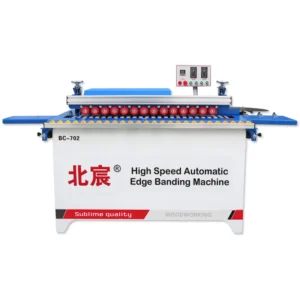
Six-Station Configuration — The DW-3600GF automatic edge banding machine maps gluing through polishing into one continuous pass, eliminating standalone scraping or buffing steps for workshops scaling up panel throughput.
Technical Specifications
| Parameter |
Value |
| Model |
DW-3600GF |
| Product Type |
Automatic Edge Banding Machine |
| Total Rated Power |
4.9 kW |
| Voltage & Frequency |
380V three-phase four-wire (frequency to be confirmed at order) |
| Overall Dimensions (L×W×H) |
2200 × 650 × 1250 mm |
| Net Weight |
320 kg |
| Feed Speed |
0–14 m/min (variable) |
| Edge Band Height Range |
0–50 mm |
| Edge Band Thickness Range |
0.3–3 mm |
| Minimum Panel Length |
200 mm |
| Trimming Motor Power |
800 W × 2 (24,000 r/min) |
| Edge Banding Motor Power |
160 W |
| Transmission Motor Power |
180 W |
| Polishing Motor Power |
400 W × 2 |
| Air Supply Requirement |
0.4–0.6 MPa |
| Standard Function Stations |
Gluing, trimming, front & rear trimming, scraping, polishing, vacuuming |
| Language Options |
Chinese, English (other languages customizable) |
| Plug Options |
EU, USA, AU, UK |
| Certification |
CE (per company profile) |
Application Suitability
| Application |
Material or Output |
| Custom cabinet door edge finishing |
MDF and particleboard with PVC banding 0.4–2 mm |
| Wardrobe panel edge sealing |
Plywood and melamine-faced board with veneer banding up to 3 mm |
| Small-batch office furniture edging |
Particleboard shelving panels minimum 200 mm length |
| Joinery workshop straight-edge runs |
Solid wood panels with thin PVC or ABS edge band |
Why the Voltage Question Should Come Before the Automatic Edge Bander Specifications
Confirming your workshop supply against the machine electrical schematic prevents a unit that arrives but never powers on.
I have stood in workshops where a brand-new edge bander sat wrapped in plastic for weeks because the factory wired it for a voltage the local grid does not deliver. The DW-3600GF ships standard at 380V three-phase four-wire, which covers a wide range of industrial sites, but frequency — 50 Hz or 60 Hz — changes motor behaviour and trimming spindle speed in ways that matter when you are chasing a clean edge on 18 mm MDF. [NEED_CITE: voltage and frequency standards by export market] A quick conversation about your facility supply before the order goes in saves a much longer conversation after the container is unloaded.
Matching Feed Speed to Your Daily Panel Volume
The variable feed rate from 0 to 14 m/min gives operators room to slow down for thick veneer banding on contoured workpieces and speed up for straight PVC runs on standard cabinet sides. The dedicated 180 W transmission motor and 160 W edge banding motor work independently, so band feed stays consistent even when the main drive is under load from heavy stock. When you are evaluating Automatic Edge Bander specifications, pay attention to whether feed speed is truly variable or locked into preset steps — continuous adjustment means fewer stopped panels at shift change.
How the Six-Station Layout Covers a Complete Edge Finish
This machine sequences gluing, rough trimming, front and rear end trimming, scraping, polishing and vacuum extraction into a single linear pass. Each of the two trimming spindles runs at 24,000 r/min on 800 W motors, which is the range where PVC and thin veneer cut cleanly without chipping the substrate edge. The dual 400 W polishing wheels then remove any residual adhesive haze. For a workshop that previously sent panels to a separate scraping bench, consolidating these steps on the DW-3600GF shortens the distance between the saw and the packing table. [NEED_CITE: edge banding station sequence and finish quality standards]
Reading the Numbers That Actually Affect Edge Quality
The trimming motor speed of 24,000 r/min is the figure that most directly determines whether you get a glass-smooth edge or a micro-chipped one on melamine-faced particleboard. At lower spindle speeds the cutter tears the laminate rather than shearing it, and that defect only shows up under LED inspection lighting or when the customer runs a fingernail along the edge. The 0.3–3 mm band thickness range means the same machine handles thin 0.4 mm PVC for budget cabinet runs and 2 mm solid PVC for heavy-use worktops without a tooling change. Air supply at 0.4–0.6 MPa drives the pneumatic pressure rollers and trimming cylinders; if your compressor cannot hold that band consistently, the pressure roller contact force drops and glue lines become visible on lighter substrates. The 200 mm minimum panel length sets the lower boundary for small offcuts — anything shorter risks jamming the infeed fence.

What Happens When the Spec Sheet Is Taken at Face Value
Tolerance numbers sound reassuring on paper, but without a factory test record that measures your actual panel material and banding combination, they remain a claim. I have seen edge banders of this class produce acceptable results on 18 mm MDF and then leave visible glue lines on 25 mm particleboard simply because the pressure roller gap was never reset for the thicker stock. [NEED_CITE: edge banding tolerance verification methods in furniture manufacturing] The DW-3600GF source material does not publish a verified tolerance figure or panel thickness range, which means those two values need to be confirmed with a sample run before the machine is crated.
Why Procurement Conversations Start Here
In-house manufacturing with patented cutting mechanisms means the trimming spindles on the DW-3600GF are built and tested at the same facility that assembles the frame — not sourced from a third-party integrator. Four-stage quality control covers incoming material inspection, in-process checks, finished product verification and pre-shipment testing, so the unit that leaves the factory has been run on actual panel stock. Voltage customization from 110V to 440V and multilingual control panels are treated as standard configuration options rather than special requests. An engineer-led configuration recommendation, backed by a formal quotation within 24 hours, means the spec conversation does not stall in email chains. Factory visits are welcomed, giving buyers the chance to see the machine run their own board and banding material before committing.
Documentation & Verification
- CE declaration of conformity covering the DW-3600GF mechanical and electrical safety requirements
- Machine specification sheet with confirmed tolerance and panel thickness range for your material
- Electrical schematic with voltage and frequency matched to your facility supply
- Factory test record using your specified PVC or veneer banding before dispatch
- Operation and maintenance manual delivered in the operator's agreed language
- Spare parts list identifying consumable trimming cutters and polishing wheels
Installation, Commissioning & Support
- Allocate floor space exceeding 2200 × 650 mm to allow infeed and outfeed clearance for long panels
- Provide a dedicated 380V three-phase circuit rated above 4.9 kW with correct frequency confirmation
- Verify compressed air delivery holds 0.4–0.6 MPa at the machine inlet under continuous cycling
- Schedule first-run parameter setting for trimming spindle offset and pressure roller gap on your board stock
- Train operators on the six-station sequence including glue pot warm-up time and band threading procedure
- Stock spare trimming cutters and polishing pads matched to your banding thickness range
What to Share When Requesting a Configuration Quote
To size the DW-3600GF against your actual production, send the panel substrates you run most often along with their thickness range and the PVC or veneer banding thickness you use. Confirm your workshop voltage and frequency, the control panel language your operators read, and the daily linear metres of edge banding you need to hit. If you already have upstream saws or downstream boring stations, note their throughput so the feed speed can be matched to the line.
Frequently Asked Questions
Q: How can I verify edge banding tolerance and what panel thickness does this machine accept?
A: The published Automatic Edge Bander specifications for the DW-3600GF do not include a confirmed tolerance value or panel thickness range. Request a factory test record that measures edge overhang and glue line visibility on your specific panel and banding combination. A pre-shipment sample run is the only way to verify tolerance against your assembly requirements before the machine ships.
Q: Is the 380V three-phase setup compatible with my local grid frequency?
A: The standard configuration is 380V three-phase four-wire, but frequency — 50 Hz or 60 Hz — affects motor speed and trimming spindle RPM. Voltage is customizable across a wide range at order. Confirm your facility frequency early so the electrical schematic and motor rating plate match your supply, avoiding commissioning delays after delivery.
Q: How does the six-station layout compare to machines with pre-milling or corner rounding?
A: The DW-3600GF covers gluing through polishing in one pass but does not include a pre-milling station or corner rounding unit. If your panels arrive from the saw with edge tear-out, a pre-milling step would clean the substrate before gluing. For radius edges on worktops, a separate corner rounding station or manual operation is needed downstream.
Q: What is the minimum panel dimension and how does feed speed influence daily throughput?
A: The minimum panel length is 200 mm, which sets the boundary for small offcuts and narrow shelving. Feed speed is continuously variable up to 14 m/min, so throughput depends on your board size mix and whether operators pause between panels. Matching feed rate to your cutting station output prevents bottlenecks at the infeed fence.
Q: Can the control panel language be set to my operator's preferred language?
A: The DW-3600GF ships with Chinese and English interfaces as standard, and other languages are customizable at order. Confirm the required language during the specification phase so the control panel labels, error messages and maintenance prompts all match what your operators read, reducing commissioning time and fault diagnosis errors.