Precision Tolerance Verification — every dimensional claim on this edge bander is backed by a factory test record before dispatch, so assembly-fit accuracy is confirmed before the crate leaves the floor.
Technical Specifications
| Parameter |
Value |
| Product Type |
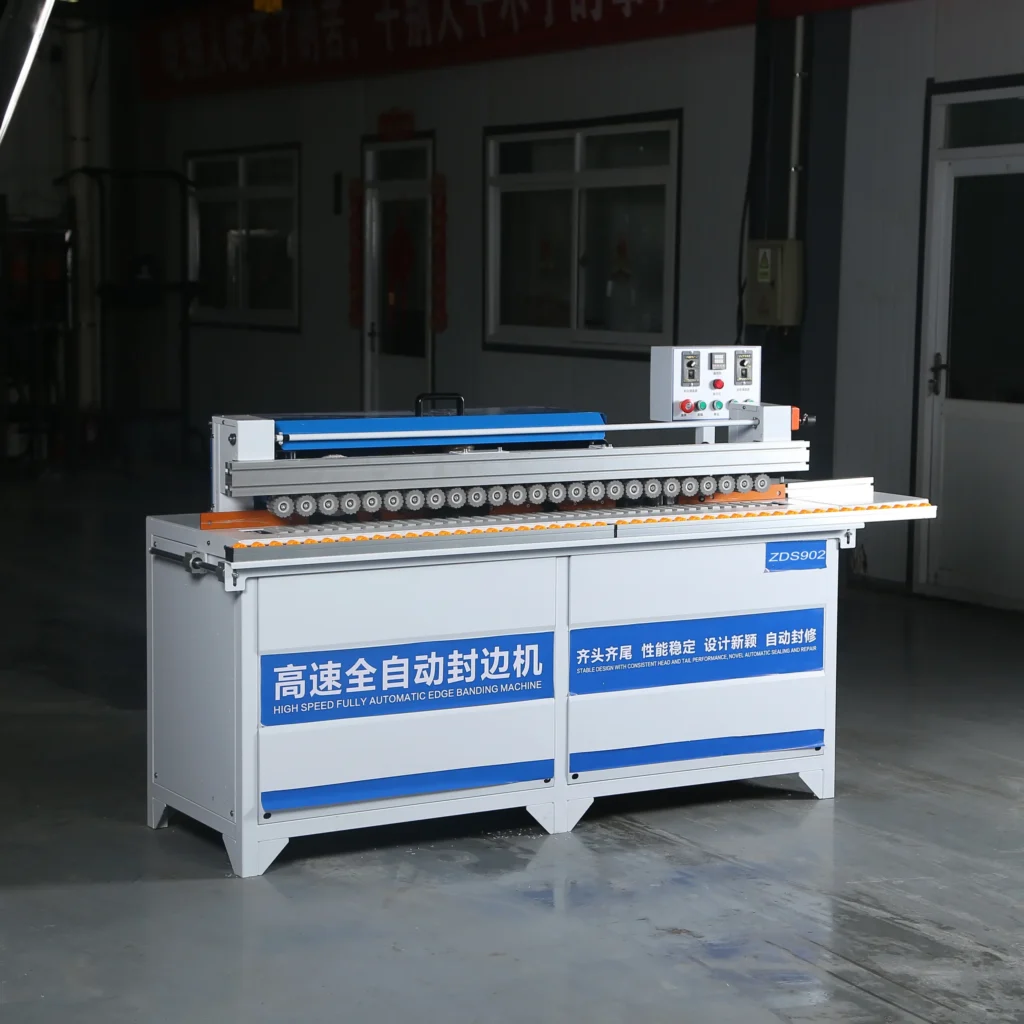
Automatic Edge Banding Machine |
| Edge Banding Type |
Linear |
| Overall Dimensions (L×W×H) |
2070 × 600 × 1220 mm |
| Net Weight |
245 kg |
| Total Power |
4200 W (rated value to be confirmed at order) |
| Voltage |
220 V (frequency and phase to be confirmed before production) |
| Edge Band Thickness Range |
0.5–2.5 mm |
| Edge Band Height Range |
0–35 mm |
| Glue Pot Capacity |
4000 ml |
| Gluing System |
Double-sided gluing |
| Trimming Stations |
Up and down double high-speed trimming motors |
| Polishing Stations |
Up and down two polishing motors |
| Pressure System |
Integrated pressure beam with double rows of pressure wheels |
| Conveyor Belt Material |
Silicone |
| Temperature Control |
Intelligent temperature control |
| Edge Strip Cutting |
Pneumatically controlled cutting device |
| Pressure Beam Adjustment |
Manual handle for board height adjustment |
| Feed Speed |
To be confirmed at quotation |
| Panel Thickness Range |
To be confirmed at quotation |
| Control System |
To be confirmed (PLC or relay logic) |
| Dust Extraction Port Diameter |
To be confirmed |
| HMI Language Options |
To be confirmed |
| Warranty |
1 year |
| Assembly State |
Partially assembled; on-site assembly required per manual |
Application Suitability
| Application |
Material or Output |
| Cabinet door and carcass edge finishing |
MDF and particleboard with PVC edge banding 0.5–2.5 mm |
| Custom wardrobe panel processing |
Plywood panels with melamine or veneer edge strips |
| Small-batch furniture component edging |
Solid wood panels up to 35 mm edge height |
| Workshop transition from manual to automated edging |
Linear workpieces requiring trimming and polishing in one pass |
Why the Voltage Question Should Come Before the Automatic Edge Banding Machine Specifications
Lock voltage, frequency, and phase before any other specification is finalized.
I once shipped a fully configured edge bander to a Colombian workshop with every mechanical parameter matched to their production — except the electrical supply. The local grid ran 440 V at 60 Hz while the machine was wired for a different standard. The unit sat on their floor for three weeks while a replacement control cabinet was sourced and shipped [NEED_CITE: voltage and frequency standards by export market]. That delay cost more than any discount on the purchase price. When evaluating automatic edge banding machine specifications, the electrical configuration is the single most consequential line item because it determines whether the machine runs at all on arrival.
How Each Specification Translates to Panel Output
Evaluating an automatic edge banding machine means reading past the headline numbers. The 0.5–2.5 mm edge band thickness range tells you which PVC, ABS, and veneer stocks the trimming motors can cleanly process without chipping or leaving adhesive residue. The double-sided gluing system paired with a 4000 ml glue pot governs how many linear meters of edging you can run before stopping to refill — a factor that directly shapes shift-level throughput on a cabinet production run.
What the Trimming and Polishing Configuration Actually Determines
The up-and-down double high-speed trimming motors remove overhanging edge material in a single pass, and their alignment precision dictates whether the finished edge sits flush or requires secondary hand-work. Following that, the dual polishing motors burnish the trimmed surface to remove micro-scratches left by the cutters [NEED_CITE: surface finish requirements for custom furniture acceptance]. When both stations operate within tolerance, the output panel moves directly to boring or assembly without intermediate rework — a detail that matters on every board that passes through.
Reading the Numbers That Affect Downstream Assembly
The integrated pressure beam with double rows of pressure wheels holds the panel flat against the silicone conveyor belt during feed, which is what prevents board drift and keeps the edge band aligned to the panel face. If the pressure wheel spacing does not match the panel thickness range, thinner boards can lift and thicker boards can jam. Intelligent temperature control on the glue pot maintains consistent adhesive viscosity across varying ambient workshop temperatures, preventing the cold-weather glue starvation or hot-weather squeeze-out that shows up as visible glue lines on finished cabinet doors [NEED_CITE: hot-melt adhesive viscosity and temperature relationship]. The 2070 × 600 × 1220 mm footprint means this unit fits into workshops where floor space is constrained, but the dust extraction port diameter and compressed air supply must still be planned into the installation layout.

What Happens When Configuration Is Skipped
Ordering a linear edge bander without confirming panel thickness range against your actual stock means discovering the incompatibility only when your thinnest shelf panel jams under the pressure beam. Skipping the feed-speed confirmation leads to throughput assumptions that your upstream panel saw cannot match, creating a bottleneck that no amount of overtime resolves [NEED_CITE: production line balancing for panel furniture workshops]. And if the HMI language is not specified before the control panel is built, your operators face a commissioning delay that stalls the entire installation schedule.
Why This Machine Fits the Specification-Driven Buyer
The four-stage quality control process covers incoming material inspection through pre-shipment verification, so each trimming motor alignment and pressure wheel calibration is checked against documented tolerances. Voltage customization from 110 V to 440 V is available as a standard configuration option, not a special request, which eliminates the grid-compatibility failures I have seen stall other installations. The product family spans entry-level units through full-function pre-milling configurations, meaning a workshop can add capacity later without switching suppliers or retraining operators on a different control interface. An engineer-led configuration review with a formal quotation within 24 hours ensures the specification sheet you receive reflects your actual workshop conditions rather than a generic catalog page.
Documentation & Verification
- Machine specification sheet listing confirmed feed speed and panel thickness range
- Electrical schematic reflecting your workshop voltage and frequency
- Factory test record run on your specified panel material before dispatch
- Operation and maintenance manual in your operator's working language
- CE declaration of conformity for applicable export markets
- Spare parts list matched to your trimming and polishing motor configuration
Installation, Commissioning & Support
- Confirm dedicated circuit capacity for the 4200 W total power draw before delivery
- Plan compressed air line routing to the pneumatic edge strip cutting device
- Allow floor space for the 2070 × 600 mm footprint plus operator clearance on both ends
- Schedule on-site assembly for partially shipped components per the supplied manual
- Verify glue pot temperature calibration with your specific adhesive during first run
- Stock replacement trimming blades and polishing wheels from the included spare parts list
What to Include in Your Inquiry
Provide the panel materials you process, including substrate type and the exact edge banding stock dimensions you use most frequently. Confirm your workshop supply voltage, frequency, and whether the circuit is single-phase or three-phase. Specify the operator language for the control panel and whether you need the operation manual translated for your local team.
Frequently Asked Questions
Q: What feed speed and panel thickness range does this edge bander support?
A: Feed speed and panel thickness range are confirmed during the configuration review based on your production volume and material mix. Requesting a formal specification sheet before order ensures these values are locked to your requirements rather than left to a default setting that may not match your workshop conditions.
Q: Is the 220 V configuration single-phase or three-phase, and can it be customized?
A: The 220 V base configuration must be confirmed as single-phase or three-phase depending on your workshop supply. Voltage customization from 110 V to 440 V with the appropriate frequency is available as a standard option and must be finalized before the control cabinet is built.
Q: What control system is used, and is the HMI available in multiple languages?
A: The control system type and HMI language options are confirmed during quotation based on your operator requirements. Specifying the display language before production prevents commissioning delays that occur when the interface arrives in a language the workshop team cannot read.
Q: How do I match the trimming and polishing stations to my edge banding material?
A: PVC, ABS, and veneer edge banding each require different trimming speeds and polishing pressures. The dual high-speed trimming motors and dual polishing motors are configured during setup to match your primary material, ensuring clean edges without secondary hand-finishing on finished panels.
Q: What utilities are needed for installation beyond the electrical supply?
A: Beyond the confirmed voltage circuit, you need a compressed air supply for the pneumatic edge strip cutting device and a dust extraction connection. The exact port diameter and air pressure requirement are listed on the electrical schematic and specification sheet provided before shipment.

![` 标签,因为回答本身就是最终内容。 * 使用标准连字符 `-` 代替 en dash `–` 以防编码问题,或者直接使用 `-`。 * `Automatic Wood Panel Edge Banding Machine - Specifications` (57 chars) * 再确认一下结构3: `[应用或物料] [品类词] – [站点修饰词]` * Wood Panel (应用或物料) Edge Banding Machine (品类词) - (分隔) Specifications (站点修饰词) * 完美。](https://ruiqiwoodmachine.com/wp-content/uploads/2026/05/H40e3bbcdfadb464da23e3e88c6ee3d0dB-1-300x300.webp)


