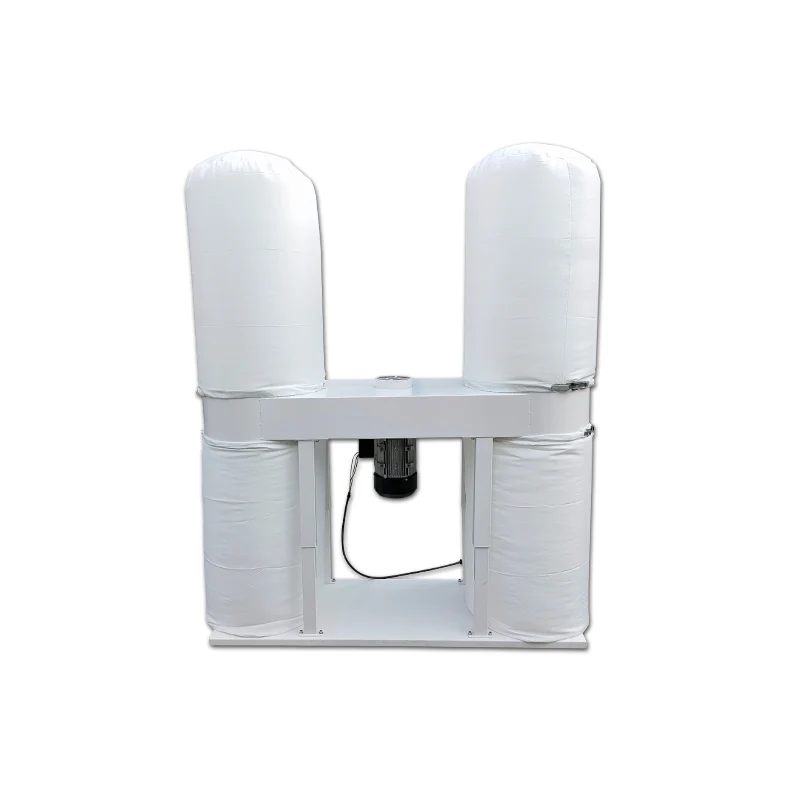
Verified Tolerance Configuration — Every dust collector specification is confirmed against your facility voltage, extraction port diameter, and machine layout before production begins.
Technical Specifications
| Parameter |
Value |
| Product Type |
Industrial Dust Collector |
| Working Principle |
Bag filtration with diversion device for large particle separation |
| Filtration Mechanism |
Multi-bag inlet with gravity pre-separation into dust hopper |
| Compatible Equipment |
CNC router, sander, panel saw, edge banding machine, slotting machine, woodworking saw table |
| Assembly State |
Complete unit: dust hopper, guide pipe, diversion device, filter bags |
| Plug Options |
EU / USA / AU / UK (configurable at order) |
| Control Panel Language |
Chinese and English standard; additional languages on request |
| Packaging |
Wooden crate |
| Rated Power |
To be confirmed based on configuration |
| Voltage & Frequency |
Configurable to local supply standard |
| Airflow Capacity |
Matched to connected machine port requirements |
| Filtration Area |
Sized per workshop extraction layout |
| Dust Collection Efficiency |
Verified during pre-shipment test |
| Dust Extraction Port Diameter |
Matched to client machine outlets |
Application Suitability
| Application |
Material or Output |
| CNC routing dust extraction |
MDF, plywood, particleboard fine dust and chips |
| Panel saw and beam saw dust capture |
Coarse wood chips and melamine edge particles |
| Wide-belt and orbital sander extraction |
Fine substrate dust from MDF and veneered panels |
| Edge bander trimming waste collection |
PVC, ABS, and wood veneer edge trimmings |
| Slotting and boring machine cleanup |
Bore dust and groove chips from panel processing |
| Multi-station workshop central extraction |
Mixed dust streams from solid wood and composite boards |
Why Matching Airflow to Your Machines Matters More Than Maximum Ratings
The dust collector specifications woodworking machinery buyers should verify first are the combined port requirements of every connected station, not a single peak number on a brochure.
I have watched workshops buy extraction units based on a headline airflow figure, then discover the duct diameter does not match their panel saw outlet or their CNC router demands a different static pressure than their sander. The result is dust settling on freshly machined panel surfaces, and edge banding adhesive refusing to bond to a board coated in fine MDF powder [NEED_CITE: impact of airborne dust on adhesive bonding in panel processing]. When extraction ports are sized without confirming each machine's individual requirement, the whole shop floor breathes what the collector was supposed to capture.

Pre-Separation Before the Filter Bags
The diversion device handles the heavy lifting before fine filtration begins. Large chips and coarse particles from panel saws and CNC routers fall directly into the dust hopper under gravity, which means the filter bags only handle the finer fraction. This two-stage approach reduces bag loading and extends the interval between cleanings during continuous production shifts. For a shop running both a sliding table saw and a wide-belt sander on the same extraction line, the pre-separation stage keeps sawdust from overwhelming bags that would otherwise clog within hours on sander dust alone.
Configuring the Electrical Interface Before Production
One of the most common failures I see with imported dust collector specifications woodworking machinery buyers overlook is the voltage mismatch. A unit wired for a different frequency runs its fan motor at the wrong speed, which shifts the entire airflow curve downward. This collector ships with confirmed plug type — EU, USA, AU, or UK — and the motor winding matches your facility supply. The control panel language is set to whatever your operators actually read, eliminating the guesswork during commissioning [NEED_CITE: voltage and frequency standards by export market].
Reading the Numbers That Actually Affect Extraction
Filtration area determines how much dust-laden air the bags can process before static pressure rises and suction drops at the machine port. Airflow capacity must exceed the sum of all open ports running simultaneously, with a margin for duct friction losses across the pipe run. Dust extraction port diameter needs an exact match: a 100 mm machine outlet forced onto a 120 mm duct creates turbulence that deposits chips inside the pipe. For shops processing MDF, fine dust penetrates standard felt bags, so specifying the correct bag media for the substrate is as important as the motor rating itself. The dust collector specifications woodworking machinery procurement teams should document include bag material grade alongside airflow and static pressure.
The Hidden Cost of Undersized Duct Connections
When a collector is selected without mapping each machine port, the shop ends up adding secondary open ports or running machines without extraction to keep suction adequate at the primary station. Operators then breathe airborne MDF dust, panel surfaces arrive at the edge bander coated in fines, and adhesive bond failures show up only after the furniture reaches the customer. I once traced a batch of delaminating cabinet doors back to a sander that had been disconnected from the main duct because the collector could not pull enough from all stations at once [NEED_CITE: CE machinery directive requirements for industrial dust extraction systems]. The downtime and rework cost far exceeded what a properly sized system would have required from the start.
Why Sourcing This Collector Through Our Configuration Process
Every dust collector configuration begins with your machine list, port diameters, and duct layout, not a generic catalog page. The engineer-led recommendation confirms airflow, voltage, and bag media before the quotation is issued, typically within one working day. The four-stage quality check includes a pre-shipment airflow verification on the assembled unit, so performance is documented before the crate leaves the factory. Plug type and control panel language are locked in at order confirmation, matching your local electrical standard and operator requirements. For workshops scaling from a single machine to a multi-station line, the same extraction product family covers the range without switching suppliers.
Documentation & Verification
- Electrical schematic confirming voltage, frequency, and plug type for your facility
- Machine specification sheet listing matched airflow and filtration area for your connected equipment
- Factory test record showing dust collector specifications woodworking machinery verification before crating
- Operation and maintenance manual in your agreed control panel language
- Filter bag material data sheet matched to your primary substrate dust type
- Packing photographs documenting assembly state prior to dispatch
Installation, Commissioning & Support
- Confirm dedicated circuit rating matches the collector motor before electrical hookup
- Position the unit with clearance around the dust hopper for bag access and hopper emptying
- Connect duct runs using matched port diameters to avoid turbulence-induced chip buildup
- Verify fan rotation direction against the wiring diagram on first power-up
- Set bag pulse cleaning interval based on your dominant substrate dust loading
- Stock replacement filter bags in the specified media grade for your material mix
What We Need to Configure Your Extraction System
Share the make and model of every woodworking machine that will connect, along with each machine's extraction port diameter and the duct run length to the collector location. Confirm your facility voltage, phase, and frequency so the motor can be wound correctly before assembly. Let us know your primary substrates — MDF generates different fines than solid oak — so the bag media can be specified accordingly.
Frequently Asked Questions
Q: How do I match dust collector airflow capacity to the number of connected woodworking machines?
A: Add the airflow requirement stated on each machine's extraction port plate, then include a margin for duct friction across the pipe length. The collector must sustain that combined volume at the required static pressure. We confirm the total during the configuration stage and size the fan and filtration area to match your specific machine list and duct layout.
Q: What voltage and plug configurations are available for my electrical standard?
A: The motor can be wound for your local voltage and frequency, and the plug is fitted as EU, USA, AU, or UK type at the factory. We confirm your supply specifications before production starts so the unit arrives ready to connect without transformers or adapters on site.
Q: Can the control panel be supplied in a language my operators read?
A: Chinese and English are standard, and additional languages are available on request. The panel labels, start-stop interface, and pulse cleaning settings are all translated so your team can operate and maintain the collector without interpretation during daily production.
Q: How is filtration performance verified before shipment?
A: Each assembled unit undergoes a pre-shipment test that documents airflow and static pressure at the extraction inlet. The test record is included with your documentation package so you have a baseline to compare against once the collector is connected to your duct system in the workshop.
Q: What is the recommended filter bag replacement interval for continuous production?
A: Replacement timing depends on the substrate dust loading and daily operating hours. MDF fine dust loads bags faster than coarse solid wood chips. We specify bag media grade for your material mix and provide a maintenance schedule in the operation manual based on your declared production volume.