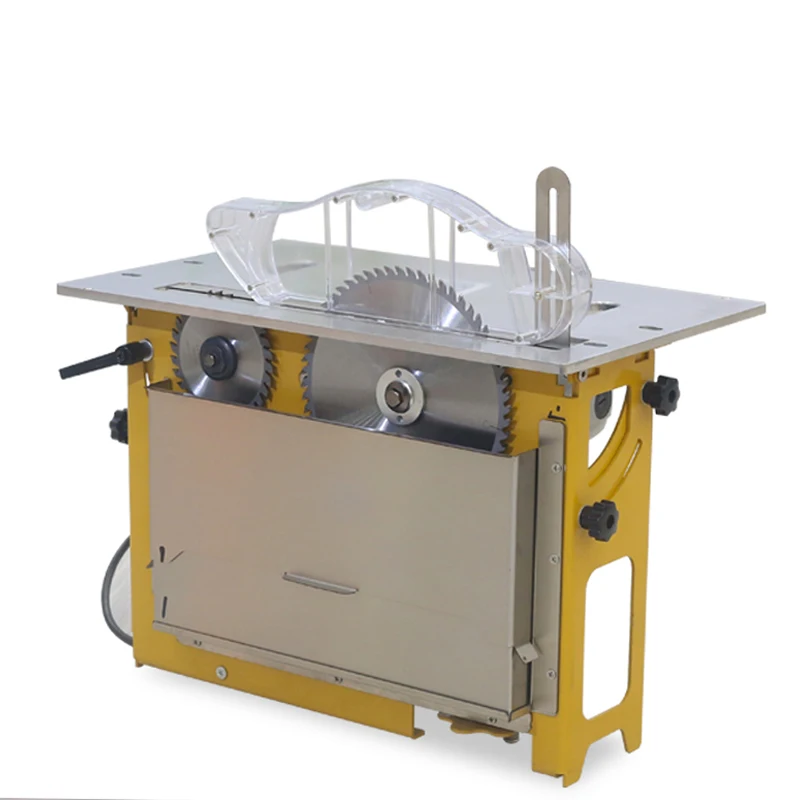
Specification-First Sourcing — Every portable panel saw configuration we quote starts with confirmed electrical supply and panel material data, ensuring the 6200W dual-motor system arrives ready to cut on your shop floor.
Technical Specifications
| Parameter |
Value |
| Product Type |
Portable Panel Saw |
| Total Rated Power |
6200W (main saw 3000W + sub saw 2000W + vacuum 1200W) |
| Main Saw Motor |
3000W at 3800 r/min |
| Sub Saw (Scoring) Motor |
2000W at 13000 r/min |
| Main Saw Blade Diameter |
20 cm |
| Dust Extraction |
Integrated 1200W vacuum cleaner |
| Maximum Panel Cutting Length |
2.44 m (basis to be confirmed by panel type and thickness) |
| Maximum Panel Cutting Thickness |
4 cm (basis to be confirmed by material density and feed speed) |
| Net Weight |
22 kg |
| Machine Dimensions |
50 × 30 × 38 cm |
| Voltage & Frequency |
Configurable — confirm local supply before order |
| Plug Options |
EU / USA / AU / UK |
| Control Language |
Chinese and English standard; other languages available on request |
| Motor Configuration |
Dual motor (main saw + scoring sub saw) plus vacuum motor |
Application Suitability
| Application |
Material or Output |
| On-site joinery and fit-out work |
MDF, particleboard, and plywood sheets up to 2.44 m length |
| Small workshop panel sizing |
Melamine-faced board with scoring saw for reduced chip-out |
| Cabinet component cutting |
Plywood and veneered panels requiring clean edges on both faces |
| Remote job site carpentry |
Sheet materials where full-size sliding table saws are impractical |
| Prototype and sample preparation |
Wood-based panels in low-volume cutting environments |
What Portable Panel Saw Specifications Actually Mean for Your Cut Quality
The difference between a clean panel edge and a chipped one comes down to motor configuration, not marketing claims.
I have seen workshops order a portable panel saw based on maximum cutting length alone, only to discover the single-motor unit tears through melamine surfaces leaving visible chip-out on every cut. When panels fail at the assembly stage because edges do not seat properly, the cost is never just one bad cut — it cascades through the entire batch. Portable panel saw specifications must be read as a system: the scoring sub saw, the main blade diameter, and the power distribution all determine whether your operator produces furniture-ready components or scrap [NEED_CITE: panel edge quality standards in furniture manufacturing].

Dual-Motor Architecture and Edge Integrity
The 3000W main saw and 2000W scoring sub saw operate independently, each tuned to a different function. The scoring saw at 13000 r/min makes a shallow preliminary cut on the underside of laminated panels, breaking the surface veneer or melamine layer before the main blade passes through. This portable panel saw configuration addresses the chip-out problem that single-motor machines cannot solve on coated substrates. Without a dedicated scoring motor, operators compensate by slowing feed rates or making double passes — both of which reduce usable output.
Power Distribution Across Three Functional Systems
The 6200W total rating splits across three independent loads: cutting, scoring, and dust extraction. The integrated 1200W vacuum motor handles chip evacuation at the cut point rather than relying on an external extractor. For workshops where floor space limits the number of standalone machines, consolidating dust extraction into the saw unit reduces the peripheral equipment footprint. Power draw planning should account for all three motors running simultaneously when sizing circuit breakers and supply cables for this portable panel saw.
Cutting Envelope and Standard Panel Alignment
The stated 2.44 m maximum cutting length aligns with the standard full-sheet dimension used globally for MDF, plywood, and particleboard panels. The 4 cm maximum thickness capacity covers the range of common furniture-grade sheet materials, though actual achievable thickness depends on material density and feed rate [NEED_CITE: panel thickness standards for wood-based sheet materials]. The 20 cm main blade diameter determines both maximum depth of cut and the torque requirement at the spindle — a smaller blade would limit thickness capacity while a larger one would demand more motor power to maintain cutting speed under load.
The Hidden Cost of Skipping Voltage Confirmation
A portable unit arriving with the wrong voltage specification becomes dead weight until a transformer is sourced and installed. I worked with a buyer whose portable saw sat idle for weeks because the motor was wound for a supply frequency that did not match their local grid. Unlike stationary machinery where an electrician might rewire on site, the compact motor housings on portable panel saws leave little room for field modification. Voltage, frequency, and plug type must be confirmed in writing before production begins — not after the machine is crated.
Why Specification Verification Matters at This Price Point
Every parameter in the table above should be traceable to a factory test record, not just a catalog claim. The dual-motor power split, the scoring saw speed, the maximum cutting envelope — these portable panel saw specifications determine whether the machine fits your production requirements or creates new bottlenecks. Request documented test results on your specific panel material rather than accepting generic cutting demonstrations [NEED_CITE: machinery test documentation requirements for international trade].
Documentation & Verification
- Machine specification sheet with confirmed cutting tolerance on your panel material
- Electrical schematic and voltage confirmation matched to your local supply standard
- Factory test record demonstrating cut quality on your specified board type and thickness
- Operation and maintenance manual provided in your agreed language before shipment
- Spare parts list with part numbers for blades, scoring saw components, and vacuum filters
Installation, Commissioning & Support
- Dedicated circuit rated for 6200W continuous draw across all three motors
- Level working surface required — the 22 kg unit must be stable during full-length cuts
- Main saw blade and scoring saw alignment verification before first production run
- Vacuum cleaner filter inspection schedule based on panel material dust density
- Scoring saw blade replacement procedure included in operator training documentation
Before You Request a Quotation
Provide your standard panel material types, typical sheet dimensions, and the thickness range your cut list demands. Confirm your workshop supply voltage and frequency so the motor specification is locked before production. If your operators require a specific control language beyond Chinese or English, note this in the inquiry so the interface is configured accordingly.
Frequently Asked Questions
Q: How do I verify cutting tolerance when specifications only list maximum dimensions?
A: Maximum cutting length and thickness describe the envelope, not precision. Request a factory test record showing actual cut measurements on your panel material at your required thickness. Tolerance should be documented in the specification sheet with the test method identified, so you can verify results independently when the machine arrives at your workshop.
Q: What documentation confirms the voltage matches my local electrical supply?
A: The electrical schematic and voltage confirmation document should state the exact motor winding specification, frequency rating, and plug configuration for your market. This document is issued before production and forms part of the pre-shipment verification package. Never rely on a general catalog voltage range — your specific order must carry a confirmed electrical specification.
Q: How does the dual-motor configuration affect cut quality on melamine-faced panels?
A: The 2000W scoring sub saw at 13000 r/min pre-cuts the melamine layer on the panel underside before the 3000W main blade passes through at 3800 r/min. This two-stage cut prevents chip-out on both faces of laminated boards. A single-motor portable panel saw cannot replicate this result without secondary finishing passes that reduce throughput.
Q: Can this portable panel saw handle my standard full-size sheets?
A: The 2.44 m maximum cutting length covers standard full-sheet panel dimensions for MDF, plywood, and particleboard. Confirm that your typical panel thickness falls within the 4 cm maximum and that material density does not exceed the motor capacity. Provide your standard panel specifications during inquiry for a confirmed compatibility assessment.