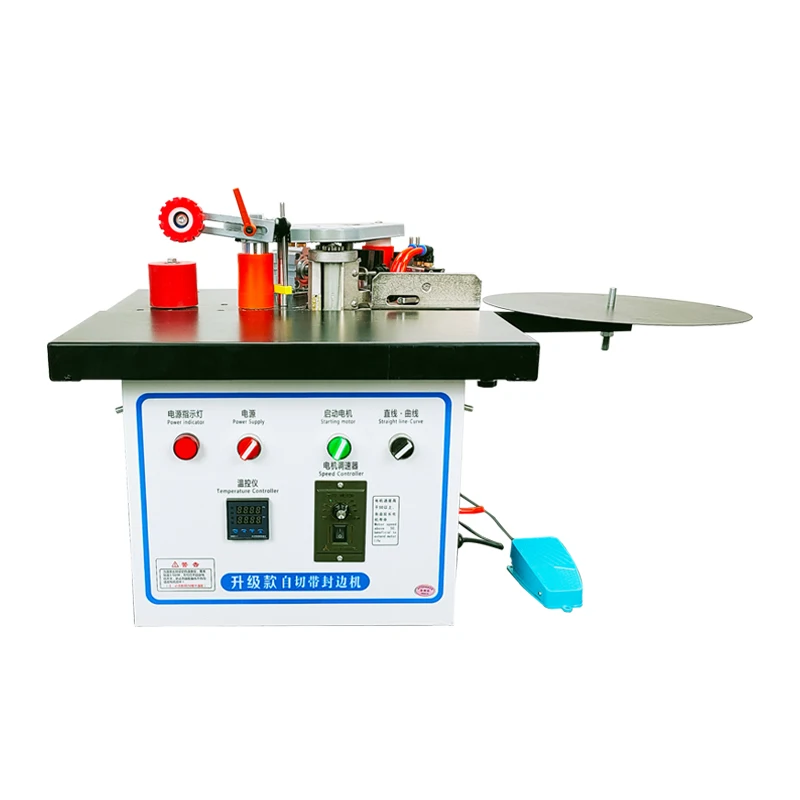
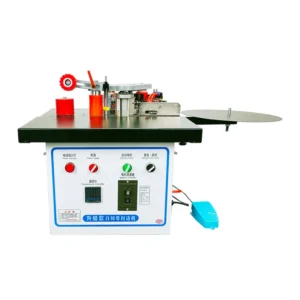
Voltage-confirmed configuration — every ST-50 Automatic Edge Banding Machine ships with a signed electrical schematic matching your facility's supply, preventing the commissioning failures I have witnessed when 380V units meet 440V grids.
Technical Specifications
| Parameter |
Value |
| Model |
ST-50 |
| Product Type |
Automatic Edge Banding Machine |
| Total Power |
1000W |
| Voltage & Frequency |
220V / 380V / customization |
| Edge Banding Height |
0–50 mm |
| Edge Banding Thickness |
0.3–3 mm |
| Minimum Sheet Length |
25 cm |
| Minimum Sheet Width |
3 cm |
| Edge Power |
20W |
| Air Source Pressure |
0.5–0.8 MPa |
| Glue Pot Capacity |
1000 ml |
| Product Size |
50 × 50 × 47 cm |
| Net Weight |
22 kg |
| Standard Features |
Curved and straight edge banding |
| Plug Options |
EU, USA, AU, UK |
| Language Options |
Chinese and English standard; Spanish and other languages customizable |
| Assembly State |
Fully assembled |
| Feed Speed |
(basis to be confirmed) |
| Tolerance |
(basis to be confirmed) |
Application Suitability
| Application |
Material or Output |
| Custom cabinet door edge sealing |
MDF and particleboard with PVC or veneer banding |
| Small workshop furniture repair |
Ecological board and plywood, curved and straight profiles |
| Home decoration on-site carpentry |
Solid wood board and plywood, portable setup |
| Joinery workshop production |
MDF and particleboard panels up to 50 mm edge height |
Why the Voltage Question Should Come Before the Automatic Edge Banding Machine Specifications
Confirming local voltage and frequency before production prevents costly commissioning delays.
I once shipped an edge bander to Colombia rated at 380V/50Hz. The workshop ran on 440V/60Hz. The inverter burned on first power-up, and the factory stood idle for three weeks waiting for replacement components. Since then, I treat voltage confirmation as a non-negotiable step before any machine enters production. The ST-50 supports 220V and 380V configurations with full customization available, and the plug type — EU, USA, AU, or UK — is specified at order. [NEED_CITE: voltage and frequency standards by export market]

Defining the Material Envelope Through Published Numbers
When you compare entry-level edge banders, the edge height range and banding thickness range tell you immediately whether a machine fits your panel stock. The ST-50 covers 0–50 mm in edge height and 0.3–3 mm in banding thickness, which accommodates standard PVC, melamine, and thin veneer tapes on MDF, particleboard, and plywood. Knowing these boundaries before purchase eliminates the situation where a machine arrives and cannot process the substrate your production depends on. The Automatic Edge Banding Machine specifications sheet should always be read against your actual material list, not against catalog claims alone.
Compact Footprint Without Sacrificing Dual Capability
Many small workshops run both curved and straight edge profiles but lack floor space for two dedicated machines. The ST-50 handles curved and straight edge banding within a single 50 × 50 × 47 cm footprint at 22 kg net weight, meaning it can sit on a bench or be relocated between job sites. The 1000 ml glue pot capacity supports continuous runs on small to medium batches without frequent refilling, and the 1000W total power draw keeps it within standard single-phase workshop circuits. [NEED_CITE: CE machinery directive requirements for industrial equipment]
Reading the Numbers That Affect Downstream Assembly
Edge banding tolerance directly determines whether assembled panels close flush or show visible gaps at the joint. While the ST-50 tolerance value requires confirmation from the manufacturer, any workshop producing cabinet boxes should request a test run on their own substrate before committing to a production order. The 0.3–3 mm banding thickness range covers most PVC and veneer tapes used in furniture manufacturing, but thicker solid wood lipping falls outside this envelope and requires a different machine class. The 0.5–0.8 MPa air pressure requirement means you need a stable compressed air supply — an undersized compressor causes inconsistent pressure at the banding roller, producing visible glue lines on porous substrates. Glue pot temperature stability matters equally; a 1000 ml pot that fluctuates across its heating cycle will bond unevenly on MDF versus plywood. These Automatic Edge Banding Machine specifications collectively define what the ST-50 can reliably produce and where a higher-tier model becomes necessary.
What Happens When Specifications Are Assumed Rather Than Verified
A workshop that buys on price alone often discovers incompatibilities after delivery. An edge bander with insufficient air pressure tolerance produces peeling edges on melamine-faced particleboard within weeks. Control panels in an unfamiliar language delay commissioning while operators search for translations. I have seen machines sit uncrated for months because the local electrician could not reconcile the wiring diagram with the facility's supply. [NEED_CITE: common causes of woodworking machinery commissioning failure]
Why Sourcing the ST-50 Through This Channel
Voltage and frequency are confirmed in writing before the ST-50 enters production, backed by a signed electrical schematic matching your local grid. The machine ships fully assembled with operation and maintenance manuals in your operator's language, whether that is English, Spanish, or another agreed option. A four-stage quality verification covers incoming components through pre-shipment testing, with factory test records documenting performance on your specified panel material. Engineer-led configuration ensures the plug type, voltage, and control language match your workshop before dispatch rather than after arrival.
Documentation & Verification
- Machine specification sheet confirming edge height range and banding thickness for your panel stock
- Electrical schematic with voltage and frequency matched to your facility supply
- Factory test record on your actual MDF or plywood substrate before dispatch
- Operation and maintenance manual in your operator's agreed language
- Spare parts list with part numbers for consumable rollers and glue pot elements
- Packing photographs and customs documentation support for your import process
Installation, Commissioning & Support
- Requires a stable bench or floor surface supporting 22 kg within the 50 × 50 × 47 cm footprint
- Dedicated circuit matching confirmed voltage (220V or 380V) with appropriate breaker rating for 1000W draw
- Ships fully assembled — connect compressed air at 0.5–0.8 MPa and power for immediate operation
- Glue pot temperature and feed alignment verified during pre-shipment test on your panel material
- Operator training covers curved and straight banding setup and glue pot refill procedure
- Consumable spare parts list included for banding rollers and heating elements
Requesting a Configuration Quote
To evaluate whether the ST-50 matches your production requirements, share your primary panel materials and their thickness range, the edge banding tape type and thickness you use most often, and your facility's voltage and frequency. If your workshop runs both curved and straight profiles, note the minimum panel dimensions you typically process so we can confirm compatibility with the 25 cm minimum sheet length and 3 cm minimum width.
Frequently Asked Questions
Q: What are the exact feed speed and edge banding tolerance for the ST-50?
A: Feed speed and tolerance values are not published in the standard specification sheet and require direct confirmation from the factory. We recommend requesting a sample processing test on your own panel material before ordering, which provides verified performance data on your specific substrate and banding tape combination.
Q: How do I confirm the correct voltage and plug type for my country's electrical supply?
A: The ST-50 supports 220V, 380V, and custom voltage configurations with EU, USA, AU, and UK plug options. We require a signed technical confirmation document specifying your local voltage, frequency, and plug type before production begins, preventing the inverter failures that occur when these details are assumed.
Q: What panel thickness range and substrate types are compatible with this model?
A: The ST-50 accommodates edge banding heights from 0 to 50 mm and banding thickness from 0.3 to 3 mm, covering MDF, particleboard, solid wood board, ecological board, and plywood. Minimum sheet dimensions are 25 cm length and 3 cm width, suitable for most cabinet and furniture component sizes.
Q: Can the control panel language be customized to my operator's requirements?
A: Chinese and English are standard language options. Spanish and other languages are available as custom configurations, specified at the quotation stage. The operation and maintenance manual is also produced in the agreed language to support proper commissioning and daily operation.
Q: How does the ST-50 compare to higher-tier models in terms of throughput and edge quality?
A: The ST-50 is positioned as a compact unit for small workshops and on-site work, handling curved and straight edges within its 0–50 mm height envelope. Higher-tier models add pre-milling stations, additional trimming functions, and greater feed speeds for continuous production volumes. We recommend matching the model to your actual daily throughput requirement rather than selecting based on maximum capability alone.