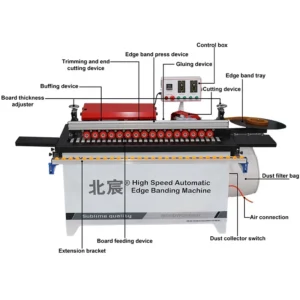
Integrated Configuration Range — Every DW902 edge bander leaves the factory with voltage, control language, and station setup confirmed against your workshop's electrical standard and panel profile, not assumed from a catalog default.
Technical Specifications
| Parameter |
Value |
| Model |
DW902 |
| Product Type |
High-speed Fully Automatic Edge Banding Machine |
| Function Stations |
Gluing, End cutting, Trimming, Scraping, Polishing |
| Trimming Configuration |
Double high-speed trimming motors (up and down) |
| Polishing Configuration |
Dual polishing motors (up and down) |
| Voltage |
220V (frequency to be confirmed per market) |
| Total Power |
3300W |
| Board Thickness Range |
0–50 mm |
| Strip Thickness Range |
0.5–3 mm |
| Glue Pot Capacity |
4000 ml |
| Conveyor Belt Material |
Silicone |
| Pressure Beam |
Integrated, double-row pressure wheels with adjustable handle |
| Edge Strip Cutting |
Pneumatically controlled |
| Overall Dimensions (L×W×H) |
175 × 60 × 112 cm |
| Net Weight |
240 kg |
| Feed Speed |
(basis to be confirmed) |
| Tolerance |
(basis to be confirmed) |
Application Suitability
| Application |
Material or Output |
| Cabinet door edge banding |
MDF and particleboard with PVC or melamine strip |
| Custom furniture panel finishing |
Plywood and blockboard with veneer or ABS edging |
| Workshop-scale production runs |
Solid wood panels requiring trimming and polishing passes |
| Shelving and carcass components |
Laminated boards up to 50 mm thickness |
Why Voltage Confirmation Must Happen Before the DW902 Edge Banding Machine Specifications Are Locked
A machine wired for the wrong frequency will stall on your shop floor, not on the supplier's test bench.
I once spent three weeks on-site in the Philippines rewiring a fully automatic edge bander that shipped with 380V/50Hz motors into a 220V/60Hz facility. The production line sat idle while replacement motors and contactors were air-freighted. That kind of downtime is entirely preventable if the DW902 edge banding machine specifications are validated against your local supply before the build starts [NEED_CITE: voltage and frequency standards by export market]. A 3300W total power rating behaves very differently across 50Hz and 60Hz grids, and motor winding configuration is not something you correct with a transformer.

Matching Station Sequence to Your Panel Material
The DW902 runs a five-station sequence — gluing, end cutting, trimming, scraping, polishing — in a single pass. For MDF and particleboard with PVC edging, the double high-speed trimming motors handle the bulk removal while the scraping station cleans the residual adhesive line. If your workshop primarily processes plywood with veneer strip, the dual polishing motors become the critical finish stage, removing micro-scratches left by the trimming cutters. Selecting the right consumable profile for each station is where edge quality is won or lost.
Pressure Beam Geometry and Panel Thickness Control
The integrated pressure beam uses double rows of pressure wheels with a manually adjustable handle, covering the full 0–50 mm board thickness range. This mechanical adjustment determines how firmly the panel is held against the silicone conveyor belt during the gluing and trimming zones. Inconsistent pressure across a warped particleboard sheet will show up as a visible glue line on the finished edge — a defect that only appears after trimming, when rework is costly. The DW902 edge banding machine specifications list the range, but verifying flatness tolerance on your actual substrate is the step that prevents downstream assembly failures [NEED_CITE: edge banding adhesion standards for wood-based panels].
Interpreting the Core Parameters for Production Planning
The 4000 ml glue pot capacity determines how long the DW902 can run continuously before a refill pause interrupts the batch. In a cabinet shop running mixed panel thicknesses, the adjustable pressure beam means changeover between a 16 mm shelf board and a 40 mm worktop requires only a handle turn rather than a tool swap. The 0.5–3 mm strip thickness range covers standard PVC, ABS, and melamine edging but excludes thick solid wood lipping — if your product mix includes solid wood edge profiles beyond 3 mm, a different station configuration is needed. Total power at 3300W on a 220V supply means the machine draws roughly 15 amps, which should be on a dedicated circuit to avoid voltage sag when other motors start on the same line. The pneumatic edge strip cutter relies on shop air supply; confirm your compressor can maintain the required pressure during continuous operation.
The Cost of Skipping Specification Verification
When an edge bander arrives with a control panel in a language your operators cannot read, commissioning stalls until someone translates each parameter label. When tolerance values are claimed but never measured on your actual panel stock, the first sign of trouble is panels that fail dowel alignment during assembly. These are not warranty claims — they are specification gaps that should have been closed before the machine was built [NEED_CITE: machinery acceptance testing protocols for woodworking equipment]. The DW902 edge banding machine specifications become meaningful only when matched to your real materials, your real operators, and your real electrical supply.
What This Supplier Configuration Process Covers
Voltage and frequency are confirmed in writing before production begins, so the motor winding and control transformer match your facility supply. The operation manual is produced in your operator's language, not a default export language. A factory test record is generated using your specified panel thickness and edge strip material before the machine is crated. Four-stage quality control covers incoming component inspection through pre-shipment verification. Engineer-led configuration ensures the station sequence and pressure beam setup match your actual product mix rather than a generic catalog build.
Documentation & Verification
- Electrical schematic confirming 220V wiring and motor frequency for your market
- Factory test record on your specified board thickness and strip material
- Operation and maintenance manual in your agreed operator language
- Spare parts list with trimming cutter and polishing wheel part numbers
- Packing photographs showing pressure beam and conveyor belt condition before crating
Installation, Commissioning & Support
- Dedicated 220V circuit rated for at least 20 amps to serve the 3300W total load
- Compressed air supply with regulated pressure for the pneumatic edge strip cutter
- Level floor within the 175 × 60 cm footprint, with clearance for panel infeed and outfeed
- Pressure beam handle calibration on your thickest and thinnest panel stock at first run
- Trimming and polishing motor alignment check after the initial break-in period
- Silicone conveyor belt inspection schedule based on your daily operating hours
Requesting a Configuration Proposal
To receive a formal quotation with confirmed DW902 edge banding machine specifications, share your local voltage and frequency, the panel materials and thickness range you process most often, and the edge strip type and width you run. If your workshop already has upstream panel saws or downstream boring machines, note their feed rates so the line throughput can be balanced. Sample processing tests using your own material are available before order commitment.
Frequently Asked Questions
Q: How is edge banding tolerance on the DW902 measured before shipment?
A: A factory test record is produced using your specified panel thickness and strip material. Trimmed edges are measured at multiple points along the panel length, and results are documented in the pre-shipment verification file. If your assembly requires a specific tolerance, state it during the inquiry so the test reflects your acceptance criteria.
Q: Can the 220V configuration support both 50Hz and 60Hz supplies?
A: Motor winding and control transformer specification depend on your exact frequency. Confirm your local Hz rating during the inquiry so the correct components are fitted before production. Shipping a machine with mismatched frequency is a preventable cause of motor overheating and line stoppage.
Q: What control interface does the DW902 use and is it available in multiple languages?
A: The control system and panel language are confirmed during the specification stage. The operation manual is produced in your agreed language so operators can read parameter labels and fault codes without translation delays during commissioning.
Q: How do I balance the DW902 with upstream and downstream machines?
A: Share the feed rate and cycle time of your panel saw and boring machine during the inquiry. The engineer-led configuration process matches station throughput to your existing line so no single machine becomes the bottleneck or sits idle between batches.
Q: What spare parts ship with the DW902 and what is the replacement schedule?
A: A spare parts list is included with trimming cutters, polishing wheels, and wear items specific to your station configuration. Replacement intervals depend on your daily operating hours and the abrasiveness of your strip material, which are discussed during the commissioning guidance session.