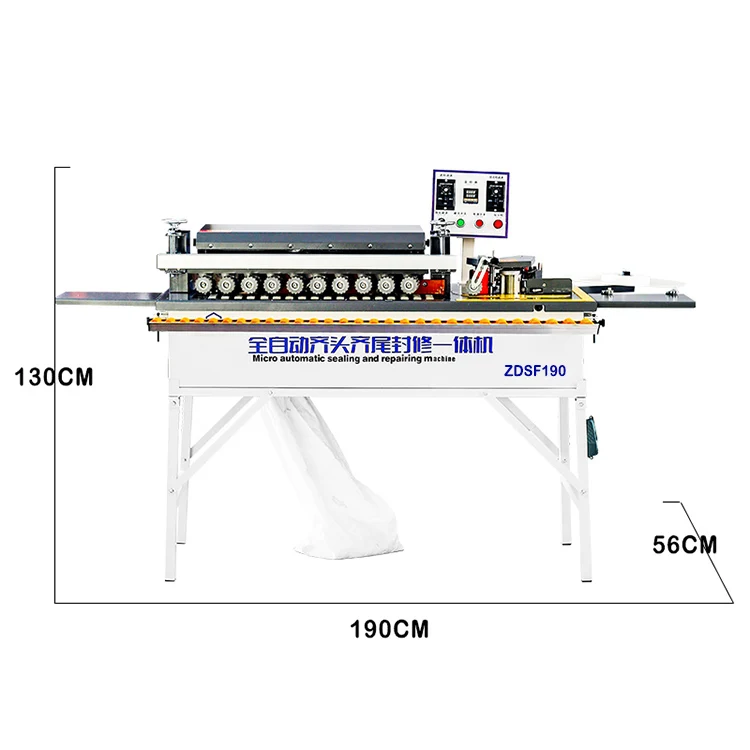
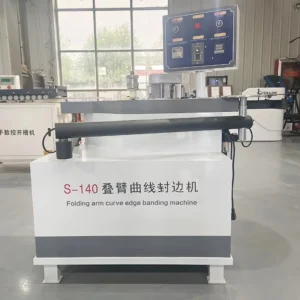
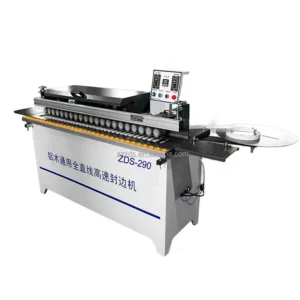
Voltage-adaptable edge banding — the WFS190 accepts customized voltage configurations from 110V to 440V, verified by electrical schematic before dispatch, so a small workshop in any export market can run it on its existing supply without a three-phase upgrade.
Technical Specifications
| Parameter |
Value |
| Model |
WFS190 |
| Product Type |
Automatic Edge Banding Machine |
| Function |
Automatic plate feeding, double-sided gluing, upper and lower polishing, automatic head and tail trimming, bending and straightening |
| Edge Type |
Both curved and straight lines |
| Voltage & Frequency |
220V 50Hz (basis stated in source — other voltages available on request) |
| Rated Power |
4 kW |
| Heating Power |
800 W |
| Trimming Power |
800 W × 2 |
| Polishing Power |
180 W × 2 |
| Suction Power |
1200 W |
| Transmission Power |
120 W |
| Belt Power |
25 W |
| Conveyer Belt Speed |
0–14 m/min |
| Sheet Thickness Range |
10–50 mm |
| Strip Thickness Range |
0.5–2.5 mm |
| Glue Capacity |
1000 ml |
| Rated Air Pressure |
0.4–0.6 MPa |
| Overall Dimensions (L×W×H) |
1900 × 560 × 1300 mm |
| Net Weight |
140 kg |
| Warranty |
1 year |
| Assembly State |
Requires assembly (user manual and video guidance provided) |
Application Suitability
| Application |
Material or Output |
| Custom cabinet door edge finishing |
MDF and plywood panels with PVC or veneer banding, 10–50 mm thickness |
| Small-batch curved furniture components |
Shaped particleboard or MDF panels with 0.5–2.5 mm strip on curved profiles |
| Joinery workshop panel processing |
Solid wood panels and plywood boards for shelving and carcass assembly |
| Startup furniture production line |
Rectangular and shaped boards requiring combined straight and curved edge treatment |
Why the Voltage Question Should Come Before the Price
One of the most common reasons an automatic edge banding machine specifications sheet never translates into a running machine is a voltage mismatch discovered after the crate is opened. Confirming your local supply standard against the machine's electrical configuration is the single most important step before placing any order.
I have watched a workshop in Southeast Asia take delivery of a single-phase edge bander wired for a frequency their grid does not support — the motor ran, but the feed speed and glue temperature never stabilized, producing weeks of unusable output [NEED_CITE: voltage and frequency standards by export market]. The WFS190 is listed at 220V/50Hz as its base configuration, and the manufacturer supports voltage customization from 110V to 440V. Asking for a confirmed electrical schematic before production starts removes this risk entirely.

Matching Feed Speed to Operator Workflow
The WFS190 offers a variable conveyor belt speed from 0 to 14 m/min, adjustable by the operator during a run. In a small workshop processing mixed batches — some panels straight and rectangular, others with curved profiles — the ability to slow the feed on complex edges and increase it on long straight runs keeps one operator in control without bottlenecks forming upstream at the saw station. This flexibility matters more than peak feed speed when daily volumes are measured in dozens rather than hundreds of panels.
Curved and Straight Edges in One Pass
Most entry-level edge banders handle straight edges only, forcing a workshop to maintain a separate manual station for any curved or shaped component. The WFS190 integrates both curved and straight line processing within a single machine footprint of 1900 × 560 mm. For a cabinet maker producing curved door fronts alongside standard carcass panels, this consolidation eliminates the quality inconsistency that typically appears when two operators and two workflows handle the same batch of furniture components [NEED_CITE: edge quality variance between manual and automated banding].
Reading the Power and Thickness Numbers
The 4 kW total rated power breaks down across heating, trimming, polishing, suction, and transmission — each subsystem has its own motor drawing from the same supply circuit. A workshop running this automatic edge banding machine on a shared circuit with other equipment risks voltage sag that affects glue temperature stability. The sheet thickness range of 10–50 mm and strip thickness range of 0.5–2.5 mm cover the MDF, plywood, and particleboard stock typical in custom cabinet production, but running 18 mm particleboard with 2 mm PVC at the upper end of the feed speed range will test the trimming unit's capacity to stay clean — a factory test on your actual panel material confirms this before commitment.
The Cost of Specifying Too Little
A small workshop that buys a machine rated for light-duty use and then feeds it production volumes beyond its design envelope will see edge adhesion failures surface weeks after installation — typically when finished cabinet doors are already in packaging or on a client's job site. The rework cost at that point is not the machine price but the material, labor, and reputation loss across an entire batch [NEED_CITE: rework costs in custom cabinet production]. Verifying that your daily panel count and edge profile complexity sit within what a 14 m/min feed speed and 1000 ml glue capacity can sustain prevents this mismatch.
Why Source This Configuration Here
In-house manufacturing with proprietary cutting mechanisms means the trimming accuracy of the WFS190 is set at the factory, not adjusted by a third-party integrator. Four-stage quality control — incoming material, in-process, finished product, and pre-shipment verification — is applied to this model before dispatch. Voltage, language, and specification customization is handled as a standard order step rather than a special request. An engineer reviews your workshop requirements and returns a formal configuration proposal within 24 hours, and factory visits to observe your actual panel material running through the machine are welcomed before any order is finalized.
Documentation & Verification
- CE declaration of conformity specific to the WFS190 model configuration ordered
- Machine specification sheet confirming feed speed, power breakdown, and panel thickness range
- Electrical schematic with voltage and frequency confirmed for your local supply standard
- Factory test record run on your specified panel material and edge strip before dispatch
- Operation and maintenance manual supplied in the agreed operator language
Installation, Commissioning & Support
- Requires a dedicated 220V circuit rated for at least 4 kW continuous draw to avoid voltage sag during heating cycles
- Overall footprint of 1900 × 560 mm fits standard single-door workshop access; confirm ceiling clearance against 1300 mm height
- Delivered in assembly-required state with video guidance; allow time for belt alignment and glue pot calibration on first setup
- Rated air pressure of 0.4–0.6 MPa requires a compressor line with moisture filtration to protect pneumatic trimming actuators
- Consumable spare parts list — glue pot, trimming blades, polishing wheels — confirmed at order for ongoing availability
What to Share With Your Inquiry
To receive a configuration recommendation that matches your actual production, include the panel materials and thicknesses you process most frequently, the edge strip type and thickness you run, and your local voltage and frequency standard. If your workshop handles curved components, describe the typical curve radius and panel dimensions so the engineer can confirm suitability before quotation.
Frequently Asked Questions
Q: How do I verify the WFS190's trimming accuracy against my panel material before ordering?
A: Request a factory test record run on your actual sheet material and edge strip thickness. The manufacturer conducts pre-shipment verification covering feed speed, glue temperature, and trimming result, and you can review the output sample or visit the facility to observe the run directly before confirming your order.
Q: Is 220V/50Hz the only electrical option available for this machine?
A: No. The base specification lists 220V/50Hz, but the manufacturer supports voltage customization from 110V to 440V as a standard order configuration. Request an electrical schematic and voltage confirmation document showing your local supply standard before production begins to ensure compatibility on arrival.
Q: Can the control interface be supplied in my operator's language?
A: Multilingual control panels are available as part of the standard customization options. Specify the required language during the inquiry stage so the operation and maintenance manual and any on-screen prompts are prepared in the correct language before dispatch, avoiding commissioning delays on site.
Q: How does this model compare to higher-tier edge banders in the same product family?
A: The WFS190 is positioned for small workshops handling mixed curved and straight edges at moderate feed speeds. As production volume grows, higher-tier models in the same family offer faster feed rates, additional trimming stations, and pre-milling functions. Starting with the WFS190 lets a workshop scale later without changing supplier or retraining operators on a different control system.
Q: What workshop utilities does the WFS190 require beyond the electrical supply?
A: The machine requires a compressed air supply at 0.4–0.6 MPa with moisture filtration, and a dust extraction connection to handle the 1200W suction system. Confirm your compressor capacity and ducting layout against these requirements, and allocate floor space for the 1900 × 560 mm footprint with operator clearance on the feed and exit sides.