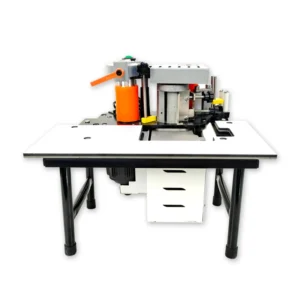
Verified Tolerance — ±0.02mm drilling precision confirmed by proprietary cutting mechanism patents and four-stage QC, not just a brochure claim you discover is false when panels fail assembly.
Technical Specifications
| Parameter |
Value |
| Model |
JL-1 |
| Product Type |
Wood Hinge Boring Machine |
| Rated Power |
1.5 kW |
| Voltage & Frequency |
380V/415V three-phase four-wire (configurable from 110V to 440V) |
| Control System |
Foot switch control |
| Overall Dimensions (L×W×H) |
70 × 56 × 145 cm |
| Net Weight |
55 kg |
| Drill Specification |
Large drill 35 mm, small drill 3 mm |
| Standard Features |
Cabinet door hinge hole opening |
| Vacuum Power |
External vacuum connection |
| Guide Rail |
Precision guide rails |
| Motor Type |
Pure copper motor |
| Noise Level |
Low noise design |
| Language Options |
Chinese, English (customizable to Spanish or other languages) |
| Standards |
CE, ISO 9001 |
Application Suitability
| Application |
Material or Output |
| Cabinet door hinge hole drilling |
MDF, plywood, particleboard panels for furniture assembly |
| Wardrobe component processing |
Laminated board and melamine-faced chipboard |
| Custom furniture hinge and loose leaf drilling |
Solid wood panels and veneer-covered substrates |
| Door manufacturing workshops |
Panel stock requiring precise hinge positioning for hardware fitting |
What Unverified Tolerance Claims Cost You on the Assembly Floor
Drilling accuracy only matters when you can measure it before the machine leaves the factory.
I have watched cabinet lines stall because hinge holes drifted off-position once the operator switched from the sample board used during commissioning to the actual production substrate. The density difference between a test piece of MDF and the particleboard running through your shop changes how the drill bites into the material. When tolerance is claimed but never documented with a factory test record, the first sign of trouble arrives as misaligned doors on the assembly bench. Wood hinge boring machine specifications should include measurable positioning data you can verify independently [NEED_CITE: woodworking machinery tolerance verification standards for panel processing].
How Guide Rail Precision Translates to Hinge Alignment
The JL-1 uses precision guide rails to maintain drill head positioning across repeated cycles. In hinge boring, even minor lateral drift means the 35 mm cup hinge hole and the 3 mm pilot hole no longer sit concentric. The result is a hinge that binds or a door that hangs crooked. This machine's rail system keeps the drill path consistent whether you are running a single custom cabinet door or a batch of wardrobe panels. Wood hinge boring machine specifications become meaningful only when the mechanical reference surfaces hold their geometry under continuous use.
Voltage Confirmation Before the Crate Arrives
A 380V/415V three-phase four-wire supply is standard for this unit, but workshops in different export markets run on varying frequency and phase configurations. Ordering without confirming local electrical infrastructure means the motor either runs at the wrong speed or refuses to start [NEED_CITE: voltage and frequency standards by export market]. The JL-1 is configurable from 110V to 440V, and an electrical schematic with voltage confirmation is part of the pre-shipment documentation package. The foot switch control system also requires a stable supply to maintain consistent drill cycle timing.
Reading the Numbers That Actually Matter
The 1.5 kW pure copper motor provides adequate torque for drilling through MDF and particleboard without stalling, though harder substrates like high-density fiberboard may require reduced feed rates. The dual drill configuration — 35 mm for the hinge cup and 3 mm for the pilot — covers standard European hinge patterns used across cabinet and wardrobe production. The external vacuum port connects to your shop's dust extraction system rather than relying on an undersized onboard collector, which matters when you are drilling hundreds of hinge pockets per shift. Low noise operation keeps the machine tolerable in smaller workshops where the boring station sits close to assembly benches. Wood hinge boring machine specifications like motor type and vacuum connection directly affect daily working conditions.

The Hidden Cost of Ignoring Feed Height and Throughput Matching
Buying a hinge borer as an isolated unit without checking how its output feeds into downstream assembly or edge banding creates bottlenecks that surface only after installation. If the JL-1's drilling cycle time does not align with your panel saw's cut rate or your edge bander's feed speed, panels pile up at one station while operators stand idle at another [NEED_CITE: production line throughput synchronization principles]. The compact 70 × 56 × 145 cm footprint fits small workshops, but throughput planning still requires matching the boring station to your actual batch volumes.
Why Technical Buyers Source This Equipment Here
In-house manufacturing with patented cutting mechanisms means the tolerance you see on the specification sheet was achieved on the factory floor, not borrowed from a supplier's catalog. The full product family ranges from entry-level to multi-boring configurations, so a workshop can scale drilling capacity without switching suppliers. Voltage, language, and specification customization come as standard options rather than special requests. Four-stage quality control with pre-shipment verification catches positioning drift before the machine ships. Engineer-led configuration recommendations with formal documentation arrive within a working day, and factory visits are welcomed for hands-on evaluation.
Documentation & Verification
- CE declaration of conformity covering machinery safety requirements for woodworking equipment
- Electrical schematic confirming voltage and frequency match your workshop supply before dispatch
- Factory test record drilled on your specified panel material and thickness range
- Machine specification sheet with verified drill positioning accuracy data
- Operation and maintenance manual in English, Spanish, or your agreed language
- Spare parts list with drill bit and guide rail component references
Installation, Commissioning & Support
- Requires a level floor pad supporting 55 kg with clearance for the 70 × 56 cm base footprint
- Dedicated 380V/415V three-phase circuit with proper earthing for the 1.5 kW motor
- External vacuum duct connection to shop extraction system for dustless operation
- Foot switch calibration and drill depth setting during first-run commissioning
- Drill bit replacement procedure and guide rail lubrication schedule in the operator manual
- Spare 35 mm and 3 mm drill bits included in the initial shipment
Preparing Your Technical Inquiry
Provide your panel material type, board thickness range, and the hinge hole pattern your hardware requires. Confirm your workshop voltage, frequency, and whether the control panel language needs to be English, Spanish, or another option. Note your daily drilling volume so the configuration recommendation accounts for actual production load rather than a sample demonstration.
Frequently Asked Questions
Q: How can I verify drilling tolerance and positioning accuracy before the JL-1 ships?
A: Request a factory test record run on your actual panel material and thickness. The four-stage quality control process includes pre-shipment verification where drill positioning is measured and documented. This gives you data you can compare against your assembly tolerances rather than relying on a general specification claim.
Q: Is the 380V/415V supply compatible with my workshop, or do I need a transformer?
A: The JL-1 is configurable from 110V to 440V. Provide your local voltage and frequency during inquiry, and the electrical schematic will confirm compatibility before production. An incorrect supply causes motor overheating or control system failure, so confirmation happens at the quotation stage.
Q: What drill bit sizes does the JL-1 support for different hinge types?
A: The standard configuration includes a 35 mm large drill for European cup hinge holes and a 3 mm small drill for pilot holes. This covers most cabinet and wardrobe hinge patterns. If your hardware requires a different cup diameter, confirm the specification during configuration.
Q: How does the external vacuum connection integrate with my existing dust extraction?
A: The JL-1 has an external vacuum port designed to connect to your shop's central dust collection system rather than a small onboard bag. This keeps the drilling area clear of particleboard dust, which otherwise accumulates on the guide rails and affects positioning accuracy over time.
Q: Can the JL-1 handle particleboard without frequent drill bit changes?
A: The pure copper motor maintains consistent torque through particleboard, but denser substrates accelerate drill bit wear. The precision guide rails keep the drill path stable, reducing lateral stress on the bit. Keep spare 35 mm and 3 mm bits in stock and follow the lubrication schedule in the maintenance manual.