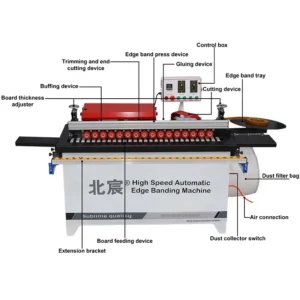
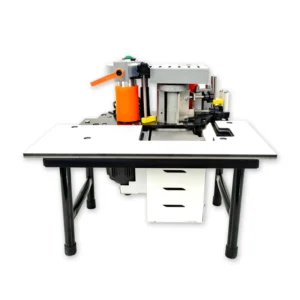
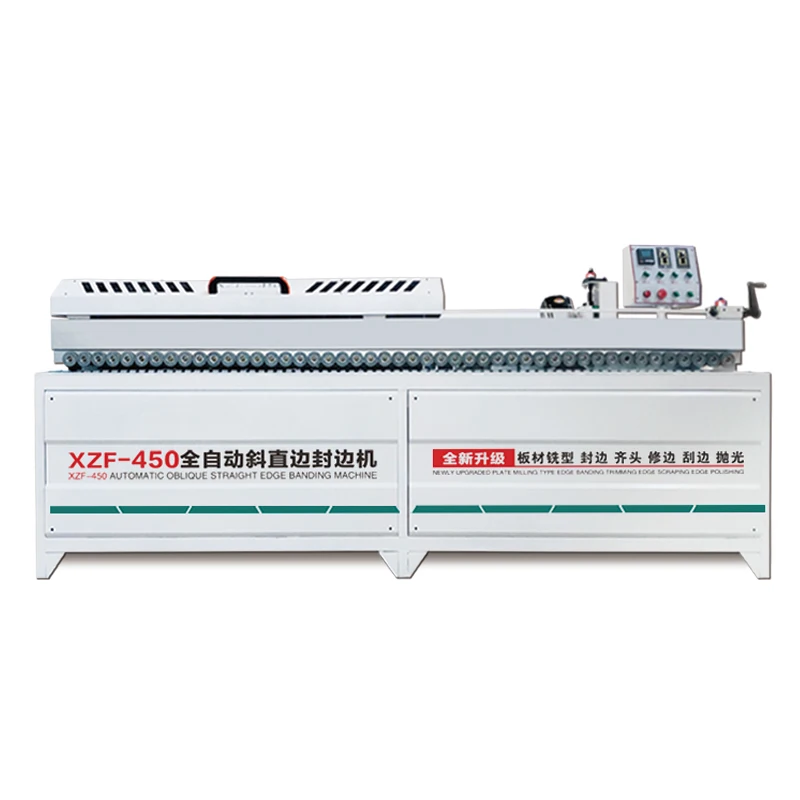
Precision-Ground Components — the XZF450 45 Degree Bevel Edge Banding Machine is built with a dedicated 4KW pre-milling motor and dual 2.2KW trimming stations to hold tight edge quality across 30, 45, and 60 degree bevel profiles.
Technical Specifications
| Parameter |
Value |
| Model |
XZF450 |
| Product Type |
45 Degree Bevel Edge Banding Machine |
| Total Power |
9.5KW |
| Voltage |
380V/415V |
| Feed Speed |
0-12M/min |
| Pre-milling Motor |
4KW |
| Edge Drive Power / Speed |
0.16KW / 0-12M/min |
| Transmission Power / Speed |
180W / 0-12M/min |
| Edge Banding Height |
0-50MM |
| Edge Banding Thickness |
0.3-3MM |
| Minimum Sheet Length |
30CM |
| Minimum Sheet Width |
15CM |
| Trimming Power |
2.2KW × 2 |
| Polishing Power |
0.4KW × 2 |
| Vacuum Power |
550W |
| Glue Pot Capacity |
4000ml |
| Air Source Pressure |
0.5-0.7Mpa |
| Standard Functions |
Plate milling, 30/45/60° edge banding, trimming, scraping, polishing, high-power vacuuming |
| Product Size |
300 × 65 × 135CM |
| Product Weight |
430KG |
| Language Options |
Chinese, English (customizable to Spanish or other languages) |
| Plug Options |
EU, USA, AU, UK |
Application Suitability
| Application |
Material or Output |
| Cabinet door bevel edge banding |
MDF and melamine-faced board with PVC or ABS edge strips |
| Angled furniture panel edging |
Plywood and blockboard at 30, 45, and 60 degree profiles |
| Polymer door frame finishing |
Polymer composite panels with thin to medium edge banding |
| Custom joinery bevel work |
Solid wood panels and particleboard up to 3MM banding thickness |
| Large-format panel processing |
Sheet stock meeting the 30CM minimum length and 15CM minimum width |
Why the Voltage Question Must Come Before the Edge Banding Machine Specifications
Confirming your facility supply before reviewing any edge banding machine specifications avoids a machine that simply cannot run when it arrives.
I once spent two days on a shop floor resetting glue pot temperatures and pre-mill depths because the buyer selected a model configured for PVC thin-strip work while their actual production ran acrylic thick banding. The voltage was correct, but the process parameters were completely mismatched to the material. A different client received a 380V machine into a 415V three-phase supply without checking frequency tolerance, and the feed motor ran hot within the first week [NEED_CITE: voltage and frequency standards by export market]. These are not warranty claims — they are configuration failures that happen before the machine even leaves the factory.

Mapping Bevel Angles to Your Panel Portfolio
The XZF450 handles 30, 45, and 60 degree bevel edge banding in a single pass, which matters when a cabinet shop runs both standard square-edge carcass panels and angled feature doors on the same line. Switching between angles requires adjusting the edge feed station and the trimming cutter geometry, and the dedicated 4KW pre-milling motor provides enough torque to prepare the panel edge cleanly before the glue roller makes contact. This edge banding machine specifications sheet shows a 0-50MM banding height range, covering most standard 16MM through 40MM panel stock used in furniture and joinery work.
Feed Speed and Drive Configuration Under Load
The 0-12M/min feed speed range is driven by two independent motors — a 180W transmission motor for the chain feed and a 0.16KW edge drive motor for the banding material feed. Running both motors independently prevents the edge strip from stretching or slipping when processing thicker 3MM PVC or acrylic banding at the upper end of the speed range. Technical buyers comparing edge banding machine specifications should note that the air source pressure requirement of 0.5-0.7Mpa powers the pneumatic trimming and scraping stations, so your compressor must sustain this pressure continuously during production [NEED_CITE: compressed air supply sizing for pneumatic woodworking stations].
What the Trimming and Polishing Power Budget Tells You
The dual 2.2KW trimming motors handle both end trimming and profile trimming in sequence, which is necessary for clean corner transitions on bevel-edged panels where a single trimming pass leaves tear-out on the exit side. Downstream, the dual 0.4KW polishing motors and the 550W vacuum station work together — the vacuum pulls trimming dust away before it can embed in the freshly polished edge. For a workshop processing melamine-faced particleboard, this dust extraction sequence directly affects whether the finished edge shows micro-scratches under angled light. The 4000ml glue pot capacity is sized for sustained runs without frequent refills, though actual consumption depends on banding width and glue application thickness.
The Cost of Skipping Material-Specific Configuration
Buying a bevel edge bander based on model brochure specs alone, without confirming the actual banding material and panel substrate, leads to predictable failures. Acrylic thick banding requires higher glue pot temperatures and slower feed speeds than thin PVC — run the wrong profile and the adhesive fails to bond at the edges, producing delamination within days of installation [NEED_CITE: adhesive bonding failure modes on engineered wood substrates]. I have seen edge banders of this class arrive at workshops where the operator could not read the control panel language, stalling commissioning for weeks until a translated manual was sourced. Another common failure: a buyer specifies a machine for 18MM board but regularly runs 40MM solid wood panels, overloading the pre-milling station and burning out the cutter blocks prematurely.
What This Machine Backs Up With Evidence
The XZF450 is manufactured in-house with precision-ground components inspected through a four-stage quality control sequence covering incoming material, in-process assembly, finished product, and pre-shipment verification. Voltage is configurable between 380V and 415V to match your facility supply, and plug options span EU, USA, AU, and UK standards so the machine arrives wired for your market. The control panel language is customizable — Chinese and English ship standard, with Spanish and other languages available on request — so your operators can read every parameter without translation guesswork. Pre-shipment testing runs your actual panel material through the machine, generating a factory test record that verifies edge quality before the crate is sealed. Engineer-led configuration recommendations are provided within 24 hours of your inquiry, matching the pre-milling depth, glue temperature, and feed speed to your specific substrate and banding combination.
Documentation & Verification
- Machine specification sheet with confirmed tolerance values for your substrate and banding material
- Electrical schematic showing 380V/415V wiring diagram and breaker sizing for your facility
- Factory test record using your actual panel stock and edge banding before dispatch
- Operation and maintenance manual printed in your operator's chosen language
- Spare parts list identifying consumable cutters, glue roller, and polishing pads by part number
Installation, Commissioning & Support
- Requires a level concrete floor supporting the 430KG machine weight across the 300 × 65CM footprint
- Dedicated 380V/415V three-phase circuit with breaker rating matching the 9.5KW total power draw
- Compressed air line delivering sustained 0.5-0.7Mpa to the pneumatic trimming and scraping stations
- First-run parameter calibration for your specific panel thickness and edge banding material combination
- Consumable cutter and polishing pad replacement schedule based on your daily panel throughput volume
- Operator training covering bevel angle changeover between 30, 45, and 60 degree profiles
What to Include in Your Inquiry
Provide your primary panel substrate, thickness range, and the edge banding material and thickness you run most often so the pre-milling and glue pot settings can be configured before build. Include your facility voltage and frequency, plus your preferred control panel language, to ensure the electrical system and interface match your shop from day one.
Frequently Asked Questions
Q: How do I verify the edge banding tolerance on the XZF450 for my specific panel material?
A: Request a pre-shipment sample processing test using your own panel stock and edge banding material. The factory runs your material through the machine and provides a test record documenting edge adhesion, trimming quality, and surface finish. This lets you inspect actual output quality against your assembly tolerances before confirming the order.
Q: Can the XZF450 voltage be configured for a 415V three-phase supply?
A: Yes. The machine is configurable for 380V or 415V three-phase power, and plug options include EU, USA, AU, and UK standards. Confirm your facility voltage and frequency at the inquiry stage so the electrical schematic and motor winding are matched to your supply before production begins.
Q: What control panel languages are available for non-Chinese operators?
A: Chinese and English ship as standard options. Spanish and other languages are available on request. Confirming your operator's language during the specification stage ensures the control interface and the printed operation manual both arrive in a language your team can read during commissioning.
Q: How should I match feed speed and glue pot capacity to my daily throughput?
A: The 0-12M/min feed speed range and 4000ml glue pot support sustained production runs, but actual throughput depends on panel length, banding thickness, and angle changeover frequency. Share your typical daily panel count and mix of bevel angles so the configuration can be optimized for your workflow rather than a generic speed rating.
Q: Can I request a sample run on my own material before placing the order?
A: Yes. Send your panel samples and edge banding stock to the factory for a test run. The machine processes your material under production conditions, and the output is documented in a factory test record so you can evaluate edge quality, glue adhesion, and trimming accuracy before committing to the purchase.

![【目标站角色】:ruiqiwoodmachine.com → SPECIFICATION AND SELECTION → 技术选型类角色 【修饰词池】:Specifications / Technical Guide / Model Selection 【记录ID数字之和】:1+4+1+8+9 = 23 【句式结构】:23 % 6 = 5 → [站点修饰词] [品类词] – [规格或产能限定] 【修饰词选取】:23 % 3 = 2 → Model Selection JT160 Sliding Table Saw with Edge Banding – Model Selection](https://ruiqiwoodmachine.com/wp-content/uploads/2026/05/H4aa4463034de438483fbbf76b1e49b3aF-1-300x300.webp)