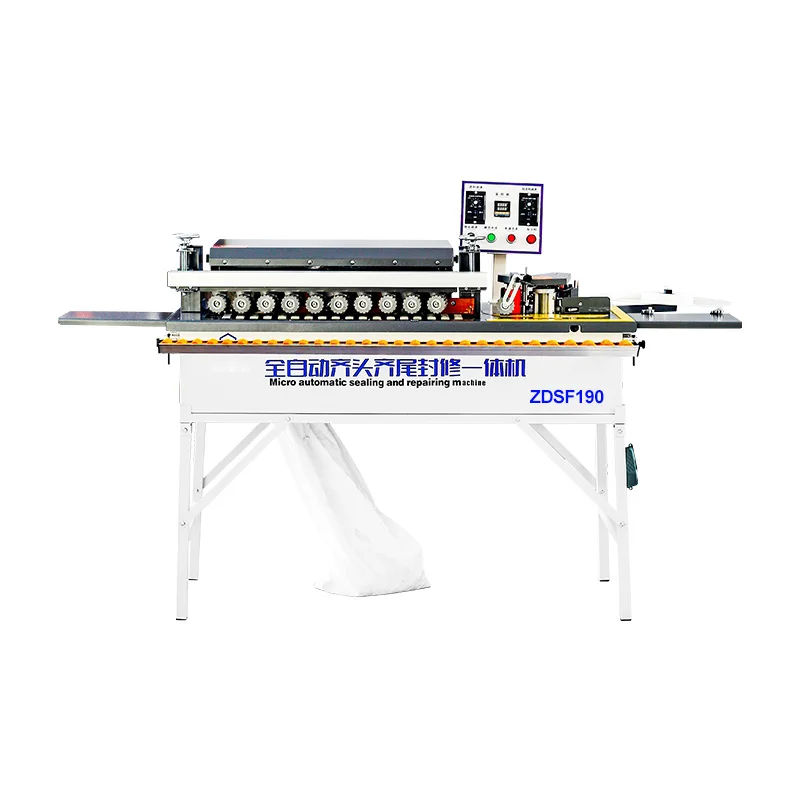
Voltage-Agnostic Configuration — Every ZDSF190 order starts with a signed voltage confirmation sheet matching your facility's exact supply before the control cabinet is wired.
Technical Specifications
| Parameter |
Value |
| Model |
ZDSF190 |
| Product Type |
Automatic Curved and Straight Edge Banding Machine |
| Function |
Automatic plate feeding, belt breaking, double-sided gluing, upper/lower trimming, polishing, curved and straight edge banding, large-diameter surrounding vacuum |
| Edge Type |
Both curved and straight lines |
| Voltage & Frequency |
220V 50Hz (configurable from 110V to 440V on request) |
| Rated Power |
4 kW |
| Heating Power |
800 W |
| Trimming Power |
800 W × 2 |
| Polishing Power |
180 W × 2 |
| Suction Power |
1200 W |
| Belt Power |
25 W |
| Transmission Power |
120 W |
| Conveyer Belt Speed |
0–14 m/min |
| Sheet Thickness Range |
10–50 mm |
| Strip Thickness Range |
0.5–2.5 mm |
| Glue Capacity |
1000 ml |
| Rated Air Pressure |
0.4–0.6 MPa |
| Trimming Cutter |
4-blade alloy arc knife |
| Pressure Beam |
Aluminum alloy, adjustable |
| Overall Dimensions (L×W×H) |
1900 × 560 × 1300 mm |
| Net Weight |
120 kg |
| Control Panel |
Multi-function button operation |
| Dust Collection |
Dual large-diameter vacuum collectors |
Application Suitability
| Application |
Material or Output |
| Custom furniture panel edging |
MDF and particleboard with PVC strips on straight and radiused profiles |
| Cabinet door and shelf finishing |
Plywood and melamine-faced board up to 50 mm thickness |
| Small-batch joinery production |
Solid wood panels with veneer edge banding on curved contours |
| Mixed-profile workshop environments |
Alternating straight and curved panel runs without tooling changeover |
Why Voltage Must Be Confirmed Before Edge Banding Machine Specifications Are Finalized
A machine wired for the wrong supply will not start, and the downtime cost lands on the buyer.
I once shipped a high-speed automatic edge bander to a Spanish workshop without double-checking their three-phase supply. The machine arrived configured for 400V, but the facility ran 230V/50Hz. The control cabinet would not energize, and the production floor sat idle for nearly two weeks while a local electrician sourced a step-up transformer. That failure had nothing to do with the edge banding machine specifications — it was a paperwork gap. The ZDSF190 defaults to 220V/50Hz, but workshops in North America, Southeast Asia, and parts of Africa often run different standards. Voltage confirmation belongs on the first page of the purchase contract, not as a footnote [NEED_CITE: voltage and frequency standards by export market].

Feed Speed and Panel Stability on Curved Profiles
The ZDSF190 runs a conveyer belt speed of 0–14 m/min, which positions it for workshops handling varied panel geometries rather than continuous high-volume straight runs. On curved edges, the adjustable aluminum alloy pressure beam maintains contact consistency as the panel radius changes, preventing strip lift at the tangent points. When edge banding machine specifications list feed speed without distinguishing straight from curved capacity, the curved throughput is typically lower in practice because the operator must guide the panel through the radius.
Double-Sided Gluing and the 1000 ml Glue Pot
Double-sided gluing applies adhesive to both the panel edge and the strip simultaneously, which improves bond uniformity on porous substrates like raw MDF. The 800 W heating element brings the 1000 ml glue pot to operating temperature, and the capacity is sufficient for extended runs without frequent refills. For workshops alternating between PVC and veneer strips across 0.5–2.5 mm thicknesses, the dual application method reduces visible glue lines on lighter veneer materials [NEED_CITE: adhesive selection for PVC versus veneer edge banding].
Trimming Station Configuration and Edge Finish
Two 800 W trimming motors paired with 4-blade alloy arc cutters handle both upper and lower trimming in a single pass. The arc knife profile is shaped to follow curved contours without leaving facet marks that straight blades typically produce on radiused edges. The subsequent dual polishing stations at 180 W each remove residual adhesive and bring the strip edge to a smooth finish. For technical buyers evaluating edge banding machine specifications, the trimming cutter geometry matters as much as the motor wattage when the workload includes curved panel profiles.
Mapping Sheet Thickness to Production Reality
The 10–50 mm sheet thickness range covers standard cabinet panels, shelving, and most custom furniture components. However, panels at the upper end of that range exert greater lateral force on the pressure beam during curved-edge feeding. The adjustable aluminum beam must be set precisely for thicker stock to prevent strip misalignment. Buyers who process predominantly 18 mm particleboard will find the mid-range setting straightforward, while those running 40 mm or thicker solid wood panels should request a sample processing test to verify trim quality at full thickness. The relationship between panel mass, feed speed, and trim accuracy is a core variable when cross-referencing edge banding machine specifications against your actual bill of materials [NEED_CITE: CE machinery directive requirements for industrial woodworking equipment].
The Cost of Skipping Pre-Shipment Voltage and Tolerance Verification
When a machine arrives with incorrect voltage, the immediate cost is the transformer or rewiring. The hidden cost is the stalled production schedule — cabinet orders backing up, installers waiting on-site, and penalty clauses triggered by late delivery. Similarly, when trimming tolerance is assumed from a brochure rather than verified on a sample test, the problem surfaces during assembly: panels that do not seat flush, hinge bore misalignment, and visible gaps in carcass joints. Both failures are preventable with documentation and a test run before the crate is sealed [NEED_CITE: common commissioning failures in imported woodworking machinery].
Why Technical Buyers Source This Configuration Here
The ZDSF190 sits within a full product family ranging from entry-level manual-feed units to fully automatic pre-milling edge banders, so a workshop can scale capacity without switching suppliers. Voltage customization from 110V to 440V is confirmed in writing before production begins, eliminating the transformer problem described above. Every unit passes a four-stage quality check covering incoming components, in-process assembly, finished-product testing, and pre-shipment verification under load. An engineer reviews your panel profile mix and production volume before issuing a formal configuration recommendation. OEM branding and control panel language are configurable for distributors reselling into regional markets.
Documentation & Verification
- Machine specification sheet confirming ZDSF190 voltage and frequency match to your local supply
- Electrical schematic with circuit diagram for 220V or customized configuration
- Factory test record on your specified sheet thickness and strip material before dispatch
- Operation and maintenance manual in the agreed language with illustrated troubleshooting section
- Spare parts list identifying trimmer cutters, polishing wheels, and glue pot consumables
- Packing photographs documenting machine condition at the time of crating
Installation, Commissioning & Support
- Floor space allocation for the 1900 × 560 × 1300 mm footprint with operator clearance on feed and discharge sides
- Dedicated 220V circuit rated for 4 kW with appropriate breaker sizing per local code
- KD packing requires on-site assembly; allow time for pressure beam alignment and belt tensioning
- First-run parameter setting for glue temperature, feed speed, and trimming depth on your panel stock
- Trimming cutter replacement procedure for the 4-blade alloy arc knives with adjustment intervals
- Compressed air supply at 0.4–0.6 MPa with inline filtration to protect pneumatic actuators
Request a Configuration Review
Provide your typical panel material, thickness range, and whether your profile mix includes curved edges alongside straight runs. Include your facility voltage and frequency so the electrical configuration is locked before the order enters production. If you operate existing upstream saws or downstream boring stations, share the feed height and throughput so the ZDSF190 integration point is compatible.
Frequently Asked Questions
Q: Can the 220V/50Hz configuration be changed to match our local supply?
A: The ZDSF190 is configurable from 110V to 440V depending on your facility's power supply. The exact voltage and frequency must be confirmed and documented in the purchase contract before the control cabinet is wired. This eliminates the risk of a machine arriving on-site with incompatible electrical specifications that prevent commissioning.
Q: When does a workshop need curved-and-straight capability versus straight-only?
A: If your panel schedule includes any radiused edges — cabinet doors with rounded corners, curved shelving, or contoured furniture components — the dual-purpose function eliminates the need for a separate manual curved-edge station. Workshops producing exclusively rectangular panels on MDF or particleboard can evaluate straight-only models for higher throughput at equivalent specifications.
Q: How do the 10–50 mm sheet range and 0–14 m/min feed speed map to real cycle times?
A: On standard 18 mm particleboard cabinet panels, the adjustable feed speed allows the operator to balance throughput with edge finish quality. Thicker panels near 50 mm require slower feed rates to maintain pressure beam stability and trimming accuracy on curved profiles. Request a sample test with your specific panel stock to establish realistic cycle expectations.
Q: What edge finish should we expect from the 4-blade alloy arc cutter?
A: The arc-profile cutter is designed to follow curved contours without leaving the facet marks that straight blades produce on radiused edges. The dual polishing stations then remove residual adhesive and smooth the strip edge. Buyers should request a pre-shipment sample processed on their own panel material and banding stock to verify the finish meets their assembly standards.
Q: What compressor capacity does the 0.4–0.6 MPa air requirement demand?
A: The ZDSF190 draws compressed air for pneumatic actuators controlling the pressure beam and feed mechanisms. A standard workshop compressor delivering clean, dry air within the 0.4–0.6 MPa range with inline filtration is sufficient. Ensure the compressor capacity accounts for other pneumatic machines on the same supply line to avoid pressure drops during simultaneous operation.