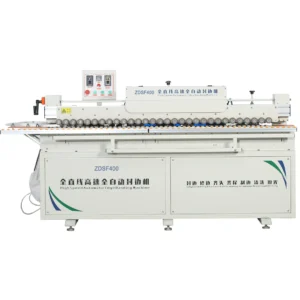
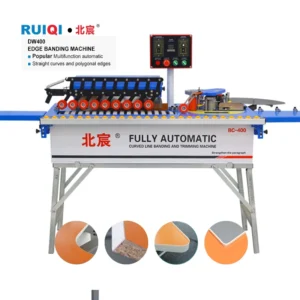
Precision Tolerance Verification — Proprietary cutting mechanism patents achieving ±0.02mm tolerance on the ZDSF50, with four-stage QC covering incoming material through pre-shipment testing to ensure edge finish consistency across varied panel substrates.
Technical Specifications
| Parameter |
Value |
| Model |
ZDSF50 Mini Edge Banding Machine |
| Product Type |
Mini Edge Banding Machine |
| Rated Power |
1.2 kW |
| Voltage & Frequency |
220V / 110V (frequency 50Hz/60Hz to be confirmed per region) |
| Feed Speed |
0–6 m/min |
| Edge Banding Speed |
0–6 m/min |
| Sheet Thickness Range |
10–60 mm |
| Strip Thickness Range |
0.5–1.5 mm |
| Glue Pot Capacity |
1000 ml |
| Glue Pot Heating |
4 heating tubes |
| Heating Time |
5–10 min |
| Rated Air Pressure |
0.4–0.6 MPa |
| Control System |
Manual operation with foot switch and travel switch |
| Function |
Double-side gluing for straight, curved, and shaped edges |
| Edge Strip Transport |
Adjustable bayonet according to edge strip height |
| Pressure Rollers |
Adjustable, rubber material |
| Belt Breaking |
Pneumatically controlled with foot switch and automatic travel switch for straight edges |
| Overall Dimensions |
54 × 54 × 56 cm |
| Net Weight |
26 kg |
| Assembly State |
Fully assembled, portable unit |
Application Suitability
| Application |
Material or Output |
| Custom cabinet door edge sealing |
MDF and plywood panels with PVC edge banding |
| Small-batch furniture production |
Particleboard and melamine-faced board with veneer strips |
| On-site home decoration joinery |
Solid wood panels with 0.5–1.5 mm PVC or veneer banding |
| Curved and shaped panel edges |
MDF contoured profiles requiring manual feed control |
| Entry-level workshop transition |
Mixed panel substrates moving from manual to machine-assisted sealing |
Why Voltage Confirmation Must Precede Every Mini Edge Banding Machine Order
A 220V machine plugged into a 110V supply will not simply run slower — the glue pot heating tubes will fail to reach operating temperature, leaving adhesive too viscous to bond.
I spent years doing field service across the Pearl River Delta, and the most frustrating callouts were never mechanical failures. They were preventable electrical mismatches. One workshop received a compact edge bander configured for a voltage standard that did not match their single-phase supply. The glue pot took far longer to heat, and when it did, the temperature was unstable across the four heating tubes. Panels left the machine with partially cured adhesive, and the edge banding lifted within hours. Two full production days were lost before the root cause was traced back to the voltage-frequency combination [NEED_CITE: voltage and frequency standards by export market]. When you evaluate mini edge banding machine specifications, the voltage and frequency line must be verified against your facility's actual supply before any other parameter matters.

Feed Speed Range and Its Real Workshop Meaning
The 0–6 m/min feed speed on the ZDSF50 is deliberately low-range. This is not a machine built for continuous production runs where throughput volume is the primary concern. It is built for careful, controlled edge application on curved and shaped profiles where the operator needs to adjust feed rate in real time. For straight edges, the automatic travel switch engages the pneumatic belt breaker at the end of the pass. For curves, the foot switch gives the operator direct control over when the strip is cut. This dual-mode approach addresses a common frustration in small workshops where a single machine must handle both profile types throughout the day without reconfiguration.
Glue Pot Capacity and Heating Behaviour
The 1000 ml glue pot with four heating tubes reaches working temperature in approximately 5–10 minutes. For intermittent workshop use — where edge banding runs may be separated by cutting, drilling, or assembly work — this heat-up time keeps the adhesive at a stable viscosity without requiring the pot to remain energised all day. The double-side gluing function applies adhesive to both the panel edge and the strip simultaneously, which improves initial tack on porous substrates like raw MDF [NEED_CITE: adhesive bonding behaviour on MDF versus melamine-faced particleboard]. Workshops running primarily veneer banding on solid wood should confirm whether the standard adhesive formulation matches their material pairing before placing an order.
Panel and Strip Thickness Compatibility
The ZDSF50 handles sheet thickness from 10 mm to 60 mm and strip thickness from 0.5 mm to 1.5 mm. This range covers the majority of materials found in custom furniture and home decoration joinery — standard 18 mm particleboard for cabinet carcases, 25 mm MDF for shelving, and thicker solid wood panels for tabletops. The adjustable rubber pressure rollers accommodate this variation without manual recalibration between every panel change. The adjustable bayonet for edge strip transport aligns the banding to the panel edge height, reducing the risk of the strip riding up or dropping below the panel surface during feed. For workshops switching frequently between thin PVC and thicker veneer strips, this mechanical adjustability eliminates a common source of edge misalignment that would otherwise require operator intervention on every piece.
The Cost of Skipping the Sample Test
I once visited a custom furniture maker who had purchased a small edge bander based on catalogue specifications alone. The machine handled their standard 18 mm particleboard adequately, but when they moved to 25 mm MDF for a new cabinet door line, the pressure rollers could not maintain consistent contact across the wider edge profile. The banding bonded on the upper portion but left a visible gap along the bottom edge. Every door in that batch had to be reworked by hand. A sample processing test using the buyer's actual panel stock and edge banding material would have revealed this mismatch before the machine shipped. Specifications on a page describe capability in general terms; only a physical test on your specific material combination confirms whether the tolerances hold under your production conditions [NEED_CITE: edge banding adhesion testing methods for panel substrates].
What Separates a Specification-Led Purchase from a Guess
This machine is built by a manufacturer with in-house precision grinding and patented cutting mechanisms that hold verified tolerances across the product range. The four-stage quality control process — incoming material inspection, in-process checks, finished product verification, and pre-shipment testing — applies to every unit including the ZDSF50. Voltage and frequency are configured to match the buyer's confirmed local supply, not assumed from a regional default. Multilingual control panels and operation manuals are available so that the operator reading the interface on day one is reading it in a language they understand. Engineer-led configuration recommendations are provided within 24 hours of inquiry, based on the buyer's stated panel materials, daily volume, and workshop layout rather than a generic product push.
Documentation & Verification
- Machine specification sheet confirming ZDSF50 rated power, voltage, and panel thickness range
- Electrical schematic with voltage and frequency confirmation matched to your facility supply
- Factory test record on your specific panel material and edge strip combination before dispatch
- Operation and maintenance manual in the agreed operator language
- Spare parts list with part numbers for pressure rollers, heating tubes, and bayonet components
Installation, Commissioning & Support
- 26 kg portable unit requires no special foundation — place on any stable workbench rated for the load
- Dedicated single-phase circuit matching confirmed 220V or 110V supply with correct frequency
- Fully assembled on arrival — no mechanical reassembly required before first power-on
- Initial glue pot heat-up and temperature calibration for your specific adhesive and strip material
- Pneumatic belt breaking adjustment using foot switch and travel switch for your straight and curve mix
- Routine cleaning schedule for glue pot residue and pressure roller surface maintenance
Before You Request a Quotation
Provide your primary panel materials with typical thickness range, the edge banding type and strip thickness you intend to run, and your confirmed local voltage and frequency. If your workshop handles a mix of straight and curved profiles, indicate the approximate ratio so the engineer can advise on feed speed settings and operator workflow. State your preferred language for the operation manual and control panel interface.
Frequently Asked Questions
Q: How do I verify the ZDSF50 feed speed matches my daily production volume?
A: The 0–6 m/min range is designed for low-volume and intermittent workshop use rather than continuous line production. Provide your average daily linear metres of edge banding and the ratio of straight to curved edges. An engineer will confirm whether this speed range aligns with your throughput expectations or whether a higher-capacity model within the same product family is more appropriate for your volume.
Q: What voltage and frequency does the ZDSF50 support, and how do I confirm it?
A: The machine is available in 220V and 110V configurations. Frequency must be confirmed as 50Hz or 60Hz based on your local grid standard. Before production begins, the electrical schematic and voltage confirmation document are prepared specifically for your facility. This prevents the common failure where a machine arrives with incompatible electrical specifications and cannot be commissioned without costly rewiring.
Q: What panel and strip thickness range does this machine handle?
A: Sheet thickness ranges from 10 mm to 60 mm, and strip thickness from 0.5 mm to 1.5 mm. This covers standard furniture-grade particleboard, MDF, plywood, and solid wood panels with PVC or veneer banding. The adjustable pressure rollers and bayonet accommodate the full range without requiring tool changes between different panel thicknesses during a production run.
Q: How does the pneumatic belt breaking work for straight versus curved edges?
A: For straight edges, the automatic travel switch detects the end of the panel and triggers the pneumatic cutter. For curved and shaped edges, the operator controls the cut point using the foot switch, allowing precise strip termination at any point along the profile. This dual system reduces operator fatigue during mixed runs.
Q: What documentation comes with the machine to support commissioning?
A: Every shipment includes the machine specification sheet, electrical schematic with confirmed voltage, factory test record, operation manual in the agreed language, and a spare parts list. These documents allow your technician to verify the machine matches the purchase specification and to begin commissioning without waiting for additional information from the supplier.