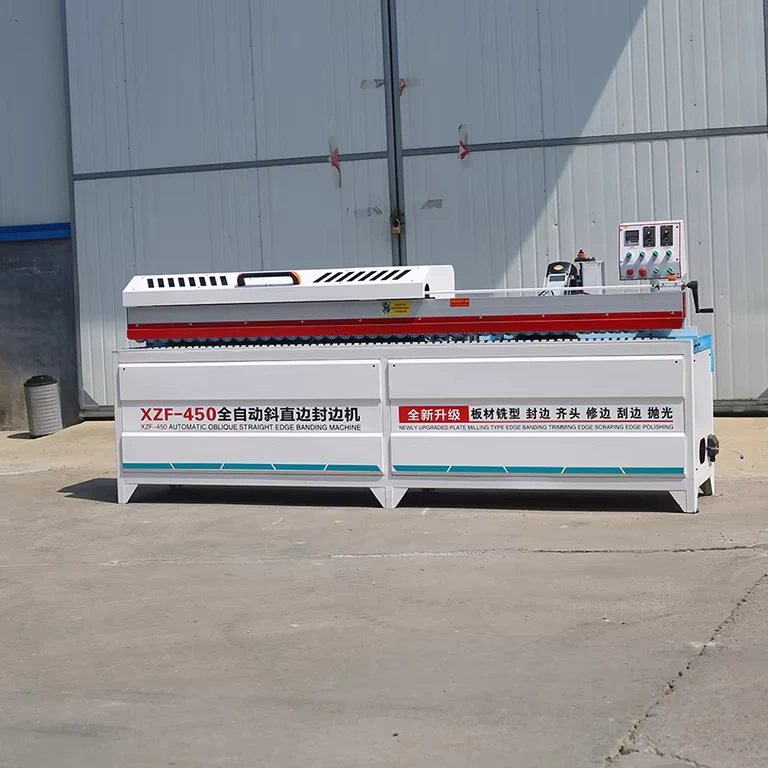
Voltage-verified configuration — every ZXF-450 electrical schematic is cross-checked against the buyer's local grid frequency before the main motor and glue pot heaters are wired, preventing the dead-on-arrival failures I have seen plague workshops running on unconfirmed 60 Hz supplies.
Technical Specifications
| Parameter |
Value |
| Model |
ZXF-450 |
| Product Type |
Fully Automatic Bevel & Straight Edge Banding Machine |
| Function Stations |
Gluing, End Cutting, Trimming, Scraping, Buffing |
| Edge Shape Capability |
30°, 45°, 60° Bevel; 90° Straight |
| Total Power |
9.5 kW |
| Voltage |
380V standard (220V available on request) |
| Feed Speed |
0–12 m/min |
| Board Thickness Range |
0–50 mm |
| Strip Thickness Range |
0.5–3 mm |
| Glue Pot Capacity |
4000 ml |
| Overall Dimensions (L×W×H) |
300 × 65 × 135 cm |
| Net Weight |
430 kg |
| Pre-Milling Station |
Not stated in source — confirm before order |
| Control Panel Language |
Confirm with manufacturer before production |
| Assembly State |
Requires on-site assembly; manual and video guidance provided |
| Warranty |
1 year |
Application Suitability
| Application |
Material or Output |
| Custom cabinet door production |
MDF and particleboard with PVC edge banding |
| Wardrobe and shelving panel finishing |
Plywood panels with melamine or veneer strips |
| Solid wood furniture components |
Hardwood boards up to 50 mm thick with 0.5–3 mm solid wood or PVC edging |
| Bevel-edged architectural millwork |
Decorative panels requiring 30°, 45°, or 60° angled edge profiles |
| Straight-edge casegoods |
Standard 90° edge banding on chipboard and MDF substrates |
What the ZXF-450 Edge Banding Machine Specifications Don't Tell You Until You Ask
The spec sheet is only the starting negotiation, not the final truth.
I once stood in a cabinet factory outside Guadalajara watching an operator feed panel after panel into a machine that was, on paper, perfectly matched to their throughput. The problem was not the machine. The problem was that the particleboard they sourced locally carried a higher resin content than the standard test substrates, and the pre-milling cutter — if one was even fitted — could not hold a clean edge on that specific material. The spec table said nothing about substrate resin tolerance because nobody had asked [NEED_CITE: substrate resin content variation and its effect on pre-milling edge quality]. When you evaluate the ZXF-450 edge banding machine specifications, every number must be tested against your actual panel stock, your actual edge strip, and your actual daily rhythm.
Matching Feed Speed to Your Upstream CNC Output
The ZXF-450 offers a variable feed speed range of 0–12 m/min, which on paper covers most small-to-mid-volume furniture workshops. The real question a technical buyer should ask is whether the upper end of that range sustains consistent glue transfer and trim accuracy on your specific board thickness, or whether edge quality degrades as speed climbs. I have seen lines where the CNC nesting machine pushes panels faster than the bander can process them cleanly, creating a bottleneck that no amount of feed speed adjustment can fix.
Dual Edge Profiles Without a Second Machine
A machine that handles both bevel angles — 30°, 45°, 60° — and standard 90° straight edges eliminates the capital outlay and floor space of a dedicated bevel bander. For a workshop producing both flat-panel casegoods and angled decorative fronts, this means one operator, one glue pot, and one set of tooling covers the full product range. The five-station sequence running gluing through buffing applies to both profile types within the same pass [NEED_CITE: edge banding station sequence and its role in final edge finish quality].

Reading the Power and Thickness Numbers Together
The 9.5 kW total power draw at 380V must be evaluated alongside the 0–50 mm board thickness range. Thicker boards demand more torque from the feed motor and more heat from the glue pot to maintain adhesive viscosity across a larger contact surface. A 4000 ml glue pot capacity is adequate for standard PVC and veneer strips at moderate feed speeds, but workshops running continuous 50 mm solid-wood panels should confirm whether the heater element can recover temperature between boards during sustained production runs. The ZXF-450 edge banding machine specifications list these as individual values; it is the interaction between them that determines actual output quality on your shop floor.
The Hidden Cost of Skipping Voltage and Frequency Confirmation
I have watched a machine sit idle for weeks because the buyer confirmed voltage but never mentioned their grid runs at 60 Hz, while the motor was wound for 50 Hz. The machine powered on, but the feed motor ran faster than the glue application rate was calibrated for, producing a visible starved glue line on every panel. This is not a defect — it is a specification gap. When 220V customization is requested for the ZXF-450, the rewiring affects not only the main drive but also the glue pot heater element and any solenoid valves in the pneumatic circuit [NEED_CITE: motor frequency mismatch effects on industrial woodworking machinery].
Why Procurement Rigor Matters Here
Every ZXF-450 leaving the Ningjin facility goes through incoming material inspection, in-process checks, finished product verification, and pre-shipment testing. The ±0.02 mm tolerance referenced in the factory's quality documentation should appear on the test record for your specific machine, measured on your specified board thickness. Voltage and frequency are confirmed in writing before wiring begins, and the control panel language is set to match your operator team before the crate is closed.
Documentation & Verification
- Factory test record using your specified board thickness and edge strip material before dispatch
- Electrical schematic confirming voltage and frequency match for your facility's power supply
- Machine specification sheet with tolerance values measured on your panel samples
- Operation and maintenance manual in your operator's working language
- Packing photographs showing crate condition and component securing before container loading
Installation, Commissioning & Support
- Floor space of at least 300 × 65 cm plus operator clearance on the feed and exit sides
- Dedicated 380V three-phase circuit rated above 9.5 kW with appropriate breaker sizing
- On-site assembly required; video-guided reassembly of feed table and station modules
- First-run calibration of trimming and scraping heads against your actual edge strip thickness
- Spare scraper blades and buffing wheels included; consumable reorder list provided at shipment
Before You Send the Inquiry
Provide the exact board materials you run — substrate type, thickness range, and any known resin or moisture characteristics — along with the edge strip materials and thicknesses you use most often. Include your local voltage and frequency, the language your operators read, and the daily panel count your upstream equipment produces so the feed speed requirement can be matched against the ZXF-450 edge banding machine specifications with real production data rather than assumptions.
Frequently Asked Questions
Q: How can I verify the edge banding tolerance on the ZXF-450 before it ships?
A: Request a pre-shipment test record where the factory runs your specified board and edge strip through all five stations and measures the trimmed and scraped edge against stated tolerances. The record should show measurement points along the board length, not a single pass/fail stamp. Ask for photographs of the test panels alongside calibrated measurement tools so you can independently assess the result.
Q: What changes when the ZXF-450 is customized from 380V to 220V?
A: The main drive motor, glue pot heater element, and pneumatic solenoid valves are all rewound or replaced to match 220V operation. This can affect glue pot recovery time between boards and feed motor torque characteristics. Confirm with the factory whether the 0–12 m/min feed speed range and 4000 ml glue pot capacity remain identical under 220V configuration before finalizing your order.
Q: Does the ZXF-450 include a pre-milling station for problem substrates?
A: The product title references pre-milling, but the specification table does not list it as a confirmed station. This must be clarified with the manufacturer before ordering, especially if you run high-resin particleboard or recycled MDF where a pre-mill cutter is necessary to achieve a clean substrate edge before glue application.
Q: How do I ensure the control panel language matches my operators?
A: Specify the required language during the quotation stage and confirm it appears on the specification document before production begins. The control panel labels and any on-screen prompts should be verified in the pre-shipment photograph package so you can confirm readability before the machine enters transit.