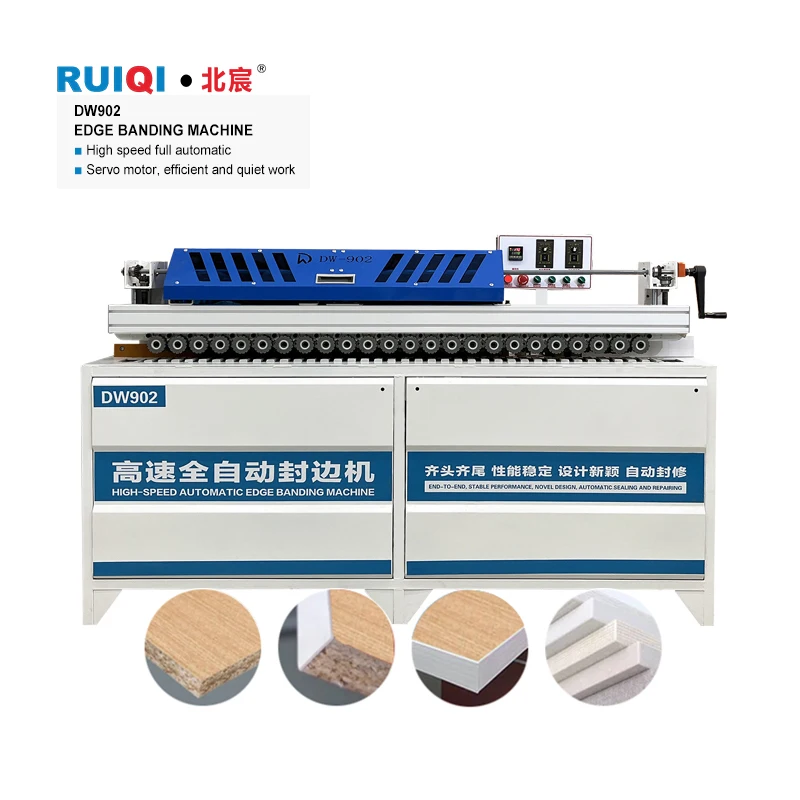
Verified Tolerance Mapping — every DW902 parameter from trimming RPM to glue pot volume is documented for independent cross-check against your panel line requirement, not buried in catalog footnotes.
Technical Specifications
| Parameter |
Value |
| Model |
DW902 |
| Product Type |
Automatic Edge Banding Machine |
| Total Power |
4000W |
| Voltage |
220V / 380V / customization (frequency 50Hz/60Hz to be confirmed) |
| Edge Banding Thickness Range |
0.3–3 mm |
| Edge Banding Height |
5 cm |
| Minimum Sheet Length |
25 cm |
| Minimum Sheet Width |
10 cm |
| Trimming Power |
800W × 2, 24,000 r/min |
| Polishing Power |
380W × 2 |
| Edge Feed Power |
140W |
| Transmission Power |
140W |
| Vacuum Power |
550W |
| Glue Pot Capacity |
4000 ml |
| Air Source Pressure |
0.5–0.8 MPa |
| Machine Dimensions |
175 × 87 × 112 cm |
| Machine Weight |
240 kg |
| Key Features |
Oblique and straight dual-purpose, double hot air design, feeding auxiliary slide plate, 4 groups of oblique pressure wheels, double row pressing wheels |
Application Suitability
| Application |
Material or Output |
| Cabinet door and carcass edge finishing |
MDF and particleboard with PVC edge banding |
| Custom furniture panel processing |
Plywood and ecological board with melamine or veneer strips |
| Home decoration component production |
Solid wood board edge banding up to 3 mm thickness |
| Small-to-medium batch panel finishing |
Boards as short as 25 cm for offcut utilization |
Why Edge Banding Machine Specifications Matter More Than Catalog Headlines
A spec sheet only earns trust when every number can be tested on your actual substrate before the machine ships.
I once watched a cabinet factory in Colombia run three full days of scrap because the trimming unit on their edge bander could not handle PVC stock thicker than what the original test used. The edge banding machine specifications looked adequate on paper — feed speed, power, thickness range — but nobody confirmed the actual banding roll before the quote. That is the gap this page tries to close. When you compare models, the trimming motor rating, glue activation method, and minimum panel dimensions determine whether the machine fits your nesting layout and your edge material, not the headline throughput number [NEED_CITE: common causes of edge banding line rejection during commissioning].
Trimming and Polishing Stations Under Load
The DW902 carries two trimming motors rated at 800W each, spinning at 24,000 r/min. On MDF and particleboard, that spindle speed keeps the cut clean across the PVC or veneer interface without tear-out at the glue line. Polishing follows with two 380W units to remove residual adhesive and leave a finish ready for downstream assembly. When edge banding machine specifications list trimming power, the figure only matters if you match it against the actual banding thickness and substrate density you run daily.
Dual Hot Air and Glue Pot Behavior Across Substrates
The double hot air design works with a 4,000 ml glue pot to keep adhesive temperature stable as panels feed through in sequence. MDF absorbs heat differently from plywood, and ecological board surfaces vary in porosity — consistent glue activation across these substrates depends on thermal recovery between panels. The 0.3–3 mm banding thickness range means a single setup can handle thin veneer strips and heavier PVC profiles without a hardware changeover. I have seen workshops lose an entire morning recalibrating glue temperature after switching from 0.5 mm melamine to 2 mm PVC, so thermal headroom here is a practical advantage [NEED_CITE: adhesive open time variation across wood-based panel substrates].
Reading the Numbers That Actually Affect Your Line
The 25 cm minimum sheet length and 10 cm minimum width define what offcuts from your panel saw can be processed without manual edge trimming. If your nesting software produces narrow drawer sides or small shelf brackets below these dimensions, those parts will bypass the DW902 entirely. The 5 cm edge banding height sets the upper boundary for thick solid-wood lipping on worktop fronts. Air source pressure between 0.5 and 0.8 MPa governs the clamping force of the pressure wheel groups — too low on dense particleboard and the band shifts during trimming; too high on thin MDF and the core compresses. The total 4,000W power draw, distributed across trimming, polishing, vacuum, and feed motors, tells your electrician whether a dedicated circuit is needed or whether the machine can share a line with your sliding table saw.

What Happens When Voltage and Frequency Are Assumed
Machines quoted without confirming local voltage and frequency arrive unusable — a 380V/50Hz motor wired into a 60Hz supply runs faster, overheats, and burns out within weeks. The DW902 is configurable from 220V to 380V, but the frequency must be stated explicitly on the electrical schematic before production begins. I have pulled motors in workshops where the importer assumed the factory would "just know" the local standard, and the replacement delay stalled an entire production line [NEED_CITE: voltage and frequency mismatch impact on industrial motor lifespan].
Why the DW902 Earns a Place on the Shortlist
The trimming mechanism carries proprietary cutting geometry backed by patent, and tolerance is verifiable on your panel substrate before dispatch through the four-stage QC process. Voltage, control panel language, and specification details are confirmed per order — not defaulted and corrected later. The oblique-and-straight dual-purpose design means one machine handles both square and angled panel edges, so a workshop scaling from manual to automated finishing does not need a second unit. Pre-shipment testing includes a documented run on buyer-supplied material, not just a generic MDF sample.
Documentation & Verification
- CE declaration of conformity covering the DW902 edge banding and trimming assembly
- Electrical schematic confirming your exact voltage and frequency before production starts
- Factory test record on your actual panel thickness and banding material before dispatch
- Operation manual in your agreed control panel language with no fallback text
- Spare parts list matching serial-numbered trimming and polishing motor assemblies
Installation, Commissioning & Support
- 175 × 87 cm footprint requires level concrete floor with clearance for infeed and outfeed tables
- 4,000W total draw needs a dedicated circuit matching confirmed voltage and frequency rating
- Arrives fully assembled; glue pot fill and air line connection required on site
- First-run parameter setting calibrated to your specific PVC or veneer banding thickness
- Four oblique pressure wheel groups inspected and tension-adjusted during commissioning
Before You Request a Quotation
Send your typical panel substrate, the brand and thickness of the edge banding roll you intend to use, and the local voltage and frequency at your facility. If you run an upstream panel saw, share its cycle time so we can confirm the DW902 feed rate will not bottleneck your line.
Frequently Asked Questions
Q: How do I verify DW902 trimming tolerance on my specific MDF or particleboard?
A: We run your actual panel sample with your chosen banding material through the trimming and polishing stations before shipment. You receive a documented test record showing edge finish quality, and you can witness the run via live video call.
Q: What voltage and frequency will the machine carry when it ships?
A: We confirm your exact voltage and frequency in writing before production begins. The electrical schematic included with the machine matches that confirmation — no assumptions, no post-delivery rewiring required.
Q: Can the control panel be set to English, Spanish, or French without Chinese text?
A: Yes. The multilingual control panel is configured to your specified language before dispatch, and the operation manual matches that same language throughout with no fallback text.
Q: How does the DW902 feed rate align with my panel saw cycle time?
A: Share your saw cycle time and typical panel dimensions with our engineering team. We map the DW902 throughput against your upstream output to confirm there is no bottleneck, or recommend a line configuration adjustment if needed.