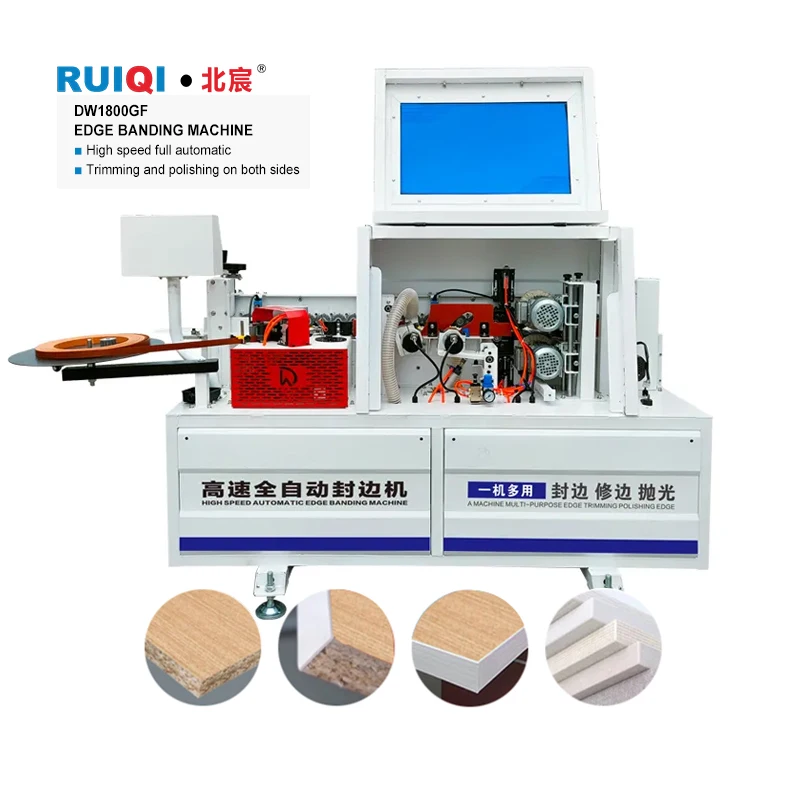
Precision Ground Tolerance — Every DW1800 workstation is machined from high-strength extruded aluminum alloy and oxidation-treated to resist deformation, ensuring the ±0.02 mm trimming tolerance holds across continuous production runs.
Technical Specifications
| Parameter |
Value |
| Model |
DW1800 |
| Product Type |
Automatic Edge Banding Machine |
| Total Power |
4.9 kW |
| Voltage Options |
380V / 220V / 415V |
| Feed Speed |
0–14 m/min (basis not stated in source — confirm panel thickness / material) |
| Edge Banding Thickness Range |
0.3–3 mm |
| Edge Banding Height Range |
0–50 mm |
| Minimum Sheet Length |
20 cm |
| Minimum Sheet Width |
10 cm |
| Trimming Power |
800 W × 2, 24000 r/min |
| Polishing Power |
380 W × 2 |
| Vacuum Power |
550 W |
| Transmission Power |
180 W |
| Air Source Pressure |
0.4–0.6 MPa |
| Glue Pot Capacity |
4000 ml |
| Profile Tracking |
Yes (rounds four corners) |
| Workstation Construction |
High-strength extruded aluminum alloy, oxidation-treated |
| Main Blade Tilt |
Adjustable with precision instrument visual display |
| Overall Dimensions |
220 × 65 × 125 cm |
| Net Weight |
320 kg |
| Control Language Options |
Chinese & English (customizable to Spanish or other languages) |
| Plug Options |
EU / USA / AU / UK |
| Key Features |
Double-sided gluing, top/bottom trimming, top/bottom polishing, front/rear alignment, flexible edge scraping, dust extraction |
Application Suitability
| Application |
Material or Output |
| Cabinet door and carcass edge finishing |
MDF and particleboard with PVC or melamine edge banding |
| Custom furniture panel processing |
Plywood panels with veneer or ABS edge strips |
| Small-batch joinery production |
Solid wood panels up to 50 mm edge height |
| Decorative panel fabrication |
ABB boards, organic glass plates, and PVC panels |
| Workshop-scale automated finishing |
Mixed substrates in batch sizes from single sheets to production runs |
Why Voltage Confirmation Must Precede Every Automatic Edge Banding Machine Specification Order
A machine wired for 380V/50Hz arriving in a 220V/60Hz region is not a delayed project — it is a dead asset until a transformer or full rewinding is arranged.
The number of edge banders sitting idle on factory floors because the buyer and supplier never confirmed local frequency and phase is higher than most importers admit. The DW1800 ships with voltage options spanning 380V, 220V, and 415V, yet the selection must match both voltage and hertz at your facility. A motor designed for 50 Hz running on 60 Hz draws different current, heats differently, and wears bearings at a rate the original specification never accounted for [NEED_CITE: voltage and frequency standards by export market].
Trimming Stations and Corner Rounding on the DW1800
This Automatic Edge Banding Machine specifications breakdown covers a complete single-pass sequence: double-sided gluing, front and rear alignment, top and bottom rough and fine trimming at 24000 r/min, profile tracking that rounds all four corners, flexible edge scraping, and dual polishing heads. Each station runs independently powered — 800 W per trimming motor, 380 W per polishing motor — so load is distributed rather than concentrated on one drive.
Worktable Stability and Continuous-Run Accuracy
The oxidation-treated aluminum alloy workstation is specified for a reason that becomes apparent after the first week of operation. Particleboard dust is abrasive, and glue overspill hardens into a film that bonds to untreated steel surfaces, creating drag marks on subsequent panels. An oxidation-treated table resists that buildup and wipes clean without scraping. The 220 cm table length accommodates the minimum 20 cm sheet length and leaves room for operator handling on larger cabinet side panels. When a production manager checks edge quality at the end of a shift, table surface condition is often the first variable that explains any drift in finish consistency [NEED_CITE: CE machinery directive requirements for industrial equipment].
What Feed Speed, Glue Pot Volume, and Trimming RPM Mean in Practice
The 0–14 m/min feed speed range should be read against your actual panel thickness and edge banding material rather than treated as a fixed production rate. Thicker PVC banding at 3 mm requires slower feed to let the glue achieve full contact before the trimming station engages; thinner 0.3 mm melamine strips tolerate the upper range. The 4000 ml glue pot capacity supports sustained runs without mid-batch refill pauses on standard cabinet panels, though high-volume environments running oversized boards may need scheduled top-ups. Dual trimming motors at 24000 r/min produce a shearing cut rather than a tearing action — the difference is visible on the edge cross-section as a clean line versus a micro-fractured surface that absorbs moisture over time. The adjustable main blade tilt, read through a precision instrument visual display, lets operators set angle-specific trimming without trial-and-error on every new batch.
What Happens When Specifications Are Skipped at Quotation Stage
Panels that pass visual inspection at the machine but fail at the assembly bench are the costliest kind of defect, because the labor and hardware around them have already been committed. Edge banding that lifts after two weeks in a humid kitchen traces back to a glue temperature or feed speed mismatch that was never validated against the buyer's actual substrate. Control panels delivered in a language the operator cannot read lead to parameter adjustments made by guesswork, and the resulting tolerance drift compounds across every sheet processed that day [NEED_CITE: common causes of edge banding delamination in panel furniture manufacturing].
Why Technical Buyers Source This Machine Here
In-house manufacturing with patented cutting mechanisms means the trimming tolerance claimed on the DW1800 specification sheet is verifiable in a factory test, not inherited from a third-party assembler. The product family ranges from entry-level to full-function configurations, so a workshop that starts with the DW1800 can scale to higher-throughput models without switching suppliers or retraining operators on a different control logic. Voltage, plug type, and control panel language are configurable at order stage — 380V, 220V, or 415V with EU, USA, AU, or UK plugs and documentation in the agreed language. A four-stage QC process covers incoming material, in-process assembly, finished product testing, and pre-shipment verification before any unit leaves the facility.
Documentation & Verification
- CE declaration of conformity covering the DW1800 electrical and mechanical safety requirements
- Machine specification sheet confirming your selected voltage, plug type, and control language
- Electrical schematic with voltage and frequency matched to your facility supply
- Factory test record on your specified panel material and edge banding thickness before dispatch
- Operation and maintenance manual in the agreed operator language
- Spare parts list with part numbers for trimming blades, polishing wheels, and glue pot components
Installation, Commissioning & Support
- Requires a dedicated 4.9 kW circuit at the confirmed voltage with correct phase and frequency
- Overall footprint of 220 × 65 cm fits standard workshop aisles; allow rear clearance for dust extraction hookup
- Air supply must deliver 0.4–0.6 MPa clean dry air to the glue pot and cylinder actuators
- First-run commissioning includes setting main blade tilt via the precision visual display for your primary panel thickness
- Operator training covers profile tracking adjustment for different corner radii and edge banding heights up to 50 mm
- Spare trimming blades and polishing wheels included; reorder intervals depend on substrate abrasiveness
Requesting a Configuration-Matched Quotation
To get an accurate Automatic Edge Banding Machine specifications proposal, share the panel substrates you run most often — MDF, particleboard, plywood, or PVC — along with the edge banding material and thickness range. Confirm your facility voltage, frequency, and phase so the correct motor and transformer configuration is quoted. If your operators need a control panel and manual in a specific language, state that at inquiry stage so it is written into the order documentation.
Frequently Asked Questions
Q: How does the 0–14 m/min feed speed range relate to panel thickness and edge banding material?
A: Thicker edge banding and denser substrates require lower feed speeds to allow full glue contact before trimming. The DW1800 feed speed should be set based on your specific panel and banding combination. We recommend a sample processing test using your actual materials to establish the optimal speed before full production begins.
Q: Which voltage and plug configuration will ship to my region, and is frequency confirmed?
A: The DW1800 is available in 380V, 220V, and 415V options with EU, USA, AU, or UK plugs. Voltage alone is not sufficient — frequency (50 Hz or 60 Hz) must also match your local supply. Confirm both values at quotation stage so the correct motor winding and electrical components are installed before shipment.
Q: Can the control panel and documentation be delivered in my operator's language?
A: Yes. The standard configuration includes Chinese and English, and the control panel and operation manual can be customized to Spanish or other languages. Specify your required language when requesting a quotation so it is documented in the order confirmation and reflected in both the HMI and printed manual.
Q: What stations are included in the standard trimming sequence?
A: The DW1800 standard sequence includes double-sided gluing, front and rear alignment, top and bottom trimming at 24000 r/min, profile tracking for four-corner rounding, flexible edge scraping, and top and bottom polishing. All stations are included as standard — no optional trimming modules are required to complete a full edge finish in a single pass.
Q: How do I verify edge quality and tolerance before accepting shipment?
A: Request a factory test record showing the DW1800 running your specified panel material and edge banding. The test record documents trimming finish, corner rounding consistency, and glue adhesion results. You may also arrange a factory visit to witness the pre-shipment test on your own sample panels before the machine is packed.