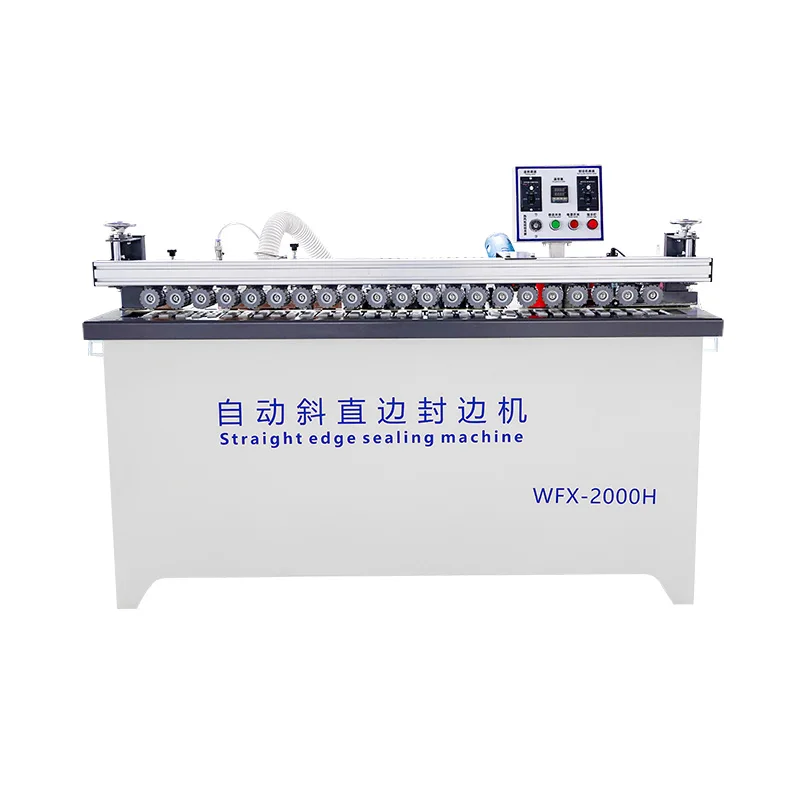
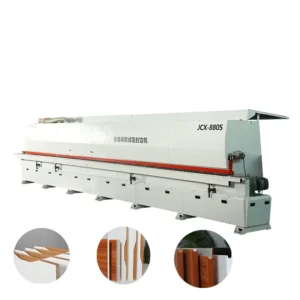
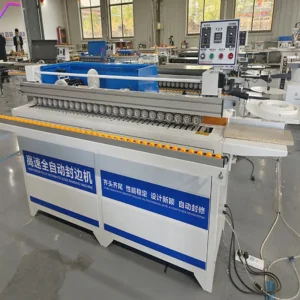
Patented Cutting Precision — Tolerance verified through multi-stage QC rather than claimed on paper, applied to every WF-2000 and WF-2000H unit before dispatch.
Technical Specifications
| Parameter |
Value |
| Model |
WF-2000 / WF-2000H |
| Product Type |
Automatic Edge Banding Machine |
| Overall Dimensions |
2100×600×630mm (WF-2000) / 2100×600×1100mm (WF-2000H) |
| Net Weight |
137kg (WF-2000) / 149kg (WF-2000H) |
| Panel Thickness Range |
18–25mm |
| Strip Thickness |
Up to 1.2mm |
| Rated Voltage |
220V |
| Rated Power |
6.17kW |
| Air Supply Requirement |
0.4–0.6 MPa |
| Feed Speed |
0–14 m/min |
| Gluing System |
Hot air heating throughout process |
| Trimming Stations |
Elastic profiling trimming |
| Pressing System |
8 pressing rollers |
| Pressure Beam |
Aluminum alloy, manually adjustable |
| Auxiliary Features |
Self-contained vacuum device, automatic belt breaking, slotting edge banding function |
| Polishing Device |
Included |
| Assembly State |
KD packing, some assembly required |
| Warranty |
1 year |
Application Suitability
| Application |
Material or Output |
| Custom cabinet door edge banding |
MDF and plywood panels 18–25mm thick |
| Wardrobe panel finishing |
Particleboard with PVC edge strips up to 1.2mm |
| Small-batch furniture production |
Veneer banding on solid wood panels |
| Workshop upgrade from manual banding |
Mixed substrate runs at variable feed rates |
| Office furniture component edging |
Melamine-faced particleboard and MDF |
Why the Voltage Question Should Come Before the Automatic Edge Banding Machine Specifications
Confirm your local supply voltage and frequency before comparing any other parameter on the sheet.
I have seen workshops receive edge banders wired for 380V three-phase when their facility runs single-phase 220V. The machine sits on the floor for weeks while an electrician rigs a transformer, and the warranty clock is already ticking. This happens more often than you would think, especially when a buyer focuses entirely on feed speed and trimming stations without checking the electrical basics [NEED_CITE: voltage and frequency standards by export market]. The WF-2000 and WF-2000H are listed at 220V rated voltage, but production environments vary. Always request the electrical schematic and voltage confirmation document before the machine leaves the factory.

Matching Feed Speed to Your Upstream Panel Saw Output
The 0–14 m/min variable feed speed on this automatic edge banding machine gives you room to synchronize with your cutting station. If your panel saw outputs thirty boards per hour, running the bander at maximum speed creates a bottleneck at the stacking end. Dial the feed rate to match your actual takt time rather than chasing the highest number on the spec sheet.
Panel Thickness Range and Substrate Compatibility
The 18–25mm panel thickness range covers standard MDF, plywood, and particleboard used in cabinet and furniture manufacturing. If your production includes thinner back panels or thicker countertop substrates, you need to verify whether this range accommodates your full material stack before issuing a purchase order. Boards outside the specified range cause feeding jams and inconsistent glue application.
Reading the Spec Sheet Beyond the Headline Numbers
The elastic profiling trimming stations are designed to follow the board contour without scoring the panel surface, which matters when you run pre-finished melamine boards where any scratch means a reject. Eight pressing rollers distribute clamping force across the strip width, reducing the risk of uneven adhesion on wider panels. The hot air gluing system heats the adhesive through the entire process rather than relying on a single pre-melt zone, which helps maintain bond consistency during long runs [NEED_CITE: hot melt adhesive temperature requirements for wood panel edge banding]. The self-contained vacuum device means you do not need a separate dust extraction line routed to this station, simplifying floor layout in tighter workshops.
What Happens When You Skip the Configuration Check
A workshop I worked with ordered an edge bander without confirming their air compressor could sustain 0.4–0.6 MPa continuously. The pressing rollers lost pressure mid-cycle, leaving strips half-bonded on a batch of wardrobe panels. The rework cost more than the machine savings. These failures rarely show up in a factory demonstration where everything runs ideal stock [NEED_CITE: common causes of edge banding adhesion failure in production environments]. Always verify utility requirements against your actual facility conditions.
Why Technical Buyers Source This Equipment Here
In-house manufacturing with patented cutting mechanisms means the tolerance claims are backed by proprietary tooling, not generic assemblies. The product family spans entry-level through full-function configurations, so a workshop can add capacity later without switching suppliers. Voltage customization from 110V to 440V is available as standard, eliminating the transformer problem described above. Four-stage quality control with pre-shipment verification catches assembly issues before the crate is sealed. An engineer-led configuration review ensures the quotation matches your actual panel range and production volume within one working day.
Documentation & Verification
- CE declaration of conformity covering the WF-2000 series edge banding platform
- Machine specification sheet listing confirmed panel thickness and strip thickness parameters
- Electrical schematic with voltage and frequency confirmation matched to your facility
- Factory test record run on your specified panel material before dispatch
- Operation and maintenance manual provided in your requested language
- Spare parts list with part numbers for pressing rollers and trimming cutters
Installation, Commissioning & Support
- KD packing requires on-site assembly of the pressure beam and polishing unit on the 2100mm frame
- Dedicated 220V circuit rated for the 6.17kW draw, with isolator switch within reach of the operator
- Air compressor must sustain 0.4–0.6 MPa at the machine inlet with a dedicated regulator
- First-run commissioning includes feed speed calibration across the 0–14 m/min range
- Elastic profiling trimming cutters require alignment check after initial break-in period
- Manual pressure beam adjustment needs verification when switching between 18mm and 25mm stock
Before You Request a Quotation
Send your typical panel material, thickness range, and edge strip specification so the configuration can be matched to your actual production. Include your facility voltage and frequency, along with the preferred control panel language. If you are integrating this unit into an existing line, note your upstream saw output rate and downstream assembly cycle so feed speed can be set accordingly.
Frequently Asked Questions
Q: How do I verify that the 18–25mm panel thickness range covers my substrate materials?
A: Send sample panels from your regular stock to the factory for a processing test. The test confirms whether the pressure beam, feed chain, and trimming stations handle your specific MDF, particleboard, or plywood without chipping or delamination. Results are documented in a factory test record shared before shipment.
Q: What voltage confirmation is needed, and can I request a different supply configuration?
A: The standard rating is 220V. If your facility runs 110V, 380V, or 440V, specify this during the quotation stage. An electrical schematic confirming the final voltage and frequency configuration is provided before production, ensuring the motor and heating elements match your local supply.
Q: How should I match the 0–14 m/min feed speed with my existing panel saw and boring machine?
A: Calculate your upstream saw output in boards per hour and your downstream assembly cycle time. Set the feed speed to balance both stations so neither the bander nor the boring machine sits idle. The variable speed control allows fine adjustment once the line is running.
Q: What control panel language options are available for the WF-2000 series?
A: Multilingual control panels are available as a customization option. Specify your preferred language during the order confirmation stage so the interface labels and error messages are set before dispatch, avoiding commissioning delays caused by unreadable displays.
Q: How can I verify edge banding quality on my own materials before the machine ships?
A: Request a sample processing test using your actual panel stock and edge strips. The factory runs your material through the gluing, pressing, trimming, and polishing stations, then ships the finished samples along with the test record for your inspection and approval.