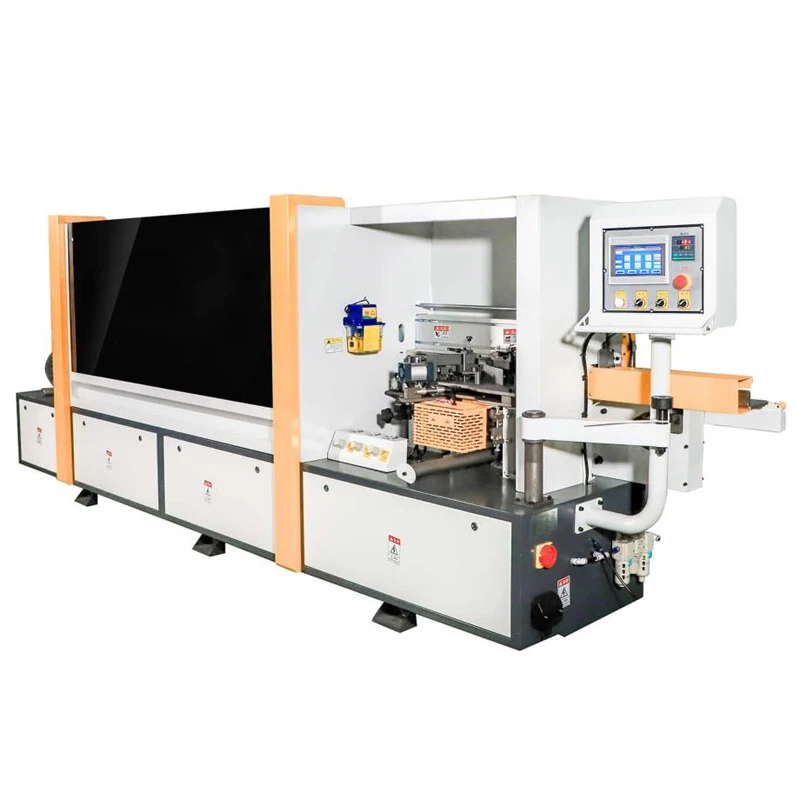
Verified Tolerance Mapping — Every ZDS-468J station parameter is documented against your panel thickness and edge material before the quotation leaves our engineering desk.
Technical Specifications
| Parameter |
Value |
| Model |
ZDS-468J |
| Product Type |
Automatic Edge Banding Machine |
| Main Functions |
Pre-milling, Gluing, End trimming, Rough trimming, Fine trimming, Corner rounding, Scraping, Buffing |
| Working Pressure |
0.6 MPa |
| Panel Thickness Range |
10–60 mm |
| Edge Thickness Range |
0.4–3 mm |
| Min. Panel Size |
300×60 mm / 150×150 mm |
| Voltage & Frequency |
380V-3HP (frequency to be confirmed 50/60Hz) |
| Rated Power |
16 kW |
| Overall Dimensions (L×W×H) |
6600×900×1600 mm |
| Net Weight |
2000 kg |
| Warranty |
1 year (basis to be confirmed) |
Application Suitability
| Application |
Material or Output |
| Custom furniture panel edge banding |
MDF and particleboard with PVC edge banding |
| Cabinet door and carcass production |
Plywood and MDF with veneer or PVC strips |
| Panel processing workshop output |
Solid wood panels with 0.4–3 mm edge material |
| Small-part edge finishing |
Boards down to 150×150 mm with thin PVC or veneer |
What "Feed Speed on Paper" Leaves Out for Your Edge Bander Selection
Automatic Edge Banding Machine specifications mean nothing unless they match your actual panel mix and shift pattern.
I once watched a Brazilian cabinet factory run their edge bander at the brochure feed speed all morning, only to realize at lunch that the operator was spending nearly half the cycle swapping edge coils and adjusting guides for different panel thicknesses. The rated speed was real, but the effective throughput was far lower because nobody had mapped the spec sheet against their daily material rotation [NEED_CITE: actual throughput versus rated feed speed in panel processing]. When you compare models, the question is not just how fast the machine can feed — it is how many of those eight stations you actually need for your board mix, and how quickly the machine transitions between them.

Eight Stations and What Each One Buys You
The ZDS-468J runs a full eight-station sequence from pre-milling through buffing. Pre-milling squares the panel edge before glue application, which matters when your sliding table saw leaves even a slight tear-out on particleboard. End trimming, rough and fine trimming, corner rounding, scraping, and buffing each remove a specific layer of excess or imperfection. If your output goes straight to assembly, all eight stations earn their place. If you run only thin PVC on MDF for cabinet carcasses, you may find scraping and buffing less critical — but removing stations from the sequence is not something you decide after delivery.
Panel and Edge Thickness Envelope
The 10–60 mm panel thickness range and 0.4–3 mm edge thickness coverage define which jobs this machine can accept without reconfiguration. A workshop cutting 18 mm particleboard for cabinet boxes and 40 mm solid wood panels for table tops stays within that envelope on both ends. The minimum panel size of 150×150 mm means small drawer components and shelf brackets can pass through without manual edge finishing [NEED_CITE: minimum panel dimensions and small-part handling on automatic edge banders].
Reading the Numbers That Actually Affect Your Floor
A 16 kW total power draw across eight stations means your electrical panel needs a dedicated circuit with headroom — shared circuits with upstream saws cause voltage dips that show up as inconsistent glue pot temperature. The 0.6 MPa working pressure requirement dictates your compressor sizing; undersized air supply leads to weak pneumatic clamping during end trimming, and you see it as chipped corners on the first panel of every batch. The 6600 mm length of the ZDS-468J determines your material flow layout — you need clear infeed and outfeed zones that add roughly another three meters to the effective footprint. Panel thickness range interacts directly with feed speed: thicker boards require slower feed to let the glue activate fully, so a machine that only quotes one speed figure is giving you incomplete Automatic Edge Banding Machine specifications.
The Cost of Skipping the Voltage Conversation
Machines quoted without confirming local voltage and frequency arrive at the dock and sit in crates while the buyer sources a transformer or sends the unit back. A 380V-3HP supply is standard across many markets, but frequency — 50 Hz or 60 Hz — changes motor RPM and therefore feed speed and glue wheel rotation [NEED_CITE: voltage and frequency standards by export market]. If your facility runs 60 Hz and the machine was wired for 50 Hz, every speed-dependent station runs faster than designed, and edge quality degrades in ways that are difficult to trace back to the power supply. Requesting a formal electrical schematic before placing the order eliminates this class of failure entirely.
Why Buyers Specify Through This Page
The ZDS-468J sits within a product family that ranges from entry-level to full-function, so a workshop can add capacity later without switching suppliers. Voltage and control language customization is treated as standard configuration, not an afterthought that delays the quotation. Every machine passes four-stage quality control with pre-shipment verification, and the factory test record travels with the documentation package. Configuration recommendations come from engineers who review your panel mix and throughput targets, not from a catalog picker. Formal quotations with complete Automatic Edge Banding Machine specifications are issued within one working day of receiving your requirements.
Documentation & Verification
- CE declaration of conformity covering the ZDS-468J edge banding station sequence
- Machine specification sheet with verified tolerance data for your panel material
- Electrical schematic confirming 380V and 50/60 Hz match for your facility
- Factory test record using your actual MDF or particleboard samples before dispatch
- Operation and maintenance manual in your operator's working language
Installation, Commissioning & Support
- Dedicated 16 kW circuit with isolated breaker required for the ZDS-468J power draw
- 6600 mm machine length plus infeed and outfeed clearance determines floor layout
- 0.6 MPa compressed air supply with dedicated line to prevent pressure drop during trimming
- First-run parameter calibration across all eight stations using your panel stock
- Spare parts list covering trimming blades, scraper inserts, and buffing wheels for the first year
Before You Request a Quotation
Send us your most common panel dimensions, the thickness range you run today and expect to run next year, and the edge materials in your inventory. Include your local voltage and frequency standard so the electrical configuration is correct on the first build. If you have upstream saws or downstream boring machines already installed, share their throughput so we can match the ZDS-468J feed rate to your line.
Frequently Asked Questions
Q: How do I verify the claimed tolerance before the machine ships?
A: Request a factory test record that documents edge banding results on your specific panel material and thickness. The record should show measured deviation across multiple sample panels processed through all eight stations. This test is performed before dispatch, so any tolerance issue is caught before the machine leaves the factory floor rather than discovered during your assembly operations.
Q: Is the 380V supply compatible with my local voltage and frequency standard?
A: The ZDS-468J is rated at 380V three-phase, but frequency must be confirmed as 50 Hz or 60 Hz for your market. Frequency affects motor speed at every station, which directly changes feed rate and glue wheel rotation. Provide your local standard during the quotation stage so the electrical schematic is built to match before production begins.
Q: How does the 10–60 mm panel thickness range map to my material mix?
A: If your workshop processes standard 18 mm particleboard for cabinets alongside thicker solid wood panels for table tops, the full range covers both without reconfiguration. Confirm whether your thinnest and thickest boards fall within this envelope, and share your edge material thickness so we verify compatibility with the 0.4–3 mm edge range.
Q: What is the feed speed, and how does it match my line throughput?
A: Feed speed is not stated in the current source documentation and must be confirmed with the engineering team based on your panel thickness and edge material combination. Share your upstream saw output rate so we can recommend a feed speed setting that keeps the ZDS-468J synchronized with the rest of your production line.