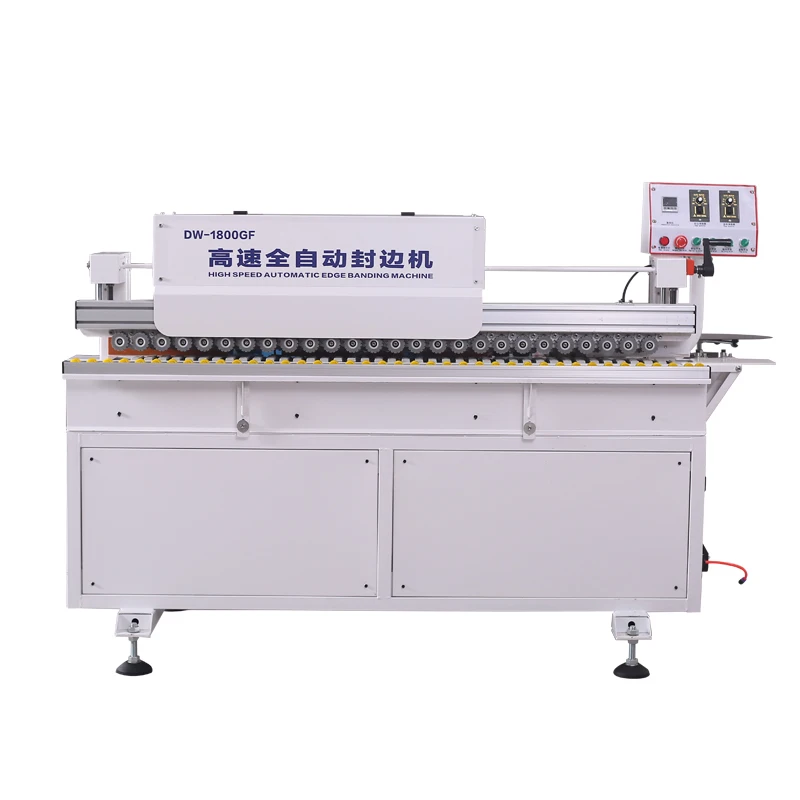
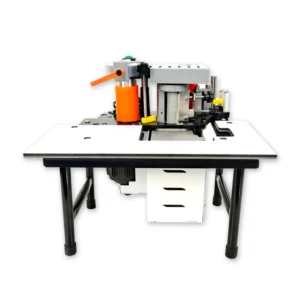
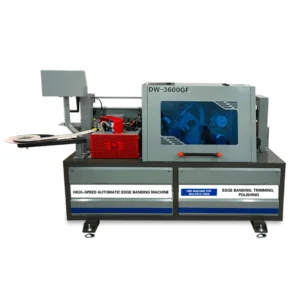
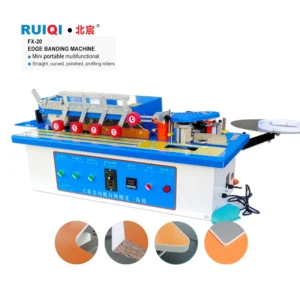
Voltage-Locked Configuration — every DW1800 automatic edge bander ships with a factory-verified electrical schematic matched to the buyer's confirmed grid frequency and plug type, preventing the three-week line stall I once caused by a single unchecked voltage mismatch.
Technical Specifications
| Parameter |
Value |
| Model |
DW1800 |
| Product Type |
Automatic Edge Bander |
| Rated Power |
4.9 kW |
| Voltage Options |
380V / 220V / 415V (frequency confirmed per destination) |
| Feed Speed |
0–14 m/min |
| Edge Banding Thickness |
0.3–3 mm |
| Edge Banding Height |
0–50 mm |
| Minimum Sheet Length |
200 mm |
| Minimum Sheet Width |
100 mm |
| Overall Dimensions (L×W×H) |
2200×650×1250 mm |
| Net Weight |
320 kg |
| Glue Pot Capacity |
4000 ml |
| Trimming Power |
800 W × 2 |
| Trimming Speed |
24,000 r/min |
| Polishing Power |
380 W × 2 |
| Vacuum Power |
550 W |
| Air Supply Requirement |
0.4–0.6 MPa |
| Standard Stations |
Double-sided gluing, front/rear alignment, top/bottom trimming, flexible edge scraping, top/bottom polishing, dust extraction |
| Control Language |
Chinese, English (other languages customizable) |
Application Suitability
| Application |
Material or Output |
| Custom cabinet panel edging |
MDF, particleboard, plywood with PVC or melamine banding |
| Furniture component finishing |
ABB boards and organic glass plates with veneer strips |
| Joinery workshop automation |
Solid wood panels with 0.3–3 mm PVC and veneer edge banding |
| Small-batch shelving and drawer fronts |
Panels down to 200 mm × 100 mm minimum footprint |
| Contract furniture production |
High-density fibreboard and plywood requiring double-sided glue application |
Why the Voltage Question Must Precede the Automatic Edge Bander Specifications
A misconfigured motor supply turns a production asset into a 320 kg floor anchor until the correct inverter arrives by air freight.
Years ago I shipped an edge bander to a Southeast Asian furniture plant with 380V winding, only to learn on commissioning day that their facility ran on 415V three-phase. The main drive motor refused to start, and the entire panel line sat idle for three weeks while we sourced a compatible variable-frequency drive. That single oversight cost the factory missed delivery deadlines and eroded trust before the first panel was edged. When you are reviewing automatic edge bander specifications, confirming the local voltage and frequency is the first engineering gate, not an afterthought on the shipping form [NEED_CITE: voltage and frequency standards by export market].
Station Sequence and Edge Finish Integrity
The DW1800 runs a six-stage sequence from double-sided gluing through top and bottom polishing. Each station addresses a specific failure mode: the front and rear alignment heads square the strip before the trimming cutters engage, which prevents the chipped leading-edge defect common on high-speed feed runs. The flexible edge scraping station removes the micro-ridge left by the trimming blades, so the final polishing wheels work on a uniform surface rather than burnishing an uneven contour. For a technical buyer comparing automatic edge bander specifications, the presence of every station in the sequence directly determines whether the finished panel goes straight to assembly or requires manual touch-up.
Throughput Calculation From Feed Speed and Panel Length
With a variable feed speed range of 0–14 m/min, the actual panels-per-hour figure depends entirely on the average cut length in your nesting layout. A workshop running full 2440 mm wardrobe sides at 12 m/min will see a different hourly count than a cabinet shop processing mostly 600 mm drawer fronts at the same belt speed. The 4000 ml glue pot capacity supports sustained operation without mid-shift refills on most standard PVC banding jobs, reducing thermal recovery pauses that interrupt feed continuity. Matching feed speed to your predominant panel size is where real throughput planning begins [NEED_CITE: nesting strategy and feed rate optimisation in panel furniture].
Tolerance, Trimming Speed, and Downstream Assembly
The trimming cutters spin at 24,000 r/min with 800 W per motor, which provides the peripheral velocity needed to shear PVC and veneer cleanly at the higher end of the feed speed range. When trimmer RPM drops relative to feed rate, the cutter tears rather than slices the banding material, leaving a visible witness line that shows up under lacquer. The 0.3–3 mm thickness range covers most PVC and veneer stock used in cabinet and furniture edging. For panels destined for concealed hinge boring, the edge finish quality set by these trimming parameters determines whether the hinge cup sits flush or rocks on an uneven substrate.

The Hidden Cost of Underspecifying Air Supply
The DW1800 requires 0.4–0.6 MPa to actuate its pneumatic pressure rollers and glue gate cylinders. When a workshop connects this machine to an undersized compressor shared with a CNC router and a panel saw, pressure drops during simultaneous tool changes cause the edge banding to lift before the glue sets. The resulting delamination is often blamed on adhesive temperature when the root cause is insufficient pneumatic volume. I have seen otherwise well-configured edge banders produce scrap at an alarming rate simply because the factory's air receiver was too small to buffer the demand spikes. Specifying a dedicated compressor or an adequately sized receiver for this machine class is a prerequisite, not an option [NEED_CITE: compressed air system sizing for woodworking machinery].
Why This Specification Set Matters for Your Line
The DW1800 is manufactured with an in-house cutting mechanism covered by proprietary patents, so trimming geometry is controlled at the component level rather than sourced from a generic catalogue. Voltage is confirmed per destination market before production begins, eliminating the on-site rewinding that strands machines at the wrong frequency. A four-stage quality control sequence covers incoming material inspection through pre-shipment functional testing with a sample panel run. The control panel language is set to the buyer's specification before dispatch, so the operator reads instructions in a familiar script from the first hour. Configuration recommendations are prepared by an engineer who reviews your panel sizes and throughput targets, not a sales algorithm.
Documentation & Verification
- Machine specification sheet confirming selected voltage and frequency
- Electrical schematic showing each station motor rating and wiring
- Factory test record using your panel material and edge banding stock
- Operation and maintenance manual in confirmed language
- CE declaration of conformity for the edge bander unit
- Packing photographs documenting crate condition before loading
Installation, Commissioning & Support
- Floor space allocation of 2200×650 mm plus operator clearance on feed and exit sides
- Dedicated 380V/415V three-phase circuit with isolation switch rated for 4.9 kW continuous draw
- Machine arrives fully assembled; level and anchor per base frame bolt pattern
- First-run parameter setting for glue temperature, feed speed and trimming offset on your stock
- Operator training on station adjustment, glue pot refill procedure and daily scraper cleaning
- Spare parts list covering trimming cutters, polishing wheels and pneumatic seals
Moving From Inquiry to Configuration
Tell us your predominant panel substrate, the edge banding materials you run most often, and the daily panel count you need to sustain. Share the voltage and frequency standard at your facility so we can lock the electrical configuration before the order enters production. If you are planning a line rather than a standalone machine, describe your upstream cutting and downstream boring equipment so we can match feed height and throughput. We will return a formal configuration proposal with confirmed automatic edge bander specifications within 24 hours.
Frequently Asked Questions
Q: How should I verify edge banding quality when the DW1800 arrives?
A: Run a sample panel using your own substrate and edge banding stock, then measure the trimming offset with a feeler gauge at multiple points along the edge. Compare the result against the tolerance stated in the factory test record. Any deviation beyond the documented value should be flagged before the machine enters production.
Q: Which voltage and frequency combination do I need for my country?
A: Provide your local grid standard at the inquiry stage so the motor winding, transformer and control components are specified correctly before assembly. We confirm the exact voltage and frequency combination on the electrical schematic before production begins, preventing the on-site incompatibility that stalls commissioning.
Q: Does the 200 mm × 100 mm minimum sheet size affect small cabinet parts?
A: Panels below this footprint cannot be reliably conveyed through the feed chain and pressure roller system. For nesting layouts that produce many small offcuts, plan your cut sequence so undersized pieces are grouped and edged on a manual or semi-automatic unit while the DW1800 handles the standard panel range.
Q: How does the full station sequence compare to a reduced configuration?
A: A machine with fewer stations may leave the trimming ridge unscraped and the edge unpolished, requiring a manual pass before the panel reaches assembly. The complete six-stage sequence on the DW1800 eliminates that secondary handling step, keeping the panel on a single-pass flow from infeed to stacking.
Q: What compressor capacity is needed to maintain 0.4–0.6 MPa continuously?
A: Size the compressor to deliver sustained airflow above the combined consumption of all pneumatic stations with a buffer for pressure drops. A receiver tank large enough to absorb demand spikes from simultaneous cylinder actuation prevents the edge banding lift that occurs when air pressure dips below the minimum threshold.