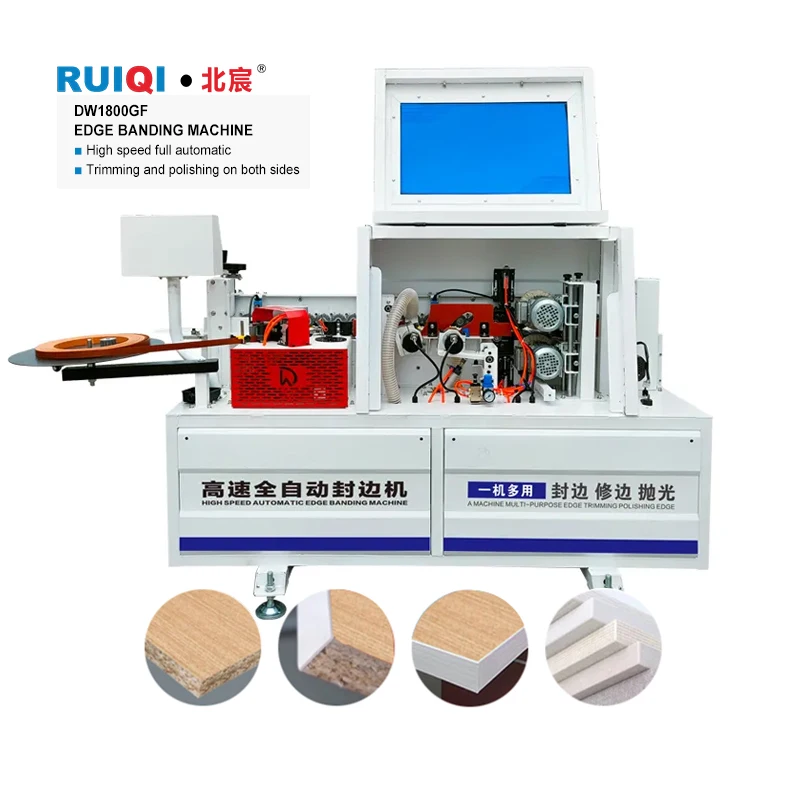
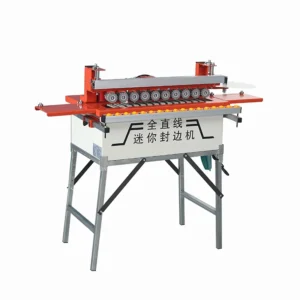
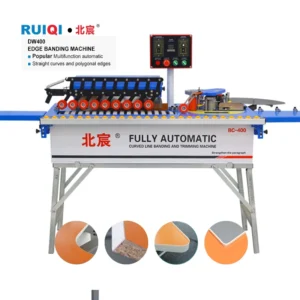
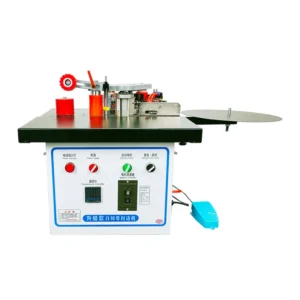
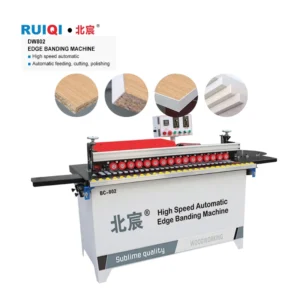
Voltage-Locked Configuration — the DW1800 is dispatched only after electrical schematics match your facility's exact phase and frequency, preventing the silent commissioning failures that strand containers at the dock.
Technical Specifications
| Parameter |
Value |
| Model |
DW1800 |
| Product Type |
Automatic Edge Banding Machine |
| Total Power |
4.9 kW |
| Voltage Options |
380V / 220V / 415V (configurable) |
| Feed Speed |
0–14 m/min |
| Edge Banding Thickness |
0.3–3 mm |
| Edge Banding Height |
0–50 mm |
| Minimum Sheet Length |
20 cm |
| Minimum Sheet Width |
10 cm |
| Trimming Station Power |
800W × 2 at 24,000 r/min |
| Polishing Station Power |
380W × 2 |
| Vacuum Power |
550W |
| Glue Pot Capacity |
4000 ml |
| Air Source Pressure |
0.4–0.6 MPa |
| Overall Dimensions (L×W×H) |
220 × 65 × 125 cm |
| Net Weight |
320 kg |
| Control Panel Languages |
Chinese, English, Spanish, or custom |
| Plug Options |
EU, USA, AU, UK |
| Standard Features |
Double-sided gluing, top/bottom trimming, top/bottom polishing, front/rear alignment, flexible edge scraping, dust suction |
Application Suitability
| Application |
Material or Output |
| Custom cabinet door edging |
MDF and particleboard with PVC or melamine strips |
| Wardrobe panel finishing |
Plywood and blockboard with veneer edge banding |
| Office furniture production |
ABB boards and melamine-faced chipboard |
| Retail fixture manufacturing |
Solid wood panels and organic glass plates |
| Small-batch joinery |
Mixed substrates from 0.3 mm veneer to 3 mm PVC |
Why Automatic Edge Banding Machine Specifications Must Precede the Purchase Order
A machine spec sheet is the only document that travels further than the machine itself.
When a panel processor in a humid climate receives an edge bander with trimming motors rated below the required RPM for their substrate density, the glue line degrades within the first production run. I have watched workshops in West Africa discover that their feed speed could not keep pace with the upstream panel saw, creating a bottleneck that no amount of operator effort could close. The DW1800 Automatic Edge Banding Machine specifications are built to be interrogated before the order is placed, not after the container arrives. [NEED_CITE: industrial machinery voltage and frequency compatibility standards by region]

Trimming Motor Architecture and Edge Consistency
The DW1800 deploys dual 800W trimming motors running at 24,000 r/min, a configuration that matters when switching between soft PVC and brittle melamine edge banding. Lower RPM units tend to chip melamine on particleboard substrates, leaving visible fracture lines that reject panels at assembly. This automatic edge banding machine maintains trimming consistency across the full 0.3–3 mm thickness range without requiring manual speed adjustments between jobs.
Glue Application and Pot Capacity for Shift-Length Runs
Double-sided gluing paired with a 4000 ml glue pot capacity allows the DW1800 to sustain continuous operation through a standard production shift without mid-run refills. The glue temperature stability directly affects adhesion on porous substrates like raw MDF, where insufficient heat penetration causes delamination during trimming. Production managers evaluating edge quality across mixed material orders will find the pot volume adequate for typical cabinet and wardrobe panel volumes. [NEED_CITE: adhesive temperature requirements for wood-based panel edge banding]
Decoding the Feed Speed and Sheet Dimension Envelope
The 0–14 m/min feed speed, driven by a dedicated transmission motor, determines how the DW1800 synchronizes with upstream sliding table saws and downstream boring machines. A panel saw cutting at a given rate requires the edge bander to absorb that output without queuing or starving. The minimum sheet dimensions of 20 cm length and 10 cm width define the smallest workpiece the feed rollers can grip reliably — critical for drawer sides and narrow cabinet components. The 0–50 mm edge banding height range covers standard panel thicknesses from 8 mm shelving stock up to thicker structural boards. Air pressure at 0.4–0.6 MPa must be stable; fluctuating pneumatic supply causes inconsistent scraping pressure, leaving residual glue marks on finished edges.
The Hidden Cost of Unverified Electrical Configuration
Shipping an edge bander configured for 380V into a facility running 415V three-phase does not produce an immediate failure — it produces a slow thermal degradation of the main motor winding that surfaces weeks later as intermittent stalling. I have traced commissioning delays across three continents back to this single oversight. The cost is never just the rewinding; it is the idle production line, the delayed shipment to the furniture buyer, and the eroded trust with a new customer. [NEED_CITE: motor winding failure modes under overvoltage conditions in tropical environments]
Why Procurement Teams Specify the DW1800
In-house manufacturing with patented cutting mechanisms means the trimming stations are not outsourced assemblies bolted onto a generic frame. The full product family from entry-level to full-function allows a workshop to add capacity later without retraining operators on a different control interface. Voltage, language, and plug type are confirmed as standard line items on the quotation, not afterthoughts negotiated post-order. A four-stage QC process includes pre-shipment verification against your specified panel thickness and edge material. Engineer-led configuration recommendations are delivered within 24 hours of receiving your production requirements.
Documentation & Verification
- Machine specification sheet confirming DW1800 voltage and frequency match your facility supply
- Electrical schematic with plug type and phase designation locked before production begins
- Factory test record on your specified panel thickness and edge banding material
- Operation and maintenance manual delivered in your selected control panel language
- Spare parts list identifying wear items for trimming and polishing stations
Installation, Commissioning & Support
- Requires a level concrete floor with clearance for the 220 cm length plus operator access on both ends
- Dedicated circuit matching confirmed voltage (220V/380V/415V) with appropriate breaker rating for 4.9 kW total draw
- Arrives partially assembled; trimming and polishing stations require alignment verification on site
- First-run calibration includes feed speed ramp-up and glue temperature stabilization for your substrate
- Pneumatic supply at 0.4–0.6 MPa must be filtered and regulated before connecting to the DW1800
- Trimming cutters and polishing wheels listed as consumables with replacement intervals in the manual
What We Need to Configure Your DW1800 Correctly
Provide your primary panel material type, thickness range, and the edge banding material you run most frequently. Confirm your facility voltage, phase, and frequency so the electrical schematic is finalized before production. Specify the control panel language your operators require and the plug standard for your region.
Frequently Asked Questions
Q: How do I verify the DW1800 trimming tolerance against my panel assembly requirements?
A: Request the factory test record that documents trimming accuracy on your specific panel thickness and edge material. The dual 800W motors at 24,000 r/min are tested against the substrate you will run in production. Tolerance verification uses the same material, not a generic test coupon, so assembly fit is predictable before the machine leaves the factory.
Q: What voltage and frequency confirmation happens before the DW1800 ships?
A: Your facility voltage, phase, and frequency are locked on the quotation and confirmed on the electrical schematic before production begins. The DW1800 supports 220V, 380V, and 415V configurations. The plug type is matched to your regional standard, and the pre-shipment test runs the machine at your specified electrical parameters.
Q: How should I match the 0–14 m/min feed speed with my existing panel saw output?
A: Calculate your panel saw cycle time and average pieces per hour, then confirm the DW1800 feed speed absorbs that throughput without queuing. The transmission motor delivers consistent feed across the range. Production managers typically set the edge bander slightly above saw output to prevent upstream bottlenecking during shift transitions.
Q: Which control panel languages are available and how do I specify them?
A: The DW1800 control panel is available in Chinese, English, Spanish, or other languages by custom request. Specify your preferred language at the inquiry stage so the interface is configured before assembly. The operation manual is delivered in the same language as the panel, ensuring operators can navigate settings during commissioning without translation delays.
Q: What spare parts and documentation support long-term maintenance of the DW1800?
A: The spare parts list identifies wear items for the trimming cutters, polishing wheels, and scraping blades with replacement intervals. The maintenance manual covers lubrication schedules for the feed chain and pneumatic filter maintenance. All documentation matches your control panel language and includes electrical schematics for troubleshooting.