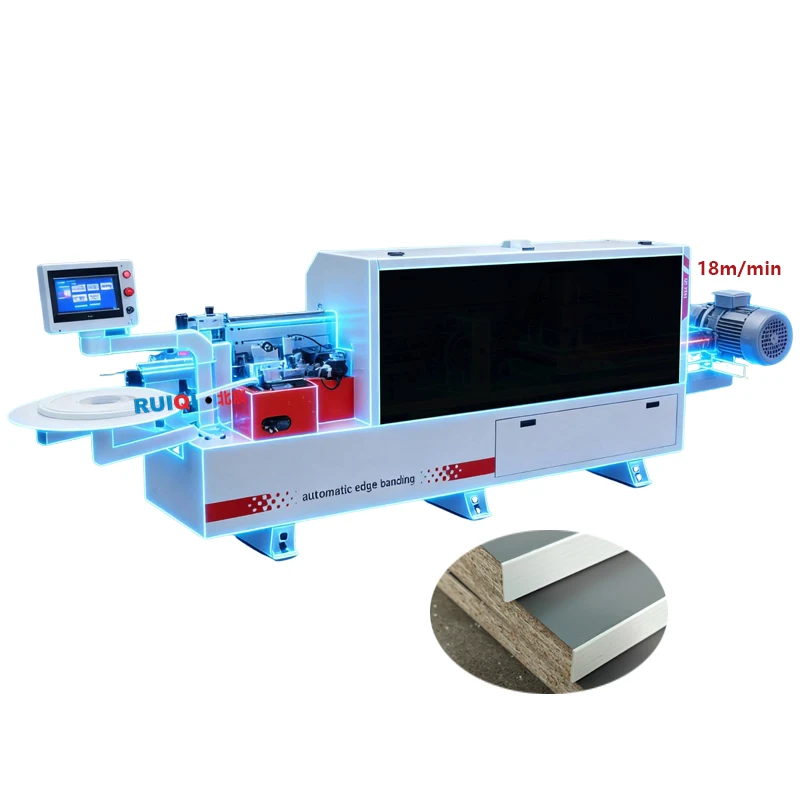
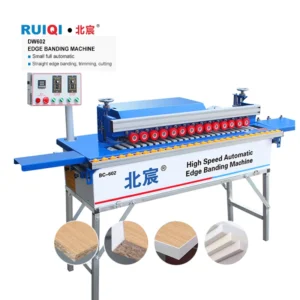
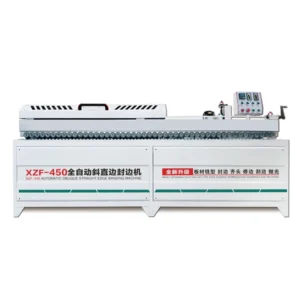
Specification-verified edge banding — every motor rating, feed parameter and panel envelope confirmed against a factory test record before the machine leaves Shandong, so your line throughput calculation holds up on day one.
Technical Specifications
| Parameter |
Value |
| Model |
DW330 |
| Product Type |
Automatic Edge Banding Machine |
| Conveying Motor |
1.5 kW |
| Transmission System |
1500 W motor, 1:40 speed ratio |
| Trimming Motor |
0.55 kW × 2 |
| Glue Feeding Motor |
0.37 kW × 2 |
| End-to-end Trimming Motor |
0.37 kW × 2 |
| Polishing Motor |
0.37 kW × 2 |
| Feed Speed |
18 m/min (basis not stated in source — confirm board type / edge banding material / thickness) |
| Minimum Machining Size |
L 200 mm × W 100 mm × T 9 mm |
| Maximum Plate Thickness |
50 mm |
| Narrowest Sealing Plate Width |
120 mm |
| Edge Banding Thickness Capacity |
Up to 3 mm |
| Gluing Shaft |
Large diameter, single-sided gluing |
| Glue Pot |
Enlarged capacity (exact volume not stated in source) |
| Heating Rod |
380 V, 300 W × 4 |
| Pressure System |
Double-row pressure rollers, aluminum profile pressure beam |
| Beam Height Adjustment |
Digital display hand crank |
| Trimming Configuration |
Contour trimming with alloy knife; curved scraper with contouring device |
| Polishing |
Industrial polishing motor |
| Control System |
7-inch PLC control panel |
| Language Options |
Chinese and English standard; others customizable |
| Net Weight |
750 kg |
| Overall Dimensions |
3500 × 710 × 1220 mm |
| Certification |
CE declaration of conformity; ISO 9001 referenced |
Application Suitability
| Application |
Material or Output |
| Custom cabinet door production |
MDF and particleboard with PVC edge banding up to 3 mm |
| Drawer side and shelving runs |
Narrow panels down to 120 mm width, plywood and MDF substrates |
| Wardrobe and carcass panel sealing |
Particleboard up to 50 mm thickness with veneer or PVC banding |
| Small-batch joinery components |
Solid wood panels and plywood, minimum board size 200 × 100 mm |
Why Voltage Confirmation Must Happen Before the Order is Placed
The automatic edge banding machine specifications on paper mean nothing if the heating circuit will not energize at the installation site.
Confirm local supply voltage and frequency against the 380 V, 300 W × 4 heating rod array before signing. I spent three weeks on a Middle East site watching a workshop full of cut panels pile up because the contract stated one voltage and the factory shipped another. The transmission motor hummed but would not turn, and the line sat idle until a replacement frequency inverter arrived by air freight. Voltage mismatch is among the most common avoidable commissioning failures on export woodworking equipment [NEED_CITE: voltage and frequency standards by export market]. Every export project now receives a dedicated electrical schematic with voltage confirmation sign-off before production begins.

Matching Feed Speed to Your Actual Panel Mix
The DW330 is rated at 18 m/min feed speed, but that figure requires qualification against the board material, edge banding thickness and substrate type running through the machine on any given shift. Automatic edge banding machine specifications often quote a peak feed rate tested on ideal stock; a production environment cutting between MDF, particleboard and plywood in the same day will see variation. The 1500 W transmission motor with a 1:40 reduction ratio provides the torque reserve to maintain consistent feed under load, which is the parameter that matters more than the headline number when scheduling daily output.
Pressure Beam Configuration and Narrow Stock Stability
Running panels down to 120 mm wide introduces stability challenges that wider stock does not present. The DW330 addresses this with double-row pressure rollers mounted on an aluminum profile pressure beam, distributing clamping force evenly across a narrow workpiece edge. Beam height adjustment via digital display hand crank allows the operator to set exact clearance for board thicknesses from 9 mm to 50 mm without trial-and-error passes [NEED_CITE: CE machinery directive requirements for industrial equipment]. This configuration matters particularly for drawer-side and internal shelving production where narrow panels represent a large share of the total edge length processed in a shift.
How Motor Allocation Defines Edge Finish Quality
Six dedicated motors handle distinct stages of the edge banding process on this machine. Two 0.55 kW trimming motors drive the contour trimming alloy knives and curved scraper, removing excess banding material flush to the panel surface. Two 0.37 kW polishing motors then finish the edge to the specified surface quality. The separation of trimming and polishing onto independent motor circuits means each station can be adjusted for feed rate and cutting depth without affecting the other — a configuration that directly determines whether the finished edge shows visible chatter marks or delivers a clean transition to the panel face. The enlarged glue pot and large-diameter single-sided gluing shaft work together to maintain adhesive flow during extended runs on large-format panels.
The Cost of Skipping the Sample Test
Ordering an edge bander based on published specifications alone leaves tolerance unverified against your actual substrate. Panels that pass inspection on a supplier's test stock may fail assembly when processed on your own MDF or particleboard batch, with glue lines becoming visible only under production conditions. Tolerance claimed but not verifiable is a recurring issue in cross-border equipment procurement [NEED_CITE: tolerance verification standards for panel processing machinery]. Requesting a sample processing test on your own material before shipment compresses the commissioning window and eliminates the most expensive category of post-delivery adjustment.
What Backs the Specification Sheet
In-house manufacturing with a patented cutting mechanism means the tolerance figures in the parameter table trace to a verifiable mechanical design, not an imported component specification. The four-stage quality control protocol covers incoming material inspection, in-process checks, finished product verification and pre-shipment testing — each stage documented. Voltage, control panel language and machine specifications are configurable as standard, with electrical schematics confirmed per order rather than assumed from a default build. The DW330 sits within a broader product family ranging from entry-level to full-function pre-milling models, so a workshop can scale capacity by adding stations within the same platform rather than replacing equipment and retraining operators on a different control interface.
Documentation & Verification
- CE declaration of conformity specific to the DW330 edge banding machine configuration ordered
- Electrical schematic with confirmed voltage and frequency match to your site supply
- Factory test record processed on your specified panel thickness and edge banding material
- 7-inch PLC panel language set to operator requirement before dispatch, with matching manual
- Spare parts list cross-referenced to each motor and wear component on the as-built machine
- Packing photographs documenting machine condition at point of loading
Installation, Commissioning & Support
- Floor space of 3500 × 710 mm plus operator clearance; level concrete pad required for the 750 kg unit
- Dedicated circuit matching confirmed heating rod voltage; overload protection sized to total motor load
- Machine ships fully assembled; beam height and roller pressure calibrated during commissioning pass
- First-run test on your panel stock to verify edge finish against the factory sample output
- Operator training on the 7-inch PLC panel, including glue pot temperature and feed speed parameters
- Alloy trimming knives and polishing pads listed as primary wear items with recommended replacement intervals
Preparing Your Inquiry
To receive a configuration proposal that matches your line, specify the primary board substrates, thickness range and edge banding material you will be processing. Confirm the local supply voltage and frequency, and indicate the language required for the PLC control panel. If you are integrating the DW330 into an existing production line, note the upstream panel saw output rate and any downstream assembly stations that depend on edge banding throughput.
Frequently Asked Questions
Q: How is the 18 m/min feed speed measured, and what board material is it based on?
A: The published feed speed is a machine capability figure. Actual production speed depends on board substrate, edge banding material and thickness. The 1500 W transmission motor with 1:40 ratio provides torque reserve for consistent feed under varying loads. Confirm expected speed against your specific panel mix for accurate throughput planning.
Q: Is the 380 V heating rod compatible with my local voltage and frequency?
A: The standard heating rod array is rated at 380 V, 300 W × 4. Compatibility with your site supply must be confirmed before production. The machine is configurable across voltage ranges, and an electrical schematic with voltage confirmation document is provided for sign-off prior to build completion.
Q: Can the PLC control panel be set to my operator's language before shipment?
A: Chinese and English are standard language options on the 7-inch PLC panel. Additional languages are available as a configurable option. Specify the required language at order stage so the panel firmware and the operation manual are matched and verified before dispatch.
Q: What is the actual glue pot volume and how long can it run continuously?
A: The DW330 features an enlarged glue pot with a large-diameter single-sided gluing shaft designed for extended production runs. Exact pot volume is confirmed per machine build. Continuous run time depends on edge banding width, adhesive type and panel feed rate during your specific production cycle.
Q: How do I verify edge banding tolerance on my own substrate before committing?
A: Submit samples of your production board material and edge banding for a factory processing test. The test output is documented in a factory test record showing edge finish quality and dimensional accuracy against your substrate, allowing verification before the machine ships.