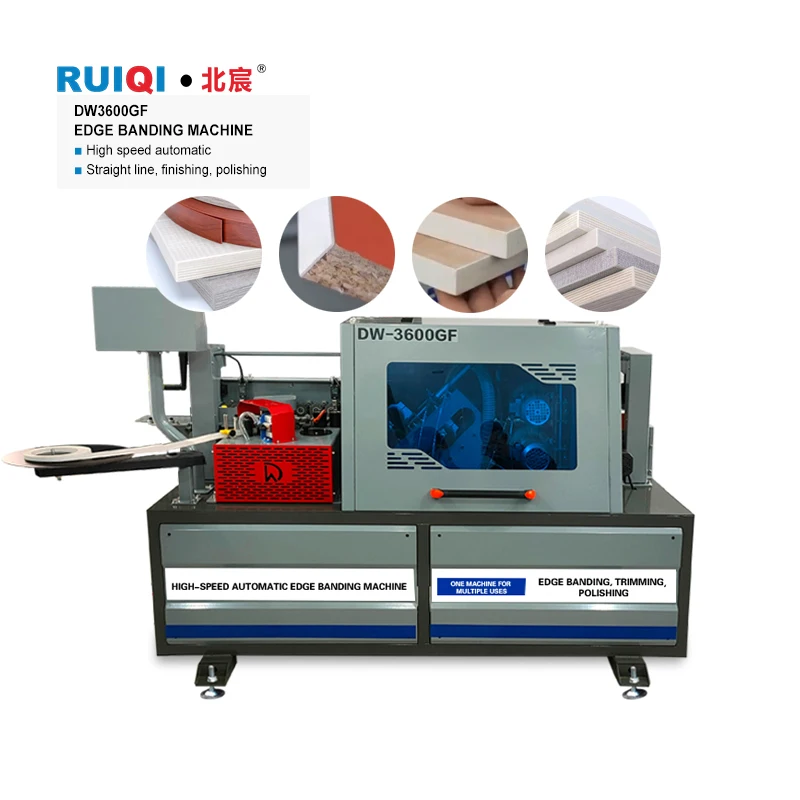
Voltage-Verified Dispatch — every DW-3600 unit ships only after electrical schematics, nameplate data, and confirmed supply frequency are cross-checked against your facility's actual three-phase input, eliminating the transformer delays that strand newly arrived machines on silent shop floors.
Technical Specifications
| Parameter |
Value |
| Model |
DW-3600GF |
| Product Type |
Automatic Edge Banding Machine |
| Total Power |
4.9 kW |
| Voltage & Frequency |
380V Three-Phase Four-Wire |
| Overall Dimensions (L×W×H) |
2200×650×1250 mm |
| Net Weight |
320 kg |
| Feed Speed |
0–14 m/min |
| Edge Banding Type |
Straight Edge Banding |
| Edge Band Height Range |
0–50 mm |
| Edge Band Thickness Range |
0.3–3 mm |
| Minimum Plate Length |
200 mm |
| Trimming Motor Power |
800W×2 at 24000 r/min |
| Polishing Motor Power |
400W×2 |
| Air Pressure Requirement |
0.4–0.6 MPa |
| Standard Stations |
Gluing, Trimming, Front/Rear Trimming, Scraping, Polishing, Vacuuming |
| Language Options |
Chinese and English; other languages customizable |
| Plug Options |
EU, USA, AU, UK |
| Assembly State |
Fully assembled in wooden box |
| Standards |
CE, ISO 9001 |
Application Suitability
| Application |
Material or Output |
| Custom cabinet door production |
MDF and particleboard with PVC edge banding |
| Wardrobe and shelving panel finishing |
Plywood panels with melamine or veneer banding |
| Office furniture component edging |
Particleboard with 0.4–2 mm PVC strips |
| Joinery workshop batch processing |
Solid wood panels with thin veneer edge band |
| Small-batch bespoke furniture runs |
Mixed substrates requiring frequent thickness changeover |
Why the Voltage Question Should Come Before the Price
A machine that cannot match your local supply is not a production asset — it is a crate of idle iron waiting for an expensive transformer.
Purchasing decisions often center on feed speed or station count, yet the most disruptive failures happen before the first panel is fed. When a workshop in Central Asia received an edge bander configured for a different voltage and frequency standard, the control cabinet tripped immediately on connection. The production line sat idle for weeks while a step-down transformer was sourced and shipped at considerable expense [NEED_CITE: voltage and frequency standards by export market]. The automatic edge banding machine specifications mean nothing if the motor windings and control logic do not align with the power arriving at your main breaker.

Matching Feed Speed to Your Upstream Saw and Downstream Borer
The variable feed speed of 0–14 m/min on this automatic edge banding machine allows production managers to tune throughput to the actual rhythm of their line. A panel saw cutting at a steady pace may produce batches faster than a slower feed setting can edge, creating a buffer pile; conversely, running the feed at maximum on thick melamine-faced chipboard may overwhelm a single-operator downstream boring station. The adjustable range lets you balance the three stations without overinvesting in any one of them.
Air Supply and the Hidden Compressor Cost
The 0.4–0.6 MPa air pressure requirement drives the pneumatic cylinders that control glue roller pressure, trimming unit engagement, and scraping blade contact. If your existing compressor cannot sustain this pressure under continuous duty, the trimming stations will chatter and leave visible witness marks on the banding edge. Before confirming an order, verify your compressor's free air delivery against the machine's consumption profile [NEED_CITE: compressed air sizing for pneumatic woodworking machinery]. An undersized receiver tank causes pressure dips each time the front and rear trimming cylinders fire in sequence.
How Trimming Motor Speed Defines Edge Quality
The dual 800W trimming motors operating at 24000 r/min determine how cleanly the excess PVC or veneer is sheared from the panel edge. Higher rotational speed produces a smoother cut surface, reducing the scraping and polishing work required downstream. When processing thin 0.3 mm melamine banding, the cutter must shear without tearing; on 3 mm solid PVC, the same cutters must remove material without leaving chatter marks across the full 0–50 mm height range. The 4.9 kW total power allocation balances all six stations within a single 380V three-phase circuit.
Minimum Plate Length and Small-Component Production
The 200 mm minimum plate length sets the lower boundary for what this straight edge bander can process reliably. Shorter components — such as drawer dividers, small shelf brackets, or spice rack panels — may not engage the feed chain and pressure beam simultaneously, causing the panel to skew during the gluing and trimming sequence. Workshops producing a mix of large cabinet sides and small internal components should verify their smallest workpiece dimensions against this threshold before finalizing their automatic edge banding machine specifications.
The Real Cost of Skipping a Factory Test Run
When specifications are taken at face value without a processing trial on your own substrate, the first sign of trouble appears during assembly. Panels with visible glue lines or uneven trimming force the joinery team to rework edges by hand, negating the automation investment. Requesting a factory test record that documents performance on your specific panel thickness and banding stock — rather than a generic demonstration on the manufacturer's sample material — surfaces incompatibilities before the machine leaves the production floor [NEED_CITE: edge banding quality verification standards for panel furniture]. The cost of air-freighting replacement trimming cutters overseas far exceeds the time spent running a validation batch.
Sourcing from a Facility That Builds the Mechanism In-House
The DW-3600GF is manufactured in a facility with proprietary cutting mechanism patents and precision-ground components inspected across a four-stage quality protocol covering incoming material, in-process assembly, finished product testing, and pre-shipment verification. Voltage confirmation is treated as a formal checkpoint, with electrical schematics and nameplate data reconciled against the buyer's signed supply declaration before the machine enters the packing area. Language customization on the control panel, plug configuration matching the destination market, and full documentation in the agreed language are included as standard configuration steps rather than optional extras. Factory visits are welcomed so technical buyers can observe assembly and run sample panels before shipment.
Documentation & Verification
- CE declaration of conformity covering the full DW-3600GF station sequence
- Electrical schematic confirming your site voltage and frequency before crating
- Factory test record on your panel material and banding thickness range
- Operation and maintenance manual in your operator's working language
- Spare parts list matched to the trimming and polishing consumables shipped
Installation, Commissioning & Support
- 2200×650 mm footprint requires a level concrete pad clear of overhead obstructions
- Dedicated 380V three-phase circuit rated above 4.9 kW with correct breaker sizing
- Machine ships fully assembled; only dust extraction hose and air line require connection
- First-run parameter tuning covers glue pot temperature, feed speed, and trimming offsets
- Operator training covers control panel navigation in the confirmed language setting
- Trimming cutter and polishing wheel replacement intervals documented in the manual
Preparing Your Inquiry
To receive an engineer-led configuration proposal within 24 hours, share your primary panel substrate and thickness range, the edge banding material and width you process most often, and your workshop's confirmed voltage and frequency. Include the language your operators read and whether your upstream saw and downstream boring equipment impose a target feed speed. If your components include pieces shorter than 200 mm, note the smallest dimension so an alternative handling method can be evaluated before the quotation is finalized.
Frequently Asked Questions
Q: How do I verify that the feed speed range suits my existing production line?
A: Share your upstream panel saw cycle time and downstream boring machine throughput with the configuration engineer. The 0–14 m/min variable feed on the DW-3600GF can then be matched to your actual bottleneck station, preventing buffer pile-ups or idle time between operations. A formal throughput calculation is provided before order confirmation.
Q: My workshop supply is 380V/50Hz — how is this confirmed before shipment?
A: A voltage confirmation document is signed by both parties before production begins. The electrical schematic, motor nameplate, and control transformer are then verified against your declared supply during the pre-shipment inspection. Any mismatch is corrected before crating, so the machine connects directly to your existing three-phase breaker panel on arrival.
Q: Can the control panel be supplied in a language my operators read?
A: Chinese and English are standard, with additional languages available as a customization option. The agreed language is programmed into the touch interface and printed on the operation manual before dispatch. This prevents commissioning delays caused by operators unable to navigate station parameters or fault codes.
Q: What compressor capacity do I need for reliable pneumatic operation?
A: The machine requires 0.4–0.6 MPa continuous air supply to operate the gluing, trimming, and scraping cylinders. Your compressor's free air delivery and receiver tank volume should sustain this pressure through repeated cylinder cycles without pressure dips that cause chatter marks on the trimmed edge. Compressor sizing guidance is provided with the quotation.
Q: How does the DW-3600GF fit into a line with upstream cutting and downstream boring?
A: The 2200 mm machine length and 0–14 m/min feed speed allow placement between a panel saw and a multi-boring station. Throughput matching is calculated during the configuration phase so panels move through edging at a rate your boring operator can keep pace with, avoiding work-in-progress accumulation on the shop floor.