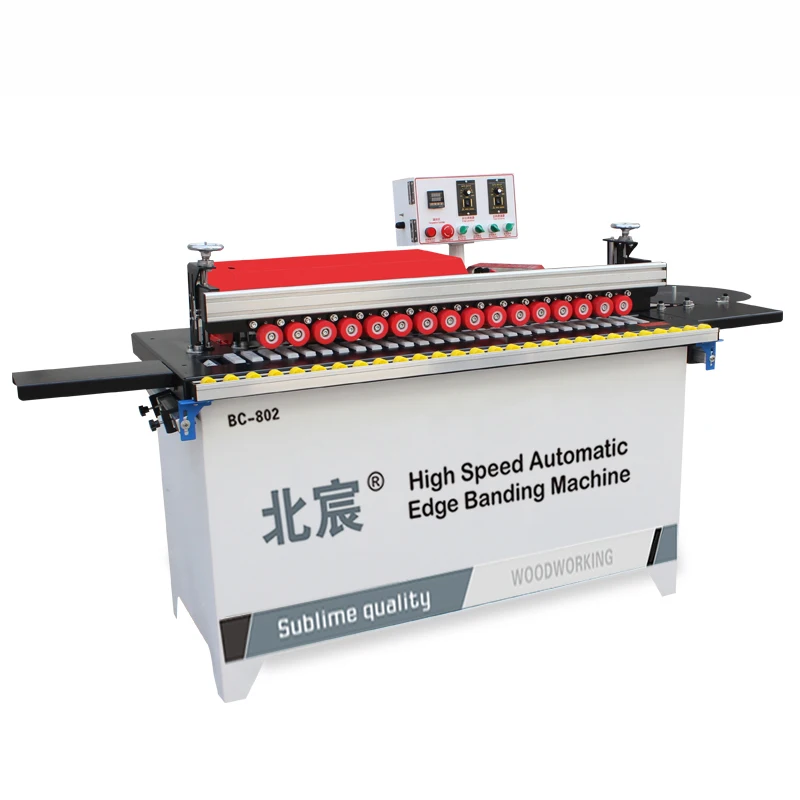
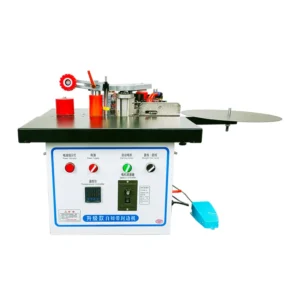
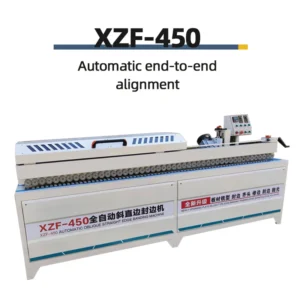
Station-by-station power transparency — the DW802 lists individual motor output for every trimming and polishing unit so technical buyers can match station load against panel density and edge material.
Technical Specifications
| Parameter |
Value |
| Model |
DW802 |
| Product Type |
Automatic Edge Banding Machine |
| Total Installed Power |
4200W |
| Edge Banding Station |
140W |
| Transmission Station |
140W |
| Trimming Station (Head & Tail) |
800W × 2 |
| Polishing Station |
180W × 2 |
| Vacuum Extraction |
1200W |
| Voltage Options |
220V / 380V / customization (frequency and phase to be confirmed) |
| Edge Banding Thickness Range |
0.3 – 3 mm |
| Edge Banding Height Range |
0 – 50 mm |
| Minimum Sheet Length |
250 mm |
| Minimum Sheet Width |
100 mm |
| Glue Pot Capacity |
4000 ml |
| Air Source Pressure |
0.4 – 0.8 MPa |
| Machine Dimensions (L × W × H) |
1300 × 600 × 950 mm |
| Machine Weight |
135 kg |
| Feed Speed |
(basis not stated in source — confirm from manufacturer) |
| Control System |
(basis not stated in source — confirm PLC / relay / manual) |
| Panel Thickness Range |
(basis not stated in source — confirm from manufacturer) |
| Language Options |
Chinese, English; customization available (Spanish, French, others) |
| Key Features |
Automatic head and tail trimming, edge banding, polishing, integrated vacuum |
Application Suitability
| Application |
Material or Output |
| Cabinet door edge sealing |
MDF and melamine-faced particleboard with PVC or ABS banding |
| Small-batch custom furniture |
Plywood and ecological board with 0.4 mm veneer strips |
| Interior fit-out components |
Solid wood panels requiring pre-milling and polish finish |
| Shelving and drawer fronts |
Particleboard up to the machine's confirmed thickness range |
| Decorative panel processing |
MDF with thin melamine edge band at 0.3 mm |
Why Voltage Confirmation Must Precede Every DW802 Automatic Edge Banding Machine Specifications Review
A machine wired for 380V three-phase will sit idle in a 220V single-phase workshop until a costly transformer or rewiring is completed.
I have watched containers arrive at European and North American ports only for the buyer to discover the motor windings and control transformer were built for a different grid standard. The DW802 lists 220V and 380V options, yet frequency and phase remain open variables that must be locked before production starts. A 50 Hz motor running on 60 Hz supply spins faster, overheats, and shortens bearing life — a failure pattern that shows up weeks after commissioning, not during the factory acceptance test [NEED_CITE: voltage and frequency standards by export market]. Requesting the electrical schematic early eliminates this category of loss entirely.

Reading the Power Distribution Across Stations
The 4200W total on the DW802 nameplate tells only part of the story. Breaking the Automatic Edge Banding Machine specifications down by station reveals where the energy actually goes: twin 800W trimming motors handle head and tail cuts, while the two 180W polishing motors finish the edge. This allocation signals that the machine dedicates most of its drive capacity to the cutting stage — an appropriate choice for workshops running standard-thickness particleboard where clean trimming matters more than high-speed feed.
What the 0.3 – 3 mm Banding Range Means for Material Planning
A thickness window spanning 0.3 mm to 3 mm covers PVC, ABS, melamine, and thin real-wood veneer strips. The lower bound lets you run decorative paper-thin edges on visible cabinet faces, while the upper bound handles impact-resistant ABS on worktops and shelving. Switching between materials within this range typically requires adjusting glue pot temperature and feed pressure — parameters that should be recorded per material so operators can reproduce results consistently across shifts [NEED_CITE: edge banding material compatibility and thermal settings].
Interpreting the Minimum Sheet Dimensions
The 250 mm × 100 mm minimum footprint is a practical constraint that directly affects small-parts production. Drawer sides, narrow shelving brackets, and filler strips below these dimensions cannot pass through the feed chain reliably. Technical buyers mapping a product mix should cross-reference their bill of materials against this threshold before assuming the DW802 covers every component. When a significant share of parts falls below the limit, a dedicated small-part edge bander or a manual station upstream may be the correct complement rather than forcing undersized sheets through a machine designed for larger panels.
The Hidden Cost of Skipping Specification Verification
When feed speed, panel thickness range, and control logic are left unconfirmed, the machine may accept every board but produce inconsistent glue lines or incomplete trimming at the tails. These defects often surface only during assembly, when a cabinet carcase refuses to square because one edge is 0.5 mm proud. By that point, dozens of panels have already been banded and the rework cost compounds through sanding, re-gluing, and re-trimming cycles. Asking for a factory test record that covers your specific panel thickness and edge material turns subjective claims into measurable data before the purchase order is signed [NEED_CITE: pre-shipment inspection standards for woodworking machinery].
Why Sourcing This Class of Machine Through an Engineering-Led Process Matters
Every configuration recommendation begins with your actual panel sizes, edge materials, and workshop voltage — not a catalog default. The DW802 ships with a pre-shipment test record documenting each station's current draw and edge finish on sample boards you approve. Voltage and phase are confirmed against your facility's electrical single-line diagram before the control cabinet is wired. Language on the HMI is set to match your operators' primary reading language, avoiding commissioning delays. And the four-stage quality check covers incoming components through to final crate photographs, so you see exactly what is inside the container before it leaves the factory.
Documentation & Verification
- CE declaration of conformity referencing applicable machinery directives
- Electrical schematic confirming your specified voltage, phase, and frequency
- Factory test record showing edge finish on your supplied panel samples
- Machine specification sheet listing every station motor rating and tolerance
- Operation manual translated into your operators' agreed language
- Spare parts list with OEM part numbers for consumables and wear items
Installation, Commissioning & Support
- Floor space of 1300 × 600 mm plus operator clearance on both feed and exit sides
- Dedicated circuit matching confirmed voltage and phase with appropriate breaker rating
- 1200W vacuum port sized to your existing dust extraction ductwork diameter
- 4000 ml glue pot filled and heated during first commissioning run to verify flow
- Control panel language verified on-site before operator training begins
- Trimming and polishing station alignment checked with your actual edge material
What to Include in Your First Specification Request
To match the DW802 to your production line, share your primary panel materials with thickness range, the edge banding types and widths you run most frequently, and your facility's exact voltage, phase, and frequency. If you operate in a region with non-standard supply or plan to relocate the machine later, flag that early so the motor and transformer specification accounts for future flexibility. Including a sample bill of materials with your smallest and largest components lets the engineering team confirm whether the 250 mm × 100 mm minimum covers your full product range or whether a supplementary station is warranted.
Frequently Asked Questions
Q: How does feed speed interact with panel thickness when evaluating Automatic Edge Banding Machine specifications?
A: Thicker panels require the trimming motors to remove more material per pass, which can demand a slower feed to maintain a clean cut. The DW802 allocates 800W to each trimming station, providing headroom for standard furniture board thicknesses. Confirm the manufacturer's recommended feed range for your specific panel density before finalizing throughput expectations.
Q: What electrical details must I confirm before ordering a 220V or 380V version?
A: Beyond nominal voltage, you need to confirm single-phase or three-phase supply, frequency in Hz, and available breaker capacity. The DW802 motor windings and control transformer are built to match your exact combination. Supplying a copy of your facility's electrical panel schedule allows the factory to wire the machine correctly and avoid on-site rewiring delays.
Q: When is automatic head and tail trimming worth specifying over manual?
A: Automatic trimming eliminates the operator-dependent variability that causes inconsistent end cuts, especially on short panels approaching the 250 mm minimum length. If your product mix includes high volumes of uniform cabinet components, automatic trimming reduces rework. For low-volume custom work with frequent size changes, manual trimming may offer acceptable flexibility with lower capital outlay.
Q: Is the 1200W vacuum sufficient for standard dust extraction systems?
A: The integrated vacuum handles chip and dust removal at the trimming and polishing stations. Matching it to your central extraction system requires confirming duct diameter, static pressure, and air volume at the connection point. If your existing system operates near capacity, adding this station may require a blower upgrade to maintain capture velocity across all drop points.
Q: Which edge banding materials fit within the 0.3 – 3 mm thickness range?
A: This range covers PVC, ABS, melamine, and thin real-wood veneer commonly used in furniture production. Switching between materials typically requires adjusting glue pot temperature and roller pressure. When moving from 0.4 mm veneer to 2 mm ABS, allow time for thermal stabilization and run test pieces to verify bond strength before committing to a production batch.