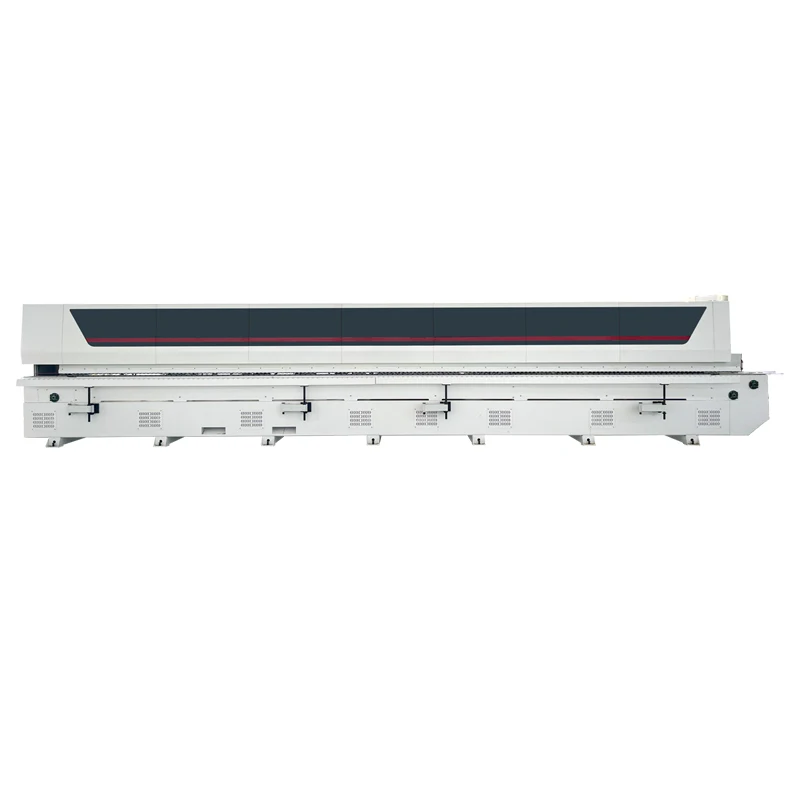
Precision-verified edge banding configuration — Every station on the DW985 carries an individually rated motor, so technical buyers can match feed speed and trimming depth to their panel material before committing to a production run.
Technical Specifications
| Parameter |
Value |
| Model |
DW985 |
| Product Type |
Automatic Edge Banding Machine |
| Working Stations |
16 functions: pre-milling, rough milling, inclined straight pre-milling, finish milling, handle-free chamfer, plate heating, edge banding, slotting, rubber coating, soft forming, end cutting, rough trimming, fine trimming, edge scraping, profiling chamfer, polishing |
| Processing Speed |
8–12 m/min (basis not stated in source — confirm panel thickness and edge banding material) |
| Semi-J Rough Milling Motor |
5 kW |
| Inclined Straight Edge Pre-Milling Motor |
5 kW |
| Semi-J Finish Milling Motor |
6 kW × 2 |
| Milling Servo Drive |
0.75 kW × 3 |
| Slab Chamfering and Edge Banding Broken Motor |
0.55 kW × 2 |
| Edge Banding and Slotting Motor |
0.3 kW |
| End to End Cutting Motor |
0.37 kW × 2 |
| Coarse and Fine Finishing Motor |
0.75 kW × 2 |
| Plate Polishing Motor |
0.37 kW × 2 |
| Plate Conveying Motor |
5.5 kW |
| Pressure Beam Lifting Motor |
0.37 kW |
| Voltage |
380V (frequency and phase to be confirmed at quotation) |
| Control System |
Touch screen operation (PLC brand to be confirmed) |
| Language Options |
Chinese and English standard; Spanish and other languages available on request |
| Overall Dimensions (L×W×H) |
950 × 98 × 184 cm (source value — verify against current production spec) |
| Gross Mass |
4.2 t (source value — verify; net weight not stated) |
| Profiling System |
Wheeled profiling with remote shape upgrading |
| Plug Options |
EU, USA, AU, UK |
| Assembly State |
Fully assembled, wooden box packaging |
Application Suitability
| Application |
Material or Output |
| Cabinet door edge banding |
MDF and plywood with PVC, ABS or acrylic edge strips |
| Custom furniture panel finishing |
Particleboard and melamine-faced chipboard |
| Handle-free soft-forming profiles |
Panels requiring concealed-handle edge contours |
| High-station automated production |
Workshops replacing multiple single-function machines |
Why the Station Count on an Automatic Edge Banding Machine Matters More Than Feed Speed
The number of active trimming and milling stations determines whether a panel leaves the machine ready for assembly or requires secondary rework.
Technical buyers often compare edge banders on feed speed alone, but a machine running at the upper end of its speed range with insufficient finishing stations will produce visible glue lines and uneven chamfers on thicker substrates [NEED_CITE: panel edge quality standards for cabinet assembly]. The DW985 addresses this by distributing 16 distinct functions across dedicated motor stations. Each station handles one specific operation, which means a panel moving through at 8 m/min receives the same trimming attention as one at 12 m/min — the feed rate changes, but the station sequence does not skip steps.
Mapping the 16-Station Sequence to Your Panel Specification
When selecting an automatic edge banding machine, understanding the station sequence is critical for matching the machine to your edge profile requirements. The DW985 begins with pre-milling to square the panel edge, then moves through rough and finish milling stages where the 6 kW dual motors handle heavier material removal. The inclined straight pre-milling station specifically addresses panels with slight warp or surface irregularity, which is common when processing particleboard stored in humid conditions.
The profiling system uses a wheeled design with remote shape upgrading, meaning operators can switch between a standard square edge and a soft-forming contour through the touch screen rather than mechanical changeover [NEED_CITE: CNC profiling changeover methods in panel edge banding]. This is relevant for cabinet door production lines that alternate between flat PVC edges and handle-free profiles within the same shift.
Motor Power Distribution Across the Trimming and Finishing Stages
The coarse and fine finishing stages each carry a 0.75 kW motor, which provides adequate torque for trimming PVC and standard ABS edge banding on 18 mm particleboard. However, when running thicker acrylic or solid wood lipping on 25 mm MDF, the finishing load increases substantially. Technical buyers should verify that the specified motor ratings align with their heaviest material combination before confirming the order. The plate polishing stage uses 0.37 kW motors at two stations, sufficient for removing residual adhesive haze on melamine surfaces but potentially underpowered for high-gloss acrylic that demands a finer finish [NEED_CITE: polishing motor requirements for high-gloss panel edges].
How Board Thickness and Feed Speed Interact at Each Station
The 5.5 kW plate conveying motor drives the panel through all 16 stations. On lighter materials such as 12 mm plywood with thin PVC banding, the feed speed can operate at the upper end of the 8–12 m/min range without loss of edge quality. Heavier panels — for example, 25 mm MDF with 2 mm acrylic — require reduced feed speed to maintain trimming accuracy at the rough and finish milling stations. The 5 kW pre-milling motors remove material ahead of the glue application, and if the panel enters too quickly, the pre-milled edge may carry chatter marks that propagate through the entire downstream sequence. The pressure beam lifting motor at 0.37 kW adjusts clamping force, which must be set correctly for each board thickness to prevent slippage or surface marring during conveyance.

The Real Cost of Ordering Without Confirming Your Material Stack
A machine specified for standard PVC edge banding on 18 mm chipboard will underperform the moment the production schedule shifts to 2 mm acrylic on 25 mm MDF. The glue temperature, feed speed and trimming motor loads all change with material density and thickness [NEED_CITE: edge banding machine configuration errors in furniture production]. Workshops that purchase based on catalog speed ratings alone frequently discover during commissioning that the finishing stations leave visible chatter on heavier substrates, requiring manual rework that offsets any throughput advantage.
Why Source the DW985 Through This Supply Channel
In-house manufacturing with patented cutting mechanisms means station configurations can be verified at the factory before shipment rather than assumed from a catalog entry. The four-stage QC process covers incoming material inspection, in-process assembly checks, finished product testing and pre-shipment verification, so each motor rating in the table above reflects a measured output rather than a nameplate claim. Voltage customization from 110V to 440V with confirmed plug type for EU, USA, AU or UK markets prevents the scenario where a machine arrives and cannot be energized. Engineer-led configuration recommendations with formal quotation within the next business day ensure that your panel thickness, edge material and daily volume are factored into the station specification before the order is placed. Factory visits are welcomed, allowing buyers to witness a test run on their own material before signing off on the configuration.
Documentation & Verification
- Machine specification sheet with station-by-station motor ratings confirmed against your panel material
- Electrical schematic matching the voltage and frequency at your installation site
- Factory test record run on your specified board thickness and edge banding material before dispatch
- Operation and maintenance manual in the language agreed at order placement
- Spare parts list with part numbers for each of the 16 working stations
Installation, Commissioning & Support
- Floor plan clearance for 950 cm length with operator access on the infeed and outfeed sides
- Dedicated 380V circuit sized for total connected motor load across all 16 stations
- Machine arrives fully assembled; crane or forklift required for 4.2 t gross mass positioning
- First-run calibration of glue temperature and feed speed against your actual panel and edge strip
- Operator training on touch screen profiling changeover for soft-forming and standard edge profiles
- Consumable spare parts stock for rough and finish milling cutters based on your weekly throughput
Requesting a Configuration Review
To receive an accurate station configuration for your production environment, provide your typical panel material, board thickness range, edge banding type and thickness, and local voltage with frequency. If your line runs both standard PVC and handle-free soft-forming profiles, note the approximate changeover frequency per shift. Confirm the control panel language required by your operators and whether a sample processing test on your material is needed before shipment.
Frequently Asked Questions
Q: How do I confirm the DW985 processing speed applies to my panel thickness and edge material?
A: Processing speed of 8–12 m/min is stated without a defined basis in the source data. Request a test run using your actual board thickness and edge banding material so you can observe feed rate and edge quality under realistic conditions. The factory will record motor load at each station during the test to confirm whether the upper speed range is sustainable for your material combination.
Q: What voltage and frequency details must I specify before placing an order?
A: The DW985 is rated at 380V, but frequency is not stated in the source specification. Confirm whether your facility runs 50Hz or 60Hz and whether the supply is three-phase. The factory configures the electrical system and selects the appropriate plug type for EU, USA, AU or UK standards based on your confirmed supply details before production begins.
Q: Can the control panel language be set to something other than Chinese or English?
A: Chinese and English are standard on the touch screen interface. Spanish and other languages are available on request at the quotation stage. Specify the required language during the inquiry so the operator manual and on-screen text are prepared in the correct version before the machine ships.
Q: Which 16 stations are included and how do I verify they match my production needs?
A: The full station sequence is listed in the specifications table, covering pre-milling through polishing. If your production requires a specific edge profile such as handle-free soft forming, confirm that the profiling chamfer and soft forming stations are configured for your contour shape. The wheeled profiling system supports remote shape updates, but the initial profile must be programmed before dispatch.