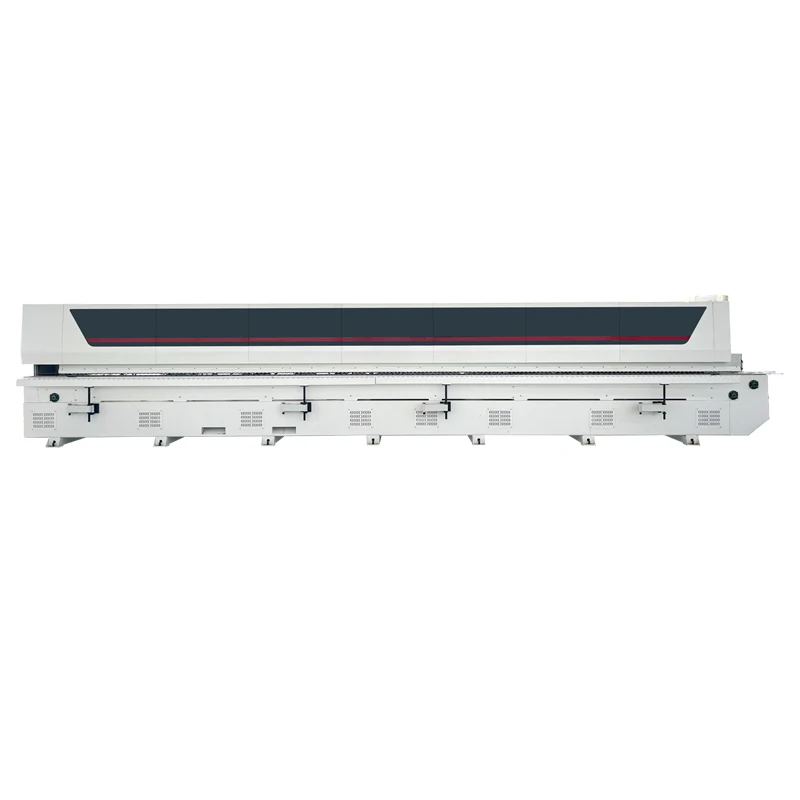
Verified Motor Data per Station — Every one of the 16 processing units on the DW985 carries an individual power rating on the nameplate, letting you map electrical load and mechanical capability before the crate leaves Shandong.
Technical Specifications
| Parameter |
Value |
| Model |
DW985 |
| Product Type |
Automatic Edge Banding Machine with Soft Forming and Hidden-handle Function |
| Function Stations |
16 (Separate, Linear Pre-milling, Milling, Rough Mill, Inclined Straight Pre-milling, Finish Milling, Finishing Milling 2, Handle-free Chamfer, Plate Heating, Wash, Edge Banding and Slotting, Rubber Coating, Heating System, Soft Forming and Pressing, End to End, Rough Repair, Truing, Scraping, Copying Chamfer, Wash, Polish) |
| Semi-J Rough Milling Motor |
5 kW |
| Inclined Straight Edge Pre-milling Motor |
5 kW |
| Semi-J Finish Milling Motor |
6 kW × 2 |
| Milling Servo Drive |
0.75 kW × 3 |
| Slab Chamfering and Edge Banding Broken Motor |
0.55 kW × 2 |
| Edge Banding and Slotting Motor |
0.3 kW |
| End to End Motor |
0.37 kW × 2 |
| Coarse and Fine Finishing Department Motor |
0.75 kW × 2 |
| Plate Polishing Motor |
0.37 kW × 2 |
| Plate Conveying Motor |
5.5 kW |
| Pressure Beam Lifting Motor |
0.37 kW |
| Voltage |
380V (frequency and regional adaptation to be confirmed) |
| Maximum Processing Speed |
8–12 m/min (basis not stated in source) |
| Machine Size |
950 × 98 × 184 cm |
| Gross Mass |
4.2 t |
| Control System |
Touch screen with operation key switches; remote shape upgrading supported |
| Profiling Design |
Wheeled profiling design system |
| Language Options |
Chinese and English standard; other languages customizable |
| Plug Options |
EU, USA, AU, UK |
Application Suitability
| Application |
Material or Output |
| Cabinet door edge profiling |
MDF and particleboard with PVC edge banding |
| Hidden-handle furniture fronts |
Plywood and MDF panels with soft-forming profiles |
| Custom wardrobe and kitchen panels |
Solid wood panels and veneer edge banding |
| High-volume batch production |
Panel boards requiring pre-milling through final polish in a single pass |
Why the Voltage Question Must Precede the DW985 Edge Banding Machine Specifications Review
A machine rated at 380V/50Hz will not start on a 415V/60Hz supply without transformer intervention or motor rewinding.
I spent weeks on-site in West Africa watching a fully functional edge bander sit silent because the local grid ran 415V three-phase while the motor windings were configured for 380V. The buyer had compared feed speeds and station counts across three suppliers but never asked about frequency compatibility. When you review DW985 edge banding machine specifications, voltage and hertz confirmation belongs at the top of the checklist, not as a footnote after the proforma invoice is signed [NEED_CITE: voltage and frequency standards by export market]. The cost of an idle machine on a factory floor compounds daily through missed delivery deadlines and operator downtime.

Station Sequence and Motor Allocation Across the 16 Functions
The DW985 edge banding machine specifications list 16 distinct processing stations arranged from infeed to final polish. Pre-milling opens the sequence with a 5 kW rough mill and a second 5 kW inclined straight edge pre-mill, removing saw marks and squaring the panel edge before adhesive application. The servo-driven milling group uses three 0.75 kW servo motors to track profile changes commanded by the touch screen, allowing operators to switch between a simple radius edge and a complex soft-forming contour without manual tool changes. Downstream, two 0.75 kW motors handle coarse and fine trimming while 0.37 kW polishing motors close the sequence.
Soft Forming and Hidden-Handle Profiling Capability
Furniture manufacturers producing handle-less cabinet doors need the edge bander to press and form PVC or ABS banding around a routed recess without lifting or visible glue lines. The soft forming and pressing station on this unit applies heated pressure to wrap the banding into the handle groove, while the copying chamfer station rounds the transition point. The wheeled profiling design system physically follows the panel contour rather than relying solely on programmed coordinates, which maintains consistent contact pressure when panel thickness varies slightly between batches. This mechanical tracking matters when MDF density shifts from one supplier lot to the next [NEED_CITE: edge banding adhesion standards for MDF substrates].
Reading the Motor Ratings Against Your Production Requirements
The 6 kW × 2 finish milling motors indicate the machine is built to remove material aggressively during the final shaping pass, which directly affects edge smoothness on dense substrates like high-moisture-resistant MDF. If your production runs primarily thin PVC on standard particleboard, those motors operate well within their capacity, extending bearing life. The 5.5 kW plate conveying motor drives the chain feed through all 16 stations simultaneously; a motor this size maintains consistent pull force even when the pressure beam is clamping thick panels. Cross-reference the 8–12 m/min processing speed range against your daily panel count to determine whether this feed rate aligns with upstream saw output and downstream drilling stations.
What Happens When Feed Speed Exceeds Station Capacity
Running a 16-station edge bander at the upper end of its speed range on thick panels with heavy glue application can overwhelm the scraping and polishing stations. When the banding material does not cool sufficiently before the scraper engages, the tool leaves chatter marks instead of a clean finish. Production managers often attribute this to blade dullness when the actual cause is insufficient dwell time between the heating station and the trim group [NEED_CITE: thermal transfer rates in hot-melt edge banding adhesives]. The 5.5 kW conveyor motor can physically push panels faster, but edge quality on soft-forming profiles degrades once adhesive cure time drops below the threshold for your specific glue type.
What the Specification Sheet Should Trigger Before You Order
Request the electrical schematic confirming whether the 380V configuration supports your local frequency, and ask for a factory test record run on panel stock matching your thickness range. The four-stage quality control process covers incoming material through pre-shipment verification; the final stage should document each station operating under load with your specified edge banding material. Engineer-led configuration review within 24 hours means you receive a formal quotation that accounts for voltage, language, and plug type rather than a generic price list. In-house manufacturing with patented cutting mechanisms means tolerance claims are traceable to the grinding process, not borrowed from a catalog. The full product family from entry-level to this 16-station model allows a workshop to scale capacity without switching suppliers or retraining operators on a different control interface.
Documentation & Verification
- CE declaration of conformity covering the full 16-station assembly and electrical enclosure
- ISO 9001 certificate referencing the manufacturing quality management system
- Machine specification sheet with individual motor ratings for all 16 stations
- Electrical schematic confirming voltage, frequency, and plug type for your facility
- Factory test record documenting edge quality on your specified panel thickness and banding material
- Operation and maintenance manual in the agreed language with spare parts list
Installation, Commissioning & Support
- Floor space allocation must accommodate the 950 × 98 × 184 cm footprint plus infeed and outfeed clearance
- Dedicated three-phase circuit sized for the combined motor load including the 5.5 kW conveyor and dual 6 kW finish mills
- Machine arrives fully assembled; pressure beam and conveyor chain alignment verified before crating
- First-run parameter setting covers glue pot temperature, feed speed, and profiling wheel calibration for your banding material
- Operator training on touch screen profile switching and remote shape upgrade procedure
- Spare scraper blades, polishing wheels, and trimming cutters included in the initial parts kit
Preparing Your Inquiry for a Technical Quotation
To receive a configuration proposal that matches your production floor, share your primary panel materials, typical thickness range, and the edge banding profiles you run most frequently. Specify your facility voltage and frequency so the electrical package is confirmed before production begins. If you operate existing upstream saws or downstream boring machines, note their feed rates so the 8–12 m/min range can be evaluated against your line throughput. Requesting a sample processing test with your own panel stock is the most direct way to verify edge quality across all 16 stations before committing to an order.
Frequently Asked Questions
Q: How do I confirm the 8–12 m/min feed speed applies to my panel thickness and edge band type?
A: The published speed range does not state the test conditions. Request a factory test using your actual panel material, thickness, and banding profile to observe edge quality at different feed rates. The results document which speed delivers acceptable finish on your specific substrate combination.
Q: Is the 380V supply standard, and can the machine be adapted for other voltages?
A: The base configuration is 380V, but customization from 110V to 440V is available. Confirm your local voltage and frequency during the inquiry stage so the motor windings, control transformer, and heating elements are matched to your grid before assembly begins.
Q: What PLC brand runs the touch screen, and how do remote shape upgrades work?
A: The PLC brand is not stated in the current specification sheet and should be confirmed in your quotation. Remote shape upgrades allow new profiling contours to be loaded via the touch screen interface without replacing physical tooling or servo cams.
Q: Which of the 16 stations are essential for standard PVC edge banding on particleboard?
A: Standard PVC on particleboard typically requires pre-milling, glue application, end cutting, rough and fine trimming, scraping, and polishing. Soft forming, hidden-handle chamfering, and inclined pre-milling stations add capability for profiled cabinet doors but are not needed for flat-panel work.
Q: How should I plan factory floor space around the 950 × 98 × 184 cm machine dimensions?
A: Allocate additional length on both the infeed and outfeed sides for panel handling and operator access. The 98 cm width does not include the chip extraction ducting or the glue supply system, both of which require adjacent clearance for maintenance access and material replenishment.