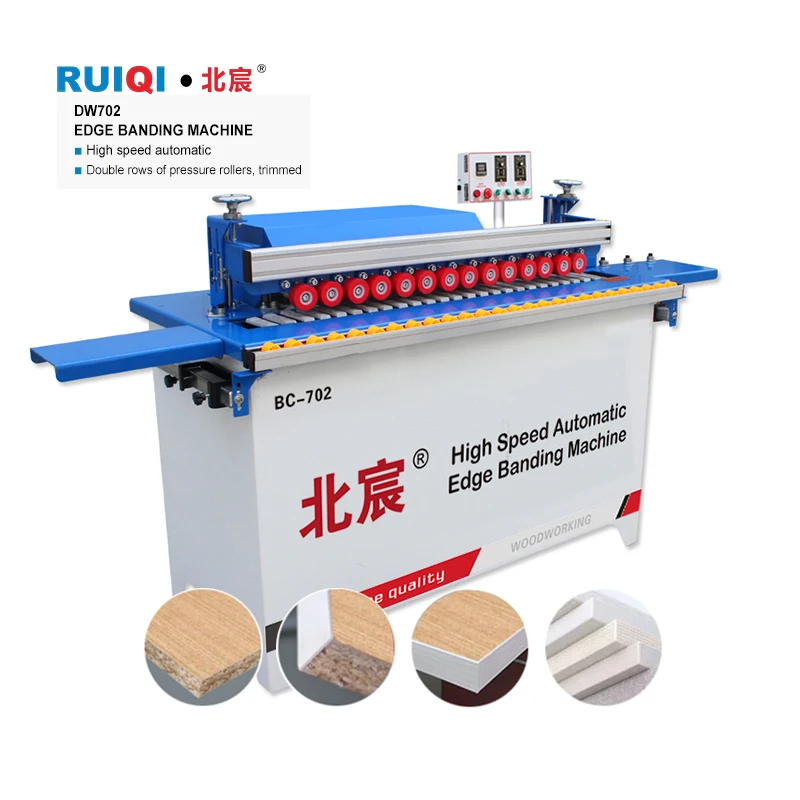
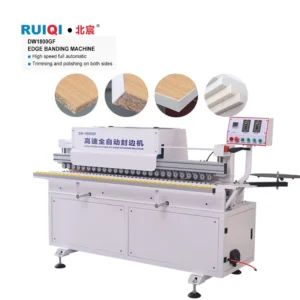
Engineer-led configuration — Every DW702 parameter sheet is verified against your local voltage and panel material before quotation, preventing the mismatch that stalls commissioning on arrival.
Technical Specifications
| Parameter |
Value |
| Model |
DW702 |
| Product Type |
High Speed Automatic Edge Banding Machine |
| Total Power |
3800W |
| Voltage |
220V / 380V / customization |
| Trimming Power |
800W × 2 |
| Polishing Power |
180W × 2 |
| Transmission Power |
140W |
| Vacuum Power |
1200W |
| Edge Banding Thickness |
0.3–3 mm |
| Edge Banding Height |
0–50 mm |
| Minimum Sheet Length |
250 mm |
| Minimum Sheet Width |
100 mm |
| Glue Pot Capacity |
1000 ml |
| Air Source Pressure |
0.4–0.8 MPa |
| Overall Dimensions |
1200 × 550 × 1100 mm |
| Net Weight |
105 kg |
| Key Features |
Edge banding, trimming, polishing, automatic head and tail cutting, vacuum hold-down |
| Control Language Options |
Chinese, English, Spanish, other languages on request |
| Standards |
CE, ISO 9001 |
Application Suitability
| Application |
Material or Output |
| Cabinet door and carcass edge banding |
MDF and particleboard with PVC or melamine strips |
| Custom furniture small-format components |
Drawer sides, shelving brackets, and narrow panels down to 250 × 100 mm |
| Plywood furniture production |
Plywood panels with wood veneer or ABS edge banding up to 3 mm thick |
| Polymer door finishing |
Polymer door blanks requiring full trimming and polishing cycle |
| Medium-volume workshop banding station |
Mixed board materials in batch production environments |
Why the Voltage Question Must Come Before the DW702 Edge Banding Machine Specifications
A machine wired for the wrong frequency will burn out its trimming motors within the first production week.
I spent years debugging edge banders across Latin American workshops, and the most expensive failures were never mechanical. They were electrical. A facility in Monterrey received a 380V/50Hz unit while their shop ran on 220V/60Hz. The transmission motor overheated, the glue pot never reached stable temperature, and the vacuum system pulled insufficient pressure to hold small panels flat. The buyer had compared DW702 edge banding machine specifications line by line but skipped the voltage confirmation step entirely [NEED_CITE: voltage and frequency standards by export market].
When a technical buyer evaluates this model, the electrical configuration must be locked before any other parameter discussion begins. The DW702 supports voltage customization, but that option only works if the buyer states the requirement during the inquiry stage, not after the machine is crated.

Power Distribution Across Working Stations
The DW702 edge banding machine allocates its 3800W total power across five functional zones, and understanding this split matters more than the headline number. The dual trimming motors draw 800W each, which is the station that determines whether your edge finish arrives clean or requires secondary hand-sanding. The polishing stage uses 180W per wheel, sufficient for removing residual adhesive haze from PVC and melamine surfaces without scorching veneer.
The 1200W vacuum system is not a peripheral add-on but a core holding mechanism. On panels as small as 250 × 100 mm, mechanical clamps cannot grip without obstructing the banding path, so vacuum hold-down becomes the only reliable method to keep the workpiece registered against the fence during trimming and polishing passes.
Matching Banding Thickness to Material Behaviour
The 0.3–3 mm banding thickness range covers the four most common edge materials in cabinet and furniture production, but each material demands different glue pot behaviour and feed pressure. Thin PVC and melamine at 0.3–0.6 mm require lower glue temperature and lighter pressure roller force to prevent squeeze-out that leaves visible residue on the panel face.
Thicker PVC and ABS strips at 2–3 mm need extended open time in the glue zone and firmer pressure to ensure full contact along the panel edge, especially on MDF where surface porosity absorbs adhesive rapidly. Wood veneer in the 0.5–1.5 mm range sits between these extremes but introduces grain-direction sensitivity during trimming [NEED_CITE: edge banding adhesive behaviour across substrate types]. The DW702 configuration must therefore be discussed in terms of your primary banding material, not just the thickness range on paper.
Reading the Specification Sheet Against Your Production Reality
Panel thickness range reaches up to 50 mm based on the edge banding height specification, which covers standard furniture board thicknesses from 12 mm through to thick worktop panels. The minimum workpiece dimensions of 250 mm length and 100 mm width are what separate this machine from larger-format edge banders that simply cannot accept small drawer components or narrow shelving brackets.
The 1000 ml glue pot capacity is sized for batch production rather than continuous high-volume runs, meaning a workshop processing several hundred panels per shift will need scheduled refill intervals. Air source pressure between 0.4 and 0.8 MPa drives the pneumatic actuators for head-and-tail cutting and pressure roller adjustment, so confirming your compressor output matches this range is part of the pre-installation checklist.
The Hidden Cost of Skipping Configuration Verification
Buying a single edge bander without confirming how it connects to upstream cutting and downstream assembly creates a bottleneck that no specification sheet can warn you about. I have visited workshops where a technically capable machine sat idle because the feed height did not align with the panel saw output table, forcing operators to manually lift boards into position all shift.
When the control panel arrives in a language the operator cannot read, commissioning stretches from hours into days while someone translates error codes over a phone call [NEED_CITE: operator interface language impact on commissioning timelines]. These are not equipment failures. They are configuration oversights that a structured inquiry process would have caught before the order was placed.
Why Technical Buyers Source This Model Here
In-house manufacturing with patented cutting mechanisms means the trimming stations are built and tested under one roof, not assembled from third-party sub-modules with mismatched tolerances. The four-stage quality control process covers incoming material inspection, in-process checks, finished product verification, and pre-shipment testing, so the DW702 edge banding machine specifications you read are the specifications that ship.
Voltage customization from 220V to 380V with multi-language control panels is treated as a standard configuration step, not a special request that adds lead time and cost. Engineer-led configuration recommendations ensure the quotation you receive within 24 hours reflects your actual panel material, banding type, and production volume rather than a generic catalog price. Factory visits are welcomed so you can witness the precision grinding and assembly process before committing to an order.
Documentation & Verification
- CE declaration of conformity covering the DW702 electrical and mechanical safety requirements
- Machine specification sheet with confirmed voltage, frequency, and control language for your facility
- Electrical schematic showing circuit protection ratings and motor wiring for local electrician review
- Factory test record using your specified panel thickness and banding material before dispatch
- Operation and maintenance manual supplied in the agreed operator language
- Spare parts list identifying consumable trimming blades and polishing wheels with reorder codes
Installation, Commissioning & Support
- Overall dimensions of 1200 × 550 × 1100 mm require a level floor area with clearance on both sides for panel infeed and outfeed
- Dedicated circuit matching the confirmed voltage and 3800W total draw with appropriate breaker rating
- Machine ships partially assembled; trimming and polishing stations require alignment verification on site
- First-run parameter setup includes glue pot temperature calibration for your specific banding material thickness
- Operator training covers pneumatic pressure adjustment within the 0.4–0.8 MPa range for different panel sizes
- Consumable spare parts stock covers trimming blades and polishing wheels for the initial production period
What to Include in Your Technical Inquiry
Send your primary panel material, the edge banding type and thickness you run most frequently, and your daily panel count so the configuration can be matched to your actual workload. State your facility voltage, phase, and frequency along with the preferred control panel language to prevent rework after delivery.
Frequently Asked Questions
Q: What feed speed does the DW702 support, and how does it affect edge quality on PVC vs. veneer banding?
A: Feed speed is confirmed during configuration based on your primary banding material and panel thickness. Running PVC at speeds suited for thin melamine causes incomplete trimming, while feeding veneer too slowly risks heat damage at the glue line. The engineer proposal specifies the recommended feed range for your material combination before order confirmation.
Q: How do I confirm the correct voltage and plug type for my facility before ordering?
A: Provide your local supply voltage, phase configuration, and frequency in hertz during the inquiry stage. The quotation includes an electrical schematic and voltage confirmation document matching your specification. Plug type is selected from EU, USA, AU, or UK standards, or the machine ships with hardwired terminals for direct panel connection.
Q: What is the actual trimming tolerance achievable on MDF and particleboard, and how is it verified before shipment?
A: Trimming tolerance depends on panel density, banding thickness, and tool condition. The pre-shipment test record documents measured edge deviation on your specified material using calibrated instruments. Buyers can request sample panels processed on the exact DW702 unit assigned to their order to verify results independently.
Q: Can the control panel be customized to my language, and does the machine support metric and imperial units?
A: Control panels are available in Chinese, English, and Spanish as standard, with additional languages configured on request. The interface supports metric measurement display. Confirming the operator language during inquiry ensures the manual and panel labels match before the machine leaves the factory.
Q: How does the 1000 ml glue pot capacity translate to continuous runtime before refill?
A: Runtime between refills depends on banding thickness, panel edge length, and glue application rate. Thicker banding at 2–3 mm consumes adhesive faster than 0.4 mm melamine strips. The configuration proposal includes an estimated refill interval based on your stated panel dimensions and daily volume to plan production breaks accordingly.