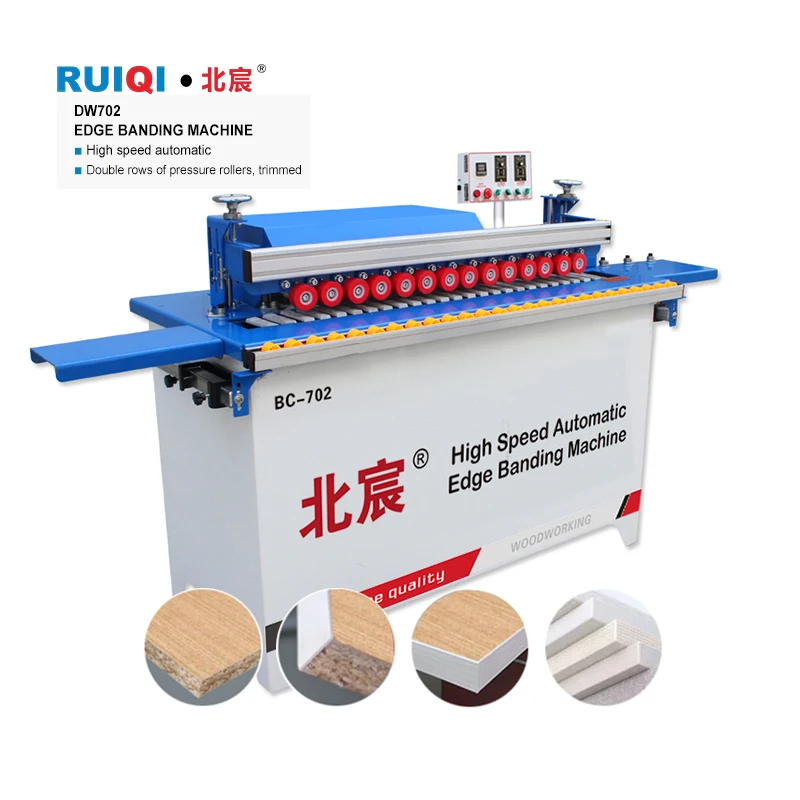
Voltage flexibility with factory verification — the DW702 ships with 220V/380V options or a custom configuration, each validated against an electrical confirmation sheet before the crate is sealed.
Technical Specifications
| Parameter |
Value |
| Model |
DW702 |
| Product Type |
Automatic Edge Banding Machine |
| Total Power |
3800W |
| Voltage |
220V / 380V / customization |
| Trimming Power |
800W × 2 |
| Polishing Power |
180W × 2 |
| Vacuum Power |
1200W |
| Transmission Power |
140W |
| Edge Power |
20W |
| Glue Pot Capacity |
1000ml |
| Edge Banding Height |
0–50mm |
| Edge Banding Thickness |
0.3–3mm |
| Minimum Sheet Length |
250mm |
| Minimum Sheet Width |
100mm |
| Air Source Pressure |
0.4–0.8 MPa |
| Product Size |
120 × 55 × 110 cm |
| Product Weight |
105 kg |
| Feed Speed |
(basis to be confirmed) |
| Control System |
(basis to be confirmed) |
| Standard Features |
Edge banding, trimming, polishing, automatic head and tail cutting, vacuum hold-down |
Application Suitability
| Application |
Material or Output |
| Cabinet door edge finishing |
MDF and plywood panels with PVC or ABS edge banding |
| Custom furniture component banding |
Particleboard shelving and carcass parts |
| Polymer door profile edging |
Polymer composite door skins and frames |
| Small-batch joinery parts |
Solid wood panels and blockboard cut-to-size pieces |
| Medium-volume production runs |
Mixed substrate batches in furniture and cabinet workshops |
Why Voltage Confirmation Matters More Than the Spec Sheet
When the DW702 edge banding machine specifications list 220V/380V alongside a customization option, that flexibility is only useful if someone actually checks which one your facility runs before the machine leaves the factory. Confirming local voltage and frequency before production starts prevents the most expensive delay in equipment commissioning: a powered-down line waiting for an electrical fix.
I once configured a panel edge bander for a cabinet shop and assumed 380V three-phase because that was standard for similar machines. The shop was on 220V single-phase with a frequency they had not mentioned during inquiry. The machine arrived, the main contactor would not pull in, and the crew sat idle while a step-up transformer was sourced locally — a three-week stall on a line that was supposed to be running production. [NEED_CITE: voltage and frequency standards by export market] Since then, every unit I spec goes through a line-by-line electrical confirmation before the order is locked, and that discipline carries directly into how the DW702 is quoted.

Reading the Power Breakdown Station by Station
The DW702 total power rating of 3800W is distributed across functionally independent stations, and each one pulls current at different stages of the feed cycle. Trimming accounts for the largest share at 800W per motor across two units, followed by the 1200W vacuum system that maintains panel registration on the feed chain. Understanding the edge banding machine specifications DW702 at this granularity lets an electrical planner verify whether the existing workshop panel can absorb the combined inrush load or whether a dedicated circuit is required.
How Sheet Dimension Limits Shape Production Sequencing
The minimum sheet dimensions of 250mm length and 100mm width define what can physically pass through the DW702 feed system and reach the banding station. For a cabinet maker running a mix of full-size carcass panels and narrow drawer fronts, this lower bound determines whether small components can be banded on the same machine or must be routed to a separate manual station. The 0–50mm edge banding height and 0.3–3mm thickness envelope covers standard PVC, melamine, and thin veneer tapes used in furniture and cabinet production. [NEED_CITE: CE machinery directive requirements for industrial woodworking equipment]
Trimming and Polishing Motor Configuration Explained
The dual 800W trimming motors handle the excess banding material above and below the panel edge in a single pass, which matters because a single trimming station forces the operator to flip or re-feed the board for the opposite side. Pairing those with two 180W polishing wheels removes the micro-scorch marks that trimming leaves on PVC and ABS edges, producing a finished edge ready for assembly without secondary hand-sanding. The 1000ml glue pot capacity sets the adhesive replenishment interval; in a full shift running mixed board thicknesses, the pot volume determines how often the operator pauses the line to refill. The automatic head and tail cutting function trims the leading and trailing band overhang as the panel enters and exits, which reduces manual cleanup on short workpieces where overhang proportionally represents more of the total edge length.
The Cost of Skipping Electrical and Air Supply Checks
A 0.4–0.8 MPa air source pressure requirement means the DW702 relies on shop compressed air for clamping and actuation — connect it to an undersized compressor and the pneumatic cylinders hesitate mid-cycle, producing inconsistent trim depth and visible glue-line gaps. I have seen edge banders of this class sit idle for days not because of a mechanical fault but because the workshop air line was shared with a spray booth that pulled pressure below the minimum threshold during peak draw. The problem only surfaces once production volume increases and the compressor can no longer recover between cycles. [NEED_CITE: compressed air requirements for pneumatic woodworking machinery] An air pressure regulator and dedicated line filter at the machine inlet eliminate this class of fault before it appears.
Why Sourcing Through a Specification-Driven Process Works
The DW702 is built in a facility that runs four-stage quality control from incoming material inspection through pre-shipment verification, so the machine you receive matches the specification sheet line by line. Voltage configuration is confirmed on a signed electrical document before production begins, not assumed from the inquiry country code. A factory test record is generated using your specified substrate and edge material, documenting actual trim finish and polish quality before the unit is crated. The configuration recommendation is engineer-led, with a formal quotation typically delivered within one working day of confirmed requirements. Every DW702 ships with documentation in the buyer's agreed language, including operation manual, electrical schematic, and spare parts list.
Documentation & Verification
- Machine specification sheet with per-station motor ratings and total power breakdown for the DW702
- Signed voltage and frequency confirmation document matching your facility supply before production
- Factory test record showing edge finish quality on your specified panel material and banding type
- Electrical schematic indicating circuit protection ratings and connection points for on-site wiring
- Operation and maintenance manual written in your agreed language with illustrated adjustment procedures
- Spare parts list with part numbers for trimming blades, polishing wheels, and glue pot seals
Installation, Commissioning & Support
- Allocate floor space for the 120 × 55 × 110 cm footprint with clearance on the infeed and outfeed sides for panel handling
- Provide a dedicated electrical circuit matching the confirmed 220V or 380V supply with correct breaker rating for the 3800W total load
- Connect a compressed air line regulated to 0.4–0.8 MPa with an inline filter upstream of the 105 kg machine inlet
- Verify glue pot heating element operation and temperature stabilization before the first production run
- Confirm vacuum hold-down function at 1200W on your actual panel thickness range before full-speed feeding
- Stock replacement trimming blades and polishing wheels from the supplied spare parts list to avoid unplanned downtime
What to Include in Your Inquiry
To configure the DW702 correctly for your line, share the primary panel materials and thickness range you process, the edge banding materials in current use (PVC, ABS, veneer, or melamine), and your facility voltage and frequency. If you are integrating this unit into an existing production cell, note the upstream and downstream equipment so feed height and workflow alignment can be confirmed. For buyers evaluating output fit, describe your typical daily panel count and shift structure so the configuration recommendation accounts for realistic operating volume.
Frequently Asked Questions
Q: How can I verify the edge banding tolerance of the DW702 before committing to an order?
A: Request a factory test record run on your specific panel substrate and edge banding material. The test documents trim depth consistency, polish finish, and glue-line appearance across a sample batch. Reviewing these results before shipment lets you confirm the DW702 produces the edge quality your assembly process requires, rather than discovering tolerance issues only after installation.
Q: Which voltage configuration should I choose and how is it confirmed before the machine ships?
A: Provide your facility voltage, phase count, and frequency during inquiry. The DW702 supports 220V, 380V, or a custom configuration. A signed electrical confirmation document is issued before production begins, matching your supply specifications. The machine is then built and tested on that exact voltage, eliminating the risk of arriving with an incompatible electrical setup.
Q: How does the 0.3–3mm edge thickness range map to different banding materials?
A: The DW702 handles PVC and ABS banding in the standard 0.4–2mm range, thin melamine at the lower end, and thicker wood veneer or solid wood strips toward the 3mm upper limit. The trimming and polishing station power ratings are sized to cut and finish across this full envelope. Specify your exact banding materials during inquiry so the factory test uses matching stock.
Q: What is the actual feed speed of the DW702 and how does it compare to production-line banders?
A: The feed speed for this model requires confirmation from the manufacturer based on current production configuration. The DW702 is positioned for medium-volume furniture and cabinet workshops rather than high-speed continuous production lines. Share your daily panel volume during inquiry so the engineering team can confirm whether the feed rate matches your throughput requirement.
Q: How should I plan glue pot replenishment across a full production shift?
A: The 1000ml glue pot capacity determines how many linear meters of edge can be banded before refill is needed, and consumption varies with board thickness and banding width. For a full shift, plan one or two scheduled refill stops depending on your panel mix. The automatic head and tail cutting reduces adhesive waste on short workpieces, extending effective pot life between refills.