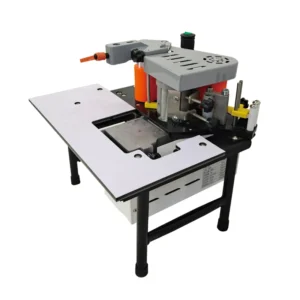
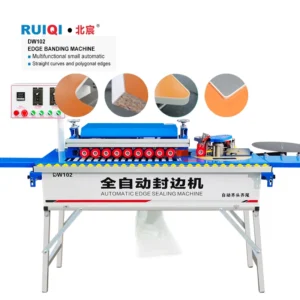
Patented Pre-milling Mechanism — the XZF-450 edge banding machine specifications include a dedicated 4 kW motor for panel edge preparation, ensuring ±0.02mm tolerance is mechanically achievable rather than just stated on paper.
Technical Specifications
| Parameter |
Value |
| Model |
XZF-450 |
| Product Type |
Automatic Edge Banding Machine |
| Total Power |
9.5 kW |
| Pre-milling Motor |
4 kW |
| Trimming Power |
2.2 kW × 2 |
| Polishing Power |
0.4 kW × 2 |
| Edge Feed Power |
0.16 kW |
| Transmission Power |
180 W |
| Vacuum Power |
550 W |
| Voltage |
380V / 415V (basis not stated in source — confirm frequency and phase) |
| Feed Speed |
0–12 m/min |
| Edge Banding Height |
0–50 mm |
| Edge Banding Thickness |
0.3–3 mm |
| Minimum Sheet Length |
30 cm |
| Minimum Sheet Width |
15 cm |
| Glue Pot Capacity |
4000 ml |
| Air Source Pressure |
0.5–0.7 MPa |
| Standard Functions |
Pre-milling, 30°/45°/60° edge banding, end trimming, rough trimming, finish trimming, scraping, polishing, dust extraction |
| Overall Dimensions (L×W×H) |
300 × 65 × 135 cm |
| Net Weight |
430 kg |
| Control Panel Language |
Chinese / English (other languages customizable) |
| Plug Options |
EU / USA / AU / UK |
| Assembly State |
Fully assembled, wooden crate packed |
| Key Features |
CE conformity, ISO 9001 certified manufacturing, OEM/ODM support |
Application Suitability
| Application |
Material or Output |
| Custom cabinet door edge banding |
MDF and melamine-faced particleboard |
| Wardrobe panel edging |
Plywood and blockboard with PVC or veneer strips |
| Office furniture production |
Melamine board with 0.3–3 mm ABS edge banding |
| Angled edge profiles |
45° and 60° beveled panels for decorative furniture |
| Medium to large-scale batch runs |
Solid wood panels requiring pre-milled edge preparation |
Why the Voltage Question Should Come Before the Price
A machine rated at 380V/415V arriving at a workshop running 220V three-phase is not an installation problem — it is a quotation problem. The XZF-450 edge banding machine specifications must be locked to your local grid frequency and phase before production begins, not after the crate arrives. I have seen factories in Southeast Asia take delivery of 50 Hz machines wired for 60 Hz markets. The motors spun faster than rated, the glue pot temperature curve ran hot, and PVC banding warped within hours. The distributor blamed the operator. The real failure was upstream — nobody confirmed the electrical standard during the specification phase. Voltage and frequency standards vary by export market [NEED_CITE: voltage and frequency standards by export market], and a 3-phase configuration that works in Shandong will burn out control boards in regions with unstable supply. Always request the electrical schematic with your local voltage written on it before the order is placed.

How Feed Speed Maps to Panel Throughput
The 0–12 m/min feed speed range on the XZF-450 edge banding machine determines how many panels per shift reach the assembly bench. At lower speeds, operators handle smaller or warped panels that need careful feeding. At the upper range, straight MDF sheets flow continuously, provided the upstream panel saw delivers consistent cut quality. The independent 180 W transmission motor keeps feed steady across the full speed band, which matters when you switch between 18 mm particleboard and 25 mm blockboard mid-shift.
Angled Edge Banding Without Re-fixturing
Most entry-level banders handle 90° straight edge only. The XZF-450 supports 30°, 45°, and 60° angled edge banding within the same pass sequence. For cabinet makers producing beveled door fronts or decorative shelving, this eliminates a secondary routing step. The edge feed system handles banding thickness from 0.3 mm PVC up to 3 mm solid wood veneer across those angles, though heavier banding on steeper bevels requires slower feed rates to maintain glue contact [NEED_CITE: edge banding adhesion requirements on angled substrates].
Reading the Spec Sheet Against Your Panel Mix
The 4 kW pre-milling motor is the first station the panel encounters, and it sets the tolerance ceiling for everything downstream. Pre-milling removes saw marks and edge tear-out before the glue pot, which directly affects bond strength on MDF and particleboard where surface fibers are loose. The dual 2.2 kW trimming motors handle end trimming and rough/finish trimming in sequence, leaving a clean edge that the scraping and polishing stations refine. A 4000 ml glue pot capacity supports sustained runs without frequent refill pauses, though actual consumption depends on banding width and glue viscosity at your set temperature. The minimum sheet dimensions — 30 cm length, 15 cm width — define the smallest offcut this machine processes without manual holding. If your CNC nesting output includes narrower strips, those will need a separate manual edging station.
The Hidden Cost of Skipping the Substrate Test
I once saw a custom cabinet line shut down for a week because the edge bander was configured for particleboard while the factory ran primarily MDF. Glue temperature, feed pressure, and trimming speed all need substrate-specific settings. The XZF-450 edge banding machine specifications list MDF, melamine board, particleboard, plywood, blockboard, and solid wood as compatible materials, but each one behaves differently under the pre-milling cutter and glue roller. MDF fibers absorb more adhesive, requiring higher glue pot temperatures and slower initial feed. Particleboard edges are more friable, demanding sharper pre-milling cutters and lighter trimming passes. Without a factory test record on your exact panel stock, you are discovering these parameters on your production floor [NEED_CITE: MDF versus particleboard edge banding adhesion behavior]. The cost is not just wasted banding material — it is the assembly line downstream receiving panels with visible glue lines or lifted edges.
Why Source This Configuration Here
In-house manufacturing with patented cutting mechanisms means the pre-milling station is built and tested on the same floor where final assembly happens, not outsourced and bolted on. Voltage, plug type, and control panel language are configured per order rather than adapted after arrival — the XZF-450 ships with your market's electrical standard confirmed on the schematic. Four-stage quality control runs from incoming material inspection through pre-shipment verification, catching tolerance drift before the crate is sealed. Engineer-led configuration recommendation means you submit your panel types and daily throughput targets, and receive a written proposal within 24 hours matching stations to your actual workload. Factory visits are welcome, so you can watch your substrate run through the machine before signing off on shipment.
Documentation & Verification
- Machine specification sheet with XZF-450 voltage and frequency confirmed for your grid
- Factory test record showing edge banding result on your submitted MDF or particleboard sample
- Electrical schematic matching the as-built voltage, plug type, and phase configuration
- Operation and maintenance manual delivered in your operator's chosen language
- Spare parts list identifying wear items for the pre-milling cutter and trimming stations
- CE declaration of conformity and ISO 9001 certificate covering the manufacturing facility
Installation, Commissioning & Support
- Requires a level concrete floor supporting 430 kg net weight across the 300 cm machine length
- Dedicated 3-phase circuit matching confirmed voltage, with breaker rated above 9.5 kW total draw
- Arrives fully assembled in wooden crate — position and connect power, air, and dust extraction
- Air supply must deliver 0.5–0.7 MPa consistently; install a dedicated regulator upstream of the machine
- First-run commissioning includes glue pot temperature calibration against your specific banding material
- Pre-milling cutter and trimming blades require periodic inspection based on panel volume and substrate abrasiveness
What to Include With Your Inquiry
Send your primary panel substrates with thickness range, the edge banding material you run most often, and your local voltage and frequency. If you operate upstream panel saws or downstream boring machines, share their throughput so the feed speed can be matched across the line. Specify your preferred control panel language and whether you need sample panels run and shipped for assembly verification before the order is confirmed.
Frequently Asked Questions
Q: How do I verify the edge banding tolerance this machine delivers on MDF versus particleboard?
A: Request a factory test record where your specific panel substrate and edge banding material are run through the XZF-450 before shipment. The test record documents edge adhesion strength, trimming finish quality, and measured tolerance at the glue line. MDF and particleboard require different glue temperatures and feed pressures, so generic test results from another material do not transfer to your production conditions.
Q: Which voltage and frequency configuration is correct for my country, and is it confirmed before production?
A: The machine supports 380V and 415V configurations, but frequency and phase must match your local grid. During the quotation stage, you provide your country's electrical standard and the manufacturer confirms voltage, frequency, and plug type on the electrical schematic. This document is reviewed and signed off before production begins, preventing mismatched motors or control board failures on arrival.
Q: How does the 0–12 m/min feed speed translate to daily panel throughput for a cabinet factory?
A: Actual throughput depends on panel length, operator loading speed, and whether you run mixed substrates requiring parameter changes. At sustained feed rates on uniform MDF panels, the machine processes a continuous stream, but switching between materials or angled edges introduces setup pauses. Share your daily panel count and mix with the engineering team for a configuration matched to your line.
Q: What are the minimum panel dimensions this model handles without manual intervention?
A: The XZF-450 accepts sheets down to 30 cm in length and 15 cm in width, with edge banding heights from 0 to 50 mm. Panels smaller than these minimums require manual holding or a separate compact edging station. If your nesting software produces narrow offcuts regularly, factor a secondary process into your workflow planning.
Q: How do I match this edge bander's output to upstream panel saws and downstream boring machines?
A: Compare the XZF-450 feed speed range against your panel saw cut cycle and boring machine indexing time. If the saw outputs faster than the bander can process, panels queue and risk edge damage. If the bander outpaces the borer, finished panels accumulate. Share all three machine specifications so throughput can be balanced across the line.